
 +90 533 888 29 50



Buying property in North Cyprus without being physically present is possible. Many stages can be handled through an independent lawyer, an authorised representative and remote document exchange, subject to the requirements of the specific transaction.
What a remote purchase cannot do is remove the need for verification. If anything, buying from abroad requires more structured due diligence than buying in person, not less — because the buyer has fewer opportunities to notice problems independently. The checks that protect a buyer in any property transaction still have to happen; they simply need to be delegated to the right people, documented carefully, and completed in the right order.
A remote purchase should remove the need for the buyer to travel — not remove the checks that protect the buyer.
This guide covers the full process: how to shortlist and view properties from abroad, how to set up proper legal representation, what to verify before transferring funds, how to handle payments safely, how to get an independent inspection without being present, and where the specific risks of remote buying are highest.
Buying Property in North Cyprus Remotely: Quick Answer
| Question | Short answer |
|---|---|
| Can you buy without travelling? | Yes. Many stages can be handled through a lawyer, an authorised representative and remote document exchange. |
| Can the property be viewed remotely? | Yes. Use a live, unedited video viewing rather than relying only on promotional footage. |
| Do you need a lawyer? | Independent legal representation is one of the main safeguards for a foreign remote buyer. |
| Can a representative sign for you? | Yes, where a properly executed Power of Attorney gives them the required authority. |
| Is Permission to Purchase required? | Foreign buyers are generally subject to the Permission to Purchase regime, depending on the buyer and property. |
| Can PTP be submitted remotely? | Yes. The Ministry of Interior has operated an online application system since 14 November 2022. |
| What must be checked before paying? | Ownership, title history, encumbrances, seller authority, planning status where relevant and foreign-buyer eligibility. |
| Can an inspection be remote? | The buyer can remain abroad, but the physical inspection itself should be carried out at the property by an independent inspector. |
| Is off-plan possible remotely? | Yes, but it requires additional checks on the developer, approvals, specification, payment milestones and handover. |
| Is a remote purchase risk-free? | No. Remote buying reduces travel, not legal, title, construction or payment risks. |
Properties You Can Review Remotely


 Alsancak
 from 65м²






Can You Buy Property in North Cyprus Remotely?
The short answer is yes — but the distinction matters between remote property search and remote legal purchase.
Searching online, attending video viewings, reviewing floor plans and comparing projects across different areas are all things a buyer can do from anywhere in the world. The legal purchase — contract signing, government applications, payments, title registration — can also proceed without the buyer physically present, but each step requires a different kind of handling than simply browsing listings.
The table below maps the main stages of a North Cyprus property purchase to what is typically possible remotely, who is responsible, and what the buyer should receive at each stage.
| Stage | Can it usually be remote? | Who handles it | What the buyer should receive |
|---|---|---|---|
| Property selection | Yes | Buyer, agent | Shortlist, listing details, price confirmation |
| Live video viewing | Yes | Agent or developer | Recorded walkthrough, floor plan, location map |
| Legal due diligence | Yes | Independent lawyer | Written title report, encumbrance search |
| Reservation | Yes, with care | Lawyer/agent | Signed reservation agreement, receipt |
| Contract review and signing | Yes (via POA or direct signing abroad) | Independent lawyer | Signed contract, registered copy |
| Permission to Purchase application | Yes | Lawyer or authorised representative | Submission confirmation, approval document |
| Staged payments | Yes | Buyer (via bank transfer) | SWIFT confirmation, receipts, schedule |
| Construction monitoring | Yes | Lawyer, agent or appointed monitor | Progress photos/reports at milestones |
| Physical inspection | Partly — inspector goes in person | Independent inspector | Written snagging report with photos |
| Handover | Partly — representative attends | POA holder or appointed representative | Signed handover document, keys |
| Title deed transfer | May be handled with authorised representation where legally permitted; exact attendance and documentation requirements should be confirmed for the transaction | Independent lawyer | Registered title deed (koçan) |
No general guide can guarantee that every buyer in every situation will never need to travel. Whether personal attendance is needed at any particular stage should be confirmed for the specific transaction. But the framework above represents how a well-managed remote transaction is typically structured.
How Remote Buying Works
The process below assumes a buyer who has identified North Cyprus as a target market and wants to progress to purchase without travelling at the outset. The steps apply broadly to both resale and off-plan property, with off-plan-specific additions covered separately later.

1. Define a clear property brief
Before engaging anyone, write down what you are looking for: location preference, property type, approximate size, budget, intended use (permanent residence, holiday let, investment), preferred completion timeline, and whether you are open to off-plan. The more specific your brief, the more useful any initial shortlisting will be. Vague criteria lead to wasted viewings.
2. Shortlist properties through an agent
A local estate agent can filter available options against your brief and provide listing documentation, floor plans, price sheets and, for off-plan projects, developer brochures. At this stage, remember that an estate agent involved in marketing the property is part of the sales process and is not a substitute for independent legal advice. Their assistance in shortlisting is valuable; their view on legal safety is not a replacement for independent legal advice.
Not sure which properties are worth reviewing remotely? Tell Cypria Homes your budget, preferred area and buying goal in the property selection questionnaire to narrow the shortlist before arranging video viewings.
3. Arrange live video viewings
A recorded walkthrough is not the same as a live viewing. For remote buyers, insist on live, unedited video calls where you can direct what is shown in real time.
What to ask to see during a remote viewing
For a resale or completed property:
- Every room, including storage, hallway and utility spaces
- Views from each window, including views of neighbouring buildings, roads and any construction nearby
- Common areas, lifts, entrance lobby, bin storage and any shared facilities
- Parking space and how access works
- External condition: roof edge, balconies, external walls
- Any visible damp, cracks or unfinished work
- Road access and the immediate street environment
- Noise exposure — ask the agent to be quiet for 30 seconds so you can listen
For off-plan:
- The actual construction site, not only the show apartment
- Progress compared to the payment schedule you have been shown
- The exact plot or unit position on the site plan
- Whether any show apartment displayed matches the specification of your specific unit — finishes, fittings and layout can differ between show units and standard units
Confirm during the call that the unit number, floor and orientation match what is stated in the documents you have been sent. Any discrepancy found at this stage should be resolved in writing before any money changes hands.
What to Save After the Video Viewing
Do not treat the video call as a sales presentation only. Build a small evidence pack for each shortlisted property:
- floor plan used during the viewing;
- exact unit number and floor;
- orientation and view direction;
- screenshots or photographs of material defects or unfinished areas;
- views from every principal window and balcony;
- parking or storage location;
- current photographs of common areas;
- map pin for the exact building or development;
- written confirmation of any feature that affects your decision;
- for off-plan property, the current construction stage and the unit’s position on the site plan.
If something materially influences your decision to buy, make sure it later appears in the legal or contractual documentation where appropriate.
Check out new buildings in Esentepe



 Esentepefrom 49м²
 Esentepefrom 35м²
4. Appoint an independent lawyer before paying anything
This step should come before the reservation deposit, not after. Appointing an independent lawyer acting for the buyer — not a lawyer introduced or recommended by the developer or selling agent without further checks — is one of the most important safeguards in a remote purchase.
Your lawyer will conduct title searches, review the sale contract, advise on the Power of Attorney, handle the Permission to Purchase application and oversee the legal completion. They should have no financial interest in the sale proceeding.
5. Verify the property and title before reserving
Before paying a reservation deposit, your lawyer should confirm:
- Who the registered owner is
- That the property corresponds to the documents (plot, unit, floor)
- Whether any mortgages, charges, liens or other encumbrances are registered against the property, and how they affect the proposed transaction
- That the seller has authority to sell
- That the available title records and relevant title history have been reviewed
The title position in North Cyprus has a specific historical and legal context — including the potential for pre-1974 ownership claims — that requires particular attention. This is addressed in the due diligence section below.
6. Agree reservation terms in writing
A reservation agreement typically secures the property while due diligence is completed and the sale contract is drafted. Before signing, confirm in writing: the reservation fee amount, whether it is refundable and under what conditions, the timeline for moving to contract, and what happens if due diligence reveals a problem. As a buyer safeguard, avoid signing a reservation agreement that commits you to a non-refundable fee before your lawyer has reviewed the title.
7. Set up a Power of Attorney
If you will not be travelling to North Cyprus to sign documents in person, a Power of Attorney (POA) enables an authorised representative — typically your lawyer — to act on your behalf. The scope, execution and certification of the POA are explained in the dedicated section below.
8. Review and sign the sale contract
Your lawyer should review the full contract before you or your representative signs it. The contract should specify: the agreed price and payment schedule, the exact property (unit, floor, plot reference), the completion or handover date, penalties for delay, what happens if either party defaults, the specification for off-plan properties, and any included fixtures or furnishings.
Do not rely on verbal assurances about anything that is not in the signed contract. If a developer promises a swimming pool, gym or parking, it should be in the contract.
9. Apply for Permission to Purchase
Foreign nationals purchasing property in North Cyprus are generally required to obtain Permission to Purchase (PTP) from the Council of Ministers, subject to the rules, limits and exceptions in force for the buyer and property type. This application can be submitted online through your lawyer or authorised representative. The Permission to Purchase process is covered separately below.
10. Make payments, monitor progress, inspect and complete
Payments follow the schedule in the sale contract. For off-plan properties, where the contract provides for milestone-linked payments, each payment should correspond to a documented construction milestone. Before each payment, confirm that the milestone has been reached. Before handover, arrange an independent inspection. At completion, obtain written confirmation that all payments have been received and that title transfer has been applied for or completed.
Remote Purchase Timeline
| Stage | What happens | Do not move forward until |
|---|---|---|
| 1. Shortlist | Properties are selected against budget, location and purpose | Exact unit/property is identified |
| 2. Live viewing | Buyer directs a real-time video walkthrough | Unit, floor, orientation and surroundings are confirmed |
| 3. Lawyer appointment | Independent lawyer reviews the proposed transaction | Lawyer confirms they act for the buyer |
| 4. Preliminary due diligence | Ownership, title history and encumbrances are reviewed | Major legal risks are understood |
| 5. Reservation | Property is temporarily secured | Refund terms and payee are confirmed in writing |
| 6. POA if needed | Representative receives specified authority | Scope and authentication are approved |
| 7. Contract | Sale terms, specification and payments are agreed | Lawyer has approved the complete contract |
| 8. PTP | Foreign-buyer approval process is handled | Current procedure and eligibility are confirmed |
| 9. Payments / construction | Payments follow the contract | Each payment condition has been met |
| 10. Inspection and handover | Property is physically checked | Defects and outstanding items are documented |
| 11. Title transfer | Final ownership formalities are completed | PTP and current transfer requirements are satisfied |
For a broader overview of the standard North Cyprus purchase process beyond the remote-specific focus of this guide, the full guide “buying property in North Cyprus” covers the complete buying journey.
Power of Attorney
A Power of Attorney (POA) is a legal document that authorises another person — the attorney or representative — to act on behalf of the person granting the authority (the principal). A POA is generally relevant whenever another person needs legal authority to perform specified acts on your behalf: signing the sale contract, submitting government applications, attending Land Registry procedures, or being present at handover.

The POA does not transfer ownership of anything. It grants specific powers to act — and the scope of those powers should be defined carefully. An overly broad POA gives the representative authority well beyond what the transaction requires, which creates unnecessary risk. A well-drafted POA refers to the specific property and transaction, lists the permitted actions, and includes a mechanism for revocation.
Who typically holds the POA?
A buyer’s appointed independent lawyer is one common choice, particularly where the POA is limited to specific legal and administrative steps in the transaction. In some cases, a trusted family member or representative may hold the POA instead — the key is that whoever holds it is genuinely acting for the buyer, not for any other party to the transaction.
Execution, authentication and legal validity
The execution and authentication requirements for a Power of Attorney signed abroad depend on the country where it is executed and on the requirements of the authority or institution that will accept it. Notarisation, legalisation or other certification steps may be required. Obtain transaction-specific instructions from your North Cyprus lawyer before signing the document abroad — do not assume that a single standard procedure applies in all cases.
A Power of Attorney should solve the problem of absence, not give an unnecessary blank cheque over the transaction.
Remote POA: Practical Sequence
If you are signing the Power of Attorney outside North Cyprus, the practical sequence will usually look like this:
- Your North Cyprus lawyer confirms exactly which powers are required.
- The lawyer prepares or approves the POA wording.
- You confirm where and how the document must be signed and authenticated in your country.
- You sign only after the authentication route has been confirmed.
- The original document is sent to North Cyprus if an original is required.
- Your lawyer confirms that the POA has been accepted before relying on it for the transaction.
- Keep a complete copy and written instructions on how the authority can be revoked.
Do not use an internet POA template without transaction-specific legal review. The form and authentication route can depend on where the document is signed and how it will be used.
Before signing a POA, confirm:
- The identity and professional standing of the person being appointed
- The exact actions they are authorised to perform (signing contracts, making applications, attending hearings — each should be listed)
- That the property and transaction are identified by reference in the document where appropriate
- Whether the representative is authorised to receive money on your behalf — this is a significant power and should only be included if genuinely required
- How and when the POA can be revoked
- The authentication or certification steps required in your country of residence, as confirmed by your North Cyprus lawyer
- That your lawyer in North Cyprus has reviewed the final document before it is executed
A POA can be revoked. If your circumstances change — for example, if you lose confidence in your representative, or the transaction does not proceed as planned — you should understand how revocation works under both the laws of the country where it was granted and under TRNC law.
What to Prepare for a Remote Purchase
| Item | Why you need it |
|---|---|
| Valid passport and identification details | Buyer identification and legal documentation |
| Property details | Exact development, unit, floor, plot reference and agreed price must be identifiable throughout the transaction |
| Draft reservation agreement | Allows your lawyer to review the reservation amount, refund conditions and deadlines before payment |
| Draft sale contract | Required for full legal review before signing |
| Payment schedule | Shows exactly when, how much and to whom payments are due |
| Power of Attorney, if required | Allows specified transaction steps to be handled on your behalf |
| Seller/developer details | Needed for ownership, authority and company checks |
| Title and property records | Used for title-history and encumbrance review |
| Bank beneficiary details | Must be independently verified before funds are transferred |
| Source-of-funds documents if requested | Banks may request evidence for larger international transfers |
| PTP application documents | The exact current document list should be confirmed with your lawyer before submission |
Due Diligence From Abroad
One important risk in remote due diligence is allowing a single party — often someone involved in the sale — to perform functions that would benefit from independent review. One example is relying on a lawyer introduced by the developer or agent without independently verifying that the lawyer acts solely for the buyer.

| Role | Main responsibility | What they do not replace | What you should receive |
|---|---|---|---|
| Estate agent | Shortlisting, viewing, coordination | Legal advice | Listings, floor plans, price confirmation, live viewing |
| Independent lawyer | Title, contract, PTP, legal completion | Physical inspection | Written due-diligence findings and contract advice |
| Inspector / surveyor | Physical condition | Legal title review | Written inspection or snagging report with photographs |
| Buyer | Decisions and payment authorisation | Professional legal/technical checks | Complete transaction file and payment records |
The principle of independent representation is straightforward: the person checking the legal position of the property should be acting for the buyer, not for the seller, developer, or selling agent. This applies even when the person suggested seems trustworthy or is described as experienced.
What should be verified before any significant payment:
- The identity of the registered owner and their authority to sell
- The title deed (koçan) — type, reference number, and correspondence to the specific unit or plot
- The available title records and relevant title history of the property
- Whether any mortgages, charges, liens or other encumbrances are registered against the property, and how they affect the proposed transaction
- Any restrictions on use, planning conditions or disputes
- Which planning and construction approvals are legally required at the project’s current stage, and their current status with the relevant authority
- The developer’s company identity, registration and track record (for off-plan)
- The sale contract terms in full, including payment obligations, completion obligations, default provisions and what happens in the event of developer insolvency
- Service charge obligations and any outstanding amounts
- Whether a buyer of your nationality can acquire this specific property under the rules currently in force
Title history in North Cyprus
Property in Northern Cyprus has a particular historical and legal context. Some properties are affected by competing pre-1974 ownership claims, and the UK government’s guidance on buying property in Cyprus specifically warns that purchasing affected property can carry serious legal and financial implications — including the possibility of proceedings and consequences from any future political settlement.
Buyers should also be aware that the Republic of Cyprus applies its own laws to transactions involving property whose ownership is registered in the Republic of Cyprus Land Registry. UK government guidance warns that certain dealings in such property without the registered owner’s consent can carry criminal as well as civil consequences. Because the application of these rules depends on the property’s specific history and the buyer’s circumstances, independent legal advice covering both the title position and potential cross-border legal consequences is essential before committing funds.
That guidance is directed at British nationals and does not constitute legal advice on an individual transaction. The underlying caution it reflects — that specific title history should be independently reviewed before commitment — applies to buyers of any nationality.
The Immovable Property Commission was established to address claims relating to property in Northern Cyprus in the relevant historical context. The European Court of Human Rights has recognised the IPC procedure as an accessible and effective domestic remedy in the context of certain property claims by Greek Cypriot owners — a finding that should not be interpreted as confirming the legal safety of any particular title or property transaction.
The practical implication is the same regardless of nationality: the available title records and relevant history of each individual property should be independently reviewed by a qualified lawyer before any commitment is made.
Permission to Purchase
Foreign nationals purchasing property in North Cyprus are generally required to apply for Permission to Purchase (PTP) from the Council of Ministers. The requirement forms part of the foreign-acquisition regime for both resale and new-build transactions, subject to the rules and exceptions currently in force. This is a government approval process — not simply a registration — and your lawyer should confirm exactly how it applies to your nationality and the specific property.
The application can be submitted online. The TRNC Ministry of Interior has confirmed that the online system for foreign immovable property purchase applications has been operational since November 2022 and can be used by the buyer directly, through their lawyer, or through a person holding a valid Power of Attorney. This means that the PTP process itself does not require the buyer to travel to North Cyprus.
Timing and documentation
The timing of the PTP application in relation to contract signing and registration should be confirmed under the rules and procedures in force for the specific transaction. Your lawyer should confirm the current documentation requirements before submission.
Rules that have been changing
The framework governing foreign property acquisition in North Cyprus has changed repeatedly in recent years. Legislation adopted in 2024 and subsequent decree-laws in 2025 and 2026 have amended the rules. A further decree-law governing foreign acquisition of immovable property was published in the TRNC Official Gazette on 7 August 2026. Because the applicable limits, conditions and transitional rules may change, buyers should confirm the legislation currently in force for their nationality and the specific property immediately before reservation or contract commitment
These rules should be checked against the legislation in force immediately before reservation or contract commitment. Do not rely on statements about ownership limits from articles or guides that may have been written before recent legislative changes — the framework has shifted materially, and current eligibility and ownership limits should be confirmed for the buyer’s nationality and the specific property before committing funds.
No guide can responsibly state a guaranteed approval timeline or confirm that any particular application will be approved. Your lawyer should set realistic expectations based on current processing experience at the time of your purchase.
Paying From Overseas
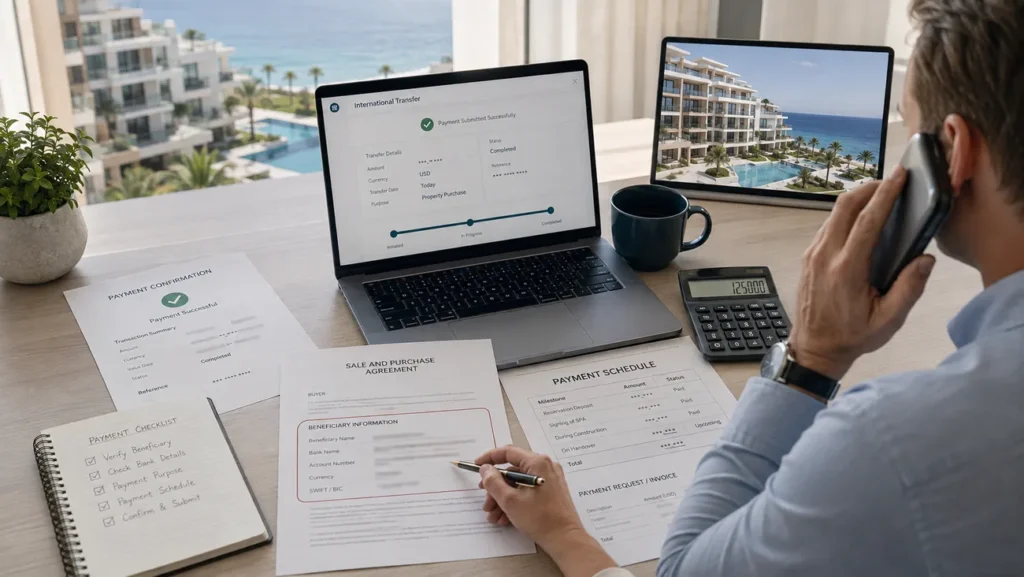
International bank transfers are commonly used for cross-border property payments, and the infrastructure for doing so is well established. The risk lies not in the transfer mechanism itself but in the possibility that payment instructions have been fraudulently substituted — remote buyers need to be especially careful about how instructions are received and verified.
What Costs Should a Remote Buyer Budget For?
| Cost category | Indicative figure | What to confirm |
|---|---|---|
| Reservation payment | Often several thousand GBP; varies by property and seller | Amount, recipient, refund conditions and whether it is credited toward the purchase price |
| Legal fees | About £1,500–£3,500 for a standard transaction in published market guides | Exact scope: due diligence, contract review, PTP, registration and title transfer |
| Stamp duty | Commonly quoted around 0.5% | Current rate, taxable base and deadline |
| VAT (KDV), where applicable | Commonly quoted around 5% for qualifying new-build transactions | Whether VAT applies and whether it is included in the advertised price |
| Title transfer charge | Can be a major percentage of the purchase price; recent guides quote up to around 9% for some foreign buyers | Current rate for your nationality, property and transaction |
| POA / authentication | Variable | Notary, legalisation, translation, courier and other authentication costs |
| Bank / FX costs | Variable | Transfer fees, receiving-bank fees and exchange-rate spread |
| Inspection | Quote required | Scope of survey/snagging inspection |
| Service charges | Development-specific | Monthly/annual fee and outstanding balance |
| Utilities / handover | Development-specific | Connection charges, deposits and infrastructure fees |
These figures are budgeting indications, not a quotation. Rates and foreign-buyer rules have changed repeatedly, including during 2026. Ask your lawyer for a written transaction-specific calculation immediately before reservation or contract signing.
Ask for the figures in writing immediately before reservation or contract signing. Foreign-buyer rules and property-related charges have changed in recent years, so an older online cost table should not be treated as a current quotation.
Example: Why the Advertised Price Is Not the Final Budget
A property advertised at £150,000 will require a higher total transaction budget once the applicable taxes, transfer charges, legal fees, banking costs and other transaction expenses are included. For example, if a 0.5% charge applied, that would equal £750 on a £150,000 purchase; 5% would equal £7,500; and 9% would equal £13,500.
These figures illustrate the effect of percentage-based charges only and should not be treated as a quotation for a particular purchase. The rates that actually apply depend on the property, buyer, transaction structure and legislation in force at the time. Ask your lawyer for a written transaction-specific calculation before committing funds.
| Payment stage | Typical purpose | Verify before paying | Evidence to keep |
|---|---|---|---|
| Reservation deposit | Secures property while due diligence proceeds | Reservation agreement signed; refund terms confirmed; payee identity checked | Signed reservation agreement, bank transfer confirmation |
| Contract deposit | Initial payment at contract exchange | Contract status and registration requirements confirmed by lawyer; title checks completed; payee bank details independently verified | Signed contract, SWIFT/transfer confirmation |
| Construction milestone payments | Stage payments tied to development progress | Independent confirmation that milestone has been reached; milestone matches contract terms | Progress report or photo evidence, payment receipt from developer |
| Balance payment | Final sum due at completion or handover | Inspection completed; snagging list agreed; completion conditions in contract met | Inspection report, signed completion/handover document, receipt |
| Tax and transfer payments | Stamp duty, transfer fee and related costs | Current rates confirmed with lawyer; amounts match official calculation | Official receipts from relevant authority |
Payment fraud: the rules that protect remote buyers
Payment fraud in property transactions typically works by intercepting email communications and substituting new bank account details for legitimate ones. The buyer transfers a large sum to an account controlled by the fraudster rather than the seller or developer.
The rules that reduce this risk:
- Never change payment beneficiary details on the basis of an email or messaging app alone. Instructions to pay a different account, or to a third party not mentioned in your contract, should be treated as potentially fraudulent until independently confirmed.
- Call your lawyer or the developer directly, using a phone number you established at the start of the relationship — not a number provided in the same email as the changed instructions.
- Verify the beneficiary name, not just the account number. Banks display the account name at the point of transfer in many jurisdictions — check that it matches the party you expect to pay.
- Keep every payment confirmation: SWIFT receipts, bank statements, developer receipts and written acknowledgements.
- Match every payment to a specific line in the contract. If the amount, timing or recipient differs from what the contract specifies, do not pay without written clarification from your lawyer.
Verify changed payment instructions through a second, previously established communication channel before acting on them.
For off-plan property, where the contract provides for milestone-linked payments, obtain independent confirmation — ideally with photographic evidence — that the milestone has been reached before releasing funds. A lawyer or appointed site monitor can confirm this remotely.
Currency and banking compliance are practical considerations for international buyers. Large incoming transfers may require source-of-funds documentation from your bank. Prepare this in advance rather than discovering the requirement mid-transaction. Whether payments can be made from an overseas bank account is subject to the transaction structure, the receiving bank’s requirements and applicable compliance procedures — confirm the practicalities with your lawyer early in the process.
Buying Off-Plan Remotely
Purchasing a property that does not yet physically exist requires additional layers of verification compared to a completed resale. The physical product cannot be inspected, the developer’s promises are spread across marketing materials and contract documents, and payment commitments extend over the construction period.
Remote buyers in particular need to be disciplined about what is verified before the first payment and what is recorded in writing before construction milestones.
| Remote check | Resale | Completed new build | Off-plan |
|---|---|---|---|
| Physical inspection | Independent surveyor visits | Independent surveyor visits | Not possible pre-completion; site visit possible |
| Title position | Title records reviewed; history checked | Title records reviewed; planning confirmation | Title search on land; building permit verification |
| Developer check | Not applicable | Company background; planning approval | Company registration, track record, financial standing |
| Construction monitoring | Not applicable | Not applicable | Regular updates against milestones required |
| Payment milestones | Single or small number of payments | Simpler schedule | Multiple staged payments tied to build progress where contract provides |
| Handover inspection | Snagging report | Snagging report | Snagging + specification comparison |
| Immediate occupancy | Yes | Usually yes | No — timeline depends on completion |
Already shortlisted a property but not sure what to compare next?
Send us your preferred area, budget and property type. We can help you build a shortlist for remote viewing while your independent lawyer handles the legal checks.
[Get a Remote Property Shortlist]
Before committing to an off-plan purchase remotely, verify:
- The developer’s company identity, registration status and completed project track record
- Which planning and construction approvals are legally required at the project’s current stage, and confirm their current status with the relevant authority
- The exact unit: number, floor, orientation, floor plan dimensions
- The full specification: materials, finishes, kitchen and bathroom fittings, window sizes, included appliances
- What facilities are promised (pool, gym, concierge, car park) and that they appear in the contract — not only in marketing materials
- The expected completion date and what grace period the contract allows
- The consequences of developer delay beyond the grace period
- The payment schedule and how it corresponds to construction stages
- The snagging and handover process
- When title can be transferred after completion
Developer promises that appear only in brochures, websites or sales discussions may be significantly harder to enforce. Any commitment that matters to you should be stated expressly in the signed contract or other legally binding transaction documents. This applies to completion dates, specification details, facility delivery and any other material commitment.
For remote buyers specifically: the gap between marketing materials and actual delivery can be harder to spot without visiting the site or speaking to earlier buyers in the same development. If other phases of the same project have been completed, asking to speak with existing owners or reviewing their experience is a reasonable due diligence step.
Inspection and Remote Handover
A lawyer checking the legal title to a property is not the same as someone physically checking the condition of the building. These are distinct functions, and a remote purchase benefits from both.

For completed properties, an independent inspector or surveyor can be appointed to visit the property and produce a written report. The report should include photographs, notes on any defects, and — for off-plan or newly completed properties — a comparison against the agreed specification.
Practical items to cover in a remote inspection:
- Internal walls and finishes — cracks, damp, uneven plaster
- Windows and external doors — operation, seals, hardware
- Plumbing — taps, drainage, hot water
- Electrical points, sockets and consumer unit
- Air conditioning units and operation
- Bathrooms — tiles, sanitary ware, shower enclosures
- Kitchen — units, worktops, appliances if included
- Balconies and terraces — drainage, balustrades, surface condition
- Water pressure — run taps simultaneously where possible
- Any visible leaks or water ingress marks
- Common areas relevant to the unit — stairwells, lifts, external landscaping
- Parking space and storage unit condition
- For furnished units: inventory of included items against the agreed list
The inspector’s report should be reviewed before handover is accepted. Any defects should be documented in writing — ideally in a snagging list signed by the developer’s representative — with a timeline for rectification agreed before the buyer or their representative accepts the keys.
There is an important distinction between legal completion — the point at which contractual obligations are satisfied and payment is due — and physical acceptance of the property. A buyer’s representative accepting keys does not necessarily mean the buyer has accepted the property as defect-free. The terms of your contract, and what is signed at handover, determine the legal position. Your lawyer should advise on this before the handover date.
A lawyer checks the legal position; an inspector checks the physical property. For a remote buyer, obtaining both forms of independent review before handover is a strong safeguard.
Remote Buying Risks
When You Should Not Proceed Remotely
A remote purchase should stop or pause if:
- you cannot appoint genuinely independent legal representation;
- the seller or developer will not provide sufficient documents for title and ownership checks;
- the exact unit or plot cannot be matched to the documents;
- material title-history questions remain unresolved;
- a live viewing is refused and only edited marketing material is available;
- planning or construction approvals relevant to the project cannot be verified;
- payment is requested to a person or account not clearly connected to the transaction;
- bank details change shortly before payment and cannot be independently verified;
- material promises are kept outside the written contract;
- an off-plan milestone payment is requested without evidence that the contractual milestone has been reached;
- a completed property cannot be independently inspected before handover.
Remote buying is a method of completing a transaction, not a reason to accept a lower standard of verification.
| Risk | Why remote buyers are more exposed | How to reduce it |
|---|---|---|
| Relying on edited marketing video | Professional footage hides neighbouring buildings, noise, access issues and construction quality | Insist on unedited live video calls; ask to see surroundings, not only interiors |
| Title history and competing claims | Cannot visit Land Registry independently; some properties are affected by pre-1974 ownership claims with potential civil and criminal consequences | Require written title search from independent lawyer; obtain specific legal advice on title history and cross-border legal consequences before paying |
| Overly broad POA | Grants representative unnecessary control over funds or decisions | Define scope precisely; limit to specific listed actions and this transaction |
| Non-independent legal advice | A lawyer with interest in the sale proceeding may not flag problems | Appoint and pay for a lawyer independently of the agent or developer |
| Payment fraud (changed bank details) | Remote buyers rely on email and messaging for instructions — high interception risk | Verify any change through a separate, pre-established phone call; never by email alone |
| Signing reservation terms too quickly | Pressure to reserve before due diligence is complete | Have lawyer review reservation terms before paying; check refund conditions |
| Off-plan delivery delay | Developer delay compounds risk for buyers who cannot monitor site | Ensure contract includes completion date, grace period and delay remedies |
| Specification mismatch | Show apartment or brochure differs from delivered unit | Require specification to be listed in contract; compare at inspection against contract |
| Missing independent inspection | Legal completion proceeds without physical check | Appoint independent inspector before handover; retain written report |
| Undocumented developer promises | Verbal commitments about facilities, completion date or upgrades may be harder to enforce | Require all material commitments to be stated expressly in the contract before signing |
| Outdated legal information | Rules on foreign ownership, PTP and taxes have changed repeatedly | Verify current rules with lawyer at the time of purchase; do not rely on older articles |
| Assuming property gives residency | Some buyers purchase expecting automatic residency rights | Property ownership does not by itself automatically grant residence status under TRNC law; confirm separately |
On property title disputes in North Cyprus
Property in Northern Cyprus has a historical and legal background that buyers should understand before committing funds. Some properties carry competing pre-1974 ownership claims. Official UK government guidance warns specifically of disputed ownership in the region, of potential legal and financial consequences for buyers, and of the possible implications of a future political settlement.
Buyers should also be aware that the Republic of Cyprus applies its own laws to certain transactions involving property registered in the Republic of Cyprus Land Registry. UK government guidance indicates that certain dealings in such property without the registered owner’s consent may carry criminal as well as civil consequences. Because the application of these rules depends on the specific property’s history and the buyer’s circumstances, independent legal advice covering both the title position and potential cross-border consequences is an essential part of due diligence — not an optional extra.
The Immovable Property Commission was established to address such claims, and the European Court of Human Rights has recognised the IPC procedure as an effective domestic remedy in the context of certain property claims by Greek Cypriot owners — a finding that does not confirm the legal safety of any particular property transaction.
The practical conclusion is the same regardless of a buyer’s nationality: the available title records and relevant history of the specific property should be independently reviewed, by a qualified lawyer, before any commitment is made.
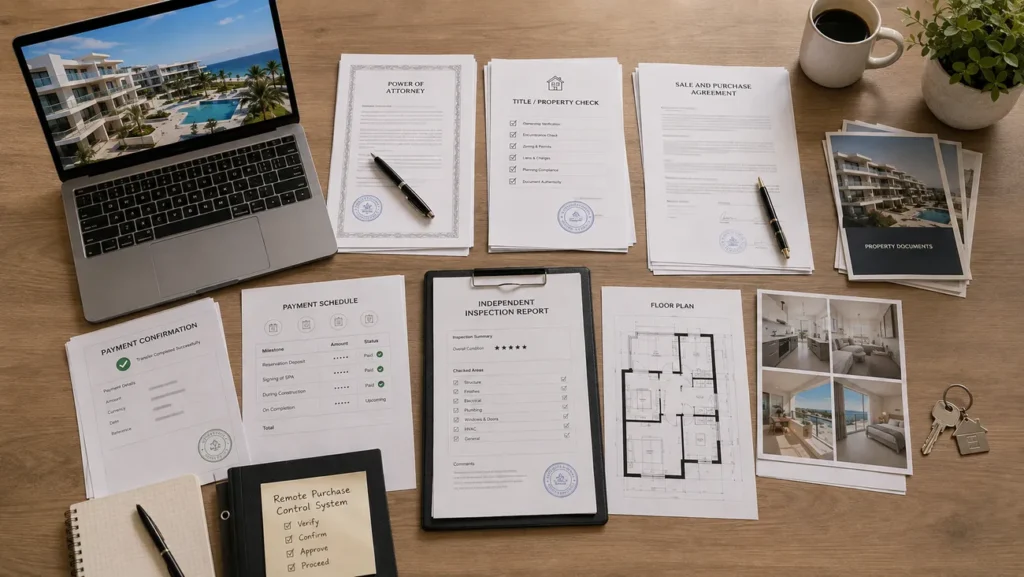
Remote Buyer Checklist
Before paying a deposit
- Live video viewing completed — unit number, floor and orientation confirmed
- Exact property identified in writing (address, unit, floor plan reference)
- Seller or developer identity confirmed in writing
- Independent lawyer appointed and acting for you (not the seller)
- Preliminary title search and encumbrance check completed
- Available title records and relevant history reviewed by lawyer
- Cross-border legal consequences of title position considered with independent advice
- Your eligibility as a foreign buyer confirmed for this property and nationality under current rules
- Reservation refund conditions reviewed and accepted in writing
Before signing the sale contract
- Full title search report received from independent lawyer
- Contract reviewed in full by independent lawyer
- Payment schedule matches contract terms
- Completion date and delay provisions confirmed in contract
- Specification listed in contract (for off-plan or furnished property)
- All material developer commitments stated expressly in contract, not only in marketing materials
- POA scope reviewed and correctly executed if required
- Authentication requirements for POA confirmed with North Cyprus lawyer before signing abroad
Before each major payment
- Bank account details independently verified — beneficiary name, account number, bank
- Payment amount and timing match contract schedule exactly
- For off-plan: construction milestone independently confirmed as reached where contract provides
- Transfer confirmation saved (SWIFT reference, bank statement)
- Written receipt requested from receiving party
Before handover
- Independent inspection completed
- Snagging list prepared and submitted to developer
- Defect rectification agreed in writing before keys are accepted
- For off-plan: delivered specification compared to contract specification
- Representative’s authority to attend handover confirmed under POA if applicable
Before title transfer
- Permission to Purchase approval confirmed
- All payments to developer receipted
- Outstanding taxes or fees confirmed with lawyer under current rules
- Title transfer application submitted or completed
- Registered title deed (koçan) received and verified
Buying Remotely With the Right Checks
Remote property purchase in North Cyprus can be structured using legal representation, remote document handling and in-person checks carried out on the buyer’s behalf. The process works because the key functions — legal verification, authorised representation, payment management and physical inspection — can each be handled by qualified professionals without the buyer being present.
The practical requirement is not to compress these functions or merge them into a single relationship for convenience. Property selection, legal due diligence, payment verification, physical inspection and documentation are separate processes, and each needs to be handled by the right person. An estate agent is not a lawyer. A lawyer is not a building inspector. A developer is not an independent adviser on the transaction.
Before transferring significant funds, the current rules for your nationality and the specific property should be confirmed. The foreign buyer framework in North Cyprus has changed meaningfully in recent years — what applied to a purchase two or three years ago may not apply today. The title position of the specific property, including any cross-border legal implications, should be independently reviewed before commitment.
Remote buyers can reduce avoidable risks by treating the absence of physical presence as a reason to be more systematic — requesting written confirmations at every stage, independently verifying payment instructions, and ensuring that all material commitments are documented in the contract rather than left as verbal assurances.
This article provides general information and does not constitute legal, tax, financial or investment advice. Property rules in North Cyprus have changed repeatedly in recent years, so buyers should obtain current independent advice for their nationality, property and transaction before committing funds.
 Real estate in Georgia
 Real estate in Montenegro
 Real estate in the UAE
 Real estate in Bali
 Real estate in Thailand
 Real estate in Spain
 Real estate in Saudi Arabia
 Real estate in Turkey
 Real estate in Zanzibar
 +90 533 888 29 50
 hello@cypria.homes
 Karsıyaka Sokak 8, Girne



 Get catalogue of TOP-7 objects