
 +90 533 888 29 50



North and South Cyprus are distinct property markets on the same island, separated by legal regime, administration and buying procedure. Some listings in the north carry lower asking prices, but that comparison only holds once title type, legal exposure, financing options and total purchase costs are factored in. The Republic of Cyprus operates an internationally recognised registration system, though individual due diligence still applies. In the north, title origin, independent legal checks and potential competing claims require particular attention. The right market depends on your budget, intended use and risk tolerance.
Consider two apartments, both a short walk from the sea, on the same Mediterranean island. One is listed at €120,000; the other at €200,000. The natural instinct is to investigate the cheaper option first. But the gap between those prices may reflect something far more significant than size, finish or sea view — it may reflect differences in legal jurisdiction, title origin, financing access, resale liquidity and the complexity of the buying process itself.
Cyprus has been divided since 1974. The south operates as the internationally recognised Republic of Cyprus, an EU member state. The northern part of the island operates under a separate administration with limited international recognition. The two markets share geography, Mediterranean climate and broadly similar property types, but they differ on almost every dimension that matters to a buyer: how ownership is registered, how disputes are resolved, what finance is available, and what happens if you decide to sell years later.
This article works through each of those dimensions in depth. It is written for buyers who want to understand both markets honestly — not to steer you towards either, but to give you a framework for asking the right questions before committing any money.
North vs South Cyprus Property: Quick Answer (2026)
Northern Cyprus often has lower advertised property prices, but it operates under a separate registration system and some properties may face competing ownership claims. The Republic of Cyprus has an internationally recognised title system, broader mortgage options and different residence-permit pathways.
| Key factor | Northern Cyprus | Republic of Cyprus |
|---|---|---|
| Legal status | Administration recognised as a state only by Türkiye | EU member state |
| Property ownership | Local koçan registration; pre-1974 title history requires verification | Department of Lands and Surveys |
| Foreign buyer approval | Permission to Purchase generally required | Non-EU buyers generally require permission |
| Transfer fees | 4% for an eligible foreign buyer’s first property under A.E.955 (Official Gazette No. 197, 7 October 2026), subject to the temporary tariff’s conditions through 5 January 2027. | Progressive 3%, 5% and 8% bands, generally reduced by 50% where applicable; no transfer fee on qualifying VAT-paid purchases |
| Stamp duty | Generally 0.5% on the purchase contract | Abolished for documents signed from 1 January 2026 |
| VAT on new homes | Local VAT rules apply; check the particular transaction | Standard 19%; qualifying main homes may benefit from 5% on an eligible portion |
| Mortgage access | Cross-border options may be limited | Mortgages available to qualifying applicants |
| Rental income | Property-specific; no reliable island-wide yield guarantee | RICS/KPMG Q2 2026 benchmark: apartments 5.51%, houses 3.01% |
| Residency | Local permit does not provide EU residence status | Separate investor route from €300,000 plus applicable VAT and other conditions |
The figures are dated benchmarks, not a complete purchase-cost quotation. The northern transfer-fee schedule is temporary, eligibility-dependent and separate from VAT, stamp duty and legal costs. The RICS/KPMG indicators concern the Republic of Cyprus only.
North vs South Cyprus at a Glance
The two markets diverge on legal status before they diverge on price. South Cyprus is administered by the Republic of Cyprus, an EU member state. Property transactions in the Republic of Cyprus are primarily governed by Cypriot legislation, within the applicable framework of EU law, and are registered through the Department of Lands and Surveys. Disputes arising from these transactions may be subject to recognised judicial procedures, with cross-border enforcement depending on the applicable rules and circumstances. North Cyprus is administered separately, and its property market operates under local law that is not recognised by the European Union or most international legal systems.
That distinction has practical consequences at every stage — from how you finance a purchase, to whether you can mortgage the property, to what recourse you have if a dispute arises. The table below maps the main factors side by side.
| Factor | North Cyprus | South Cyprus |
|---|---|---|
| Legal status | Administered by a separate authority; not internationally recognised as a state | Republic of Cyprus; internationally recognised EU member state |
| EU law | EU acquis communautaire suspended in areas not under effective RoC government control | Full EU acquis applies |
| Property registration | Local land registry (koçan system) | Department of Lands and Surveys, Republic of Cyprus |
| Common listing currencies | GBP, EUR, USD common in developer marketing | EUR standard; GBP widely used in expat-facing listings |
| Relative asking-price levels | Listings often lower than comparable south Cyprus properties; variation is wide | Generally higher per sq m in coastal and urban areas |
| Title-deed considerations | Title origin matters significantly; pre-1974 history requires specific verification | Internationally recognised title system; individual property checks still necessary |
| Foreign buyer permissions | Permission to Purchase required; Decree-Law 119/2026 amended the framework — verify current requirements | Non-EU nationals generally need permission under the Acquisition of Immovable Property (Aliens) Law even for a first qualifying purchase |
| Mortgage availability | Limited international mortgage access; developer payment plans are common | International and local bank mortgages available; more lender options |
| Off-plan options | Extensive developer market; payment plans typically tied to construction stages | Active off-plan market; consumer protections differ from north |
| Rental-market considerations | Active tourist and expat rental market in coastal areas; legal framework differs | Established short-term and long-term rental market; self-service tourist accommodation requires registration with the Deputy Ministry of Tourism |
| Residence permits | Local permits available but do not confer EU residency rights | Various RoC categories; EU residency rights apply for qualifying applicants |
| Resale and legal exposure | Potential for competing claims on some title types; buyer pool may be narrower for properties with complex title histories | Wider international buyer pool; clearer legal basis for resale |
Three points follow from this overview. First, lower listing prices in the north do not automatically translate into lower total purchase costs when legal fees, permission requirements, potential complications and financing costs are included. Second, the south’s internationally recognised system reduces certain categories of legal risk, but does not eliminate the need for property-specific due diligence. Third, your options at the financing and resale stage are substantially different depending on which market you enter.
Why the Two Markets Are Different
The island of Cyprus was divided in 1974 following a military intervention by Turkey, after a coup backed by the Greek military junta. Turkish Cypriot authorities took control of the northern third of the island; the Republic of Cyprus retained administration of the south. The United Nations has maintained a buffer zone — the Green Line — separating the two areas ever since.
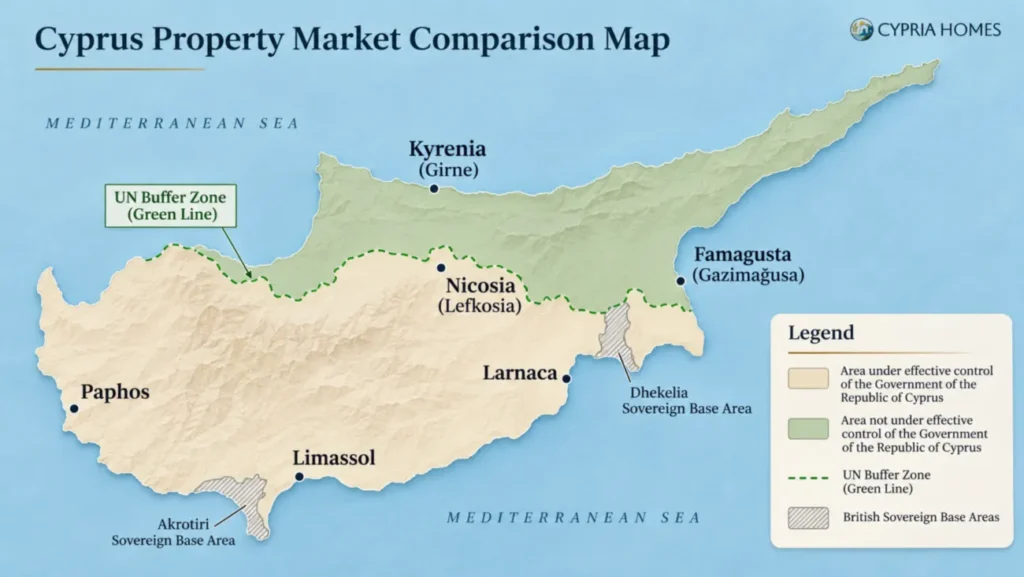
Under Protocol No. 10 to the 2003 Act of Accession, the application of the EU acquis is suspended in areas where the Government of the Republic of Cyprus does not exercise effective control. This has practical consequences for property transactions and regulatory protections, although it does not eliminate every EU-law consequence relating to northern Cyprus.
This distinction matters for property buyers because it is not merely a political label. It has direct, concrete legal consequences:
- Judgments from courts in the north do not benefit from the EU’s ordinary mutual-recognition framework. Whether a particular judgment or document has effect elsewhere depends on the applicable law and circumstances.
- Property registration in the north uses a local koçan system that is entirely separate from the internationally recognised Cyprus land registry.
- Rights conferred by purchasing property in the north — including residence and movement rights — carry no EU-law status.
The two registration systems operate separately. However, a northern registration does not prevent a court in the Republic of Cyprus from considering competing claims; certain Republic of Cyprus judgments concerning northern property may be enforceable abroad. This is not a theoretical risk — it is one buyers should obtain specific written advice on before committing any funds.
The Green Line is not an international border between two recognised states. It is a ceasefire line administered by UNFICYP, the UN peacekeeping force in Cyprus. Civilians can cross at designated checkpoints, and many people do so routinely. But the legal systems on each side do not recognise documents or registrations issued by the other. For property buyers, this means a purchase on one side has no automatic legal standing in the other jurisdiction.
Understanding this framework is not a reason to avoid the north. It is a reason to understand precisely what you are buying, under which legal system, and with what recourse available — before committing any funds.
Property Prices in North and South Cyprus
Asking prices and transaction prices are not the same thing. In both markets, advertised listings reflect what sellers and developers would like to achieve. Actual registered transaction values often differ, and in the north specifically, the absence of a centralised publicly accessible transaction database makes independent market-price benchmarking considerably more difficult than in the south, where Department of Lands and Surveys data provides a reference point.
That said, properties in the north have consistently been listed at lower prices than comparable coastal properties in the south. The difference is real and significant for buyers with limited budgets. What matters is understanding what drives it, and what the property costs to own and hold over time.
Property Asking Prices per Square Metre: North vs South Cyprus
The following figures offer a dated snapshot of asking prices, not completed transaction prices. They come from two independent listing datasets with different collection periods, coverage and property mixes, so they should not be used to calculate a precise north–south discount.
| Northern Cyprus location | Median asking price | Republic of Cyprus district | Median apartment asking price |
|---|---|---|---|
| Kyrenia (Girne) | £1,917/m² | Limassol | €4,600/m² |
| Iskele | £1,686/m² | Paphos | €3,827/m² |
| Famagusta (Gazimağusa) | £1,431/m² | Larnaca | €2,784/m² |
| Northern Nicosia | £1,200/m² | Nicosia | €2,407/m² |
Sources and dates: Northern Cyprus: North Cyprus Property Price Index by tagmac.dev, 5 November 2026, based on 12,933 live sale listings. Republic of Cyprus: AXIA Tools, listing sample collected 6 July–3 August 2026. Figures represent advertised prices, not completed sales, and the two datasets are not directly comparable.
The northern figures cover residential listings across property types, whereas the Republic of Cyprus figures refer to apartments. Currency, property type and sample differences prevent a like-for-like price comparison. For an actual buying decision, compare apartments of similar size, age, completion status and distance from the coast.
Both markets offer a broadly similar range of property types: apartments, townhouses, detached villas, studio units and plots. In the north, the new-build sector is particularly active, with developers offering multi-phase complexes across coastal corridors. In the south, both resale and new-build stock is substantial, particularly around Paphos, Limassol and Larnaca.
Location drives price as much as construction type. Front-row sea-view apartments command premiums in both markets. Distance from the coast, quality of access roads, proximity to amenities and the management quality of a complex all affect value and rental potential. A property’s title type also influences its valuation in the north — an object with a contested or uncertain title may be priced accordingly, though this is not always disclosed clearly in developer or agent marketing material.
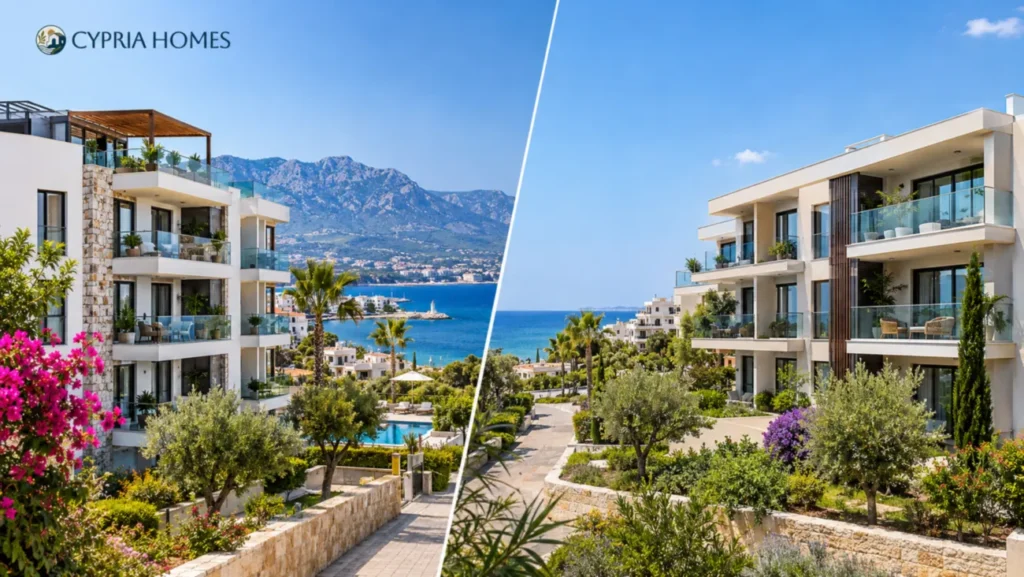
New-build pricing in the north frequently uses instalment structures rather than upfront payment. These payment plans can make entry appear accessible, but the total cost — once interest, service charges and registration fees are included — requires careful calculation. Developer-offered furnishing packages are another variable; a “furnished” listing and an “unfurnished” listing at similar prices are simply not directly comparable.
The table below compares what buyers at three budget levels should examine. These budget brackets are illustrative shopping scenarios, not verified current listings. Property type, availability and legal eligibility must be checked against dated comparable offers from active agents or developers at the time of your search.
| Buyer Budget | North Cyprus: What to Compare | South Cyprus: What to Compare | Key Questions to Ask |
|---|---|---|---|
| £120,000 | Studio or one-bed in a mid-sized complex; check if off-plan or completed; verify title type; clarify service charges and payment plan terms | Studio or one-bed in Larnaca or inland Paphos area; confirm title transfer status; check for outstanding developer charges | Is the property completed and separately registered? What are annual service charges? |
| £200,000 | One- or two-bed with sea view in Kyrenia or Iskele corridor; examine koçan origin carefully; ask about resale history of similar units | One-bed or small two-bed in Paphos, Larnaca town or Limassol outskirts; more resale stock with established title history | Has the property been resold before? What restrictions apply to foreign buyers at this price point? |
| £350,000 | Two- or three-bed villa or larger apartment in a managed complex; verify planning permissions, completion certificates and individual title; confirm current Permission to Purchase requirements under Decree-Law 119/2026 | Two-bed apartment in Limassol or beachfront areas; townhouse or villa in Paphos; factor in VAT treatment and applicable transfer costs carefully | Is the title individual or still developer-held? Is VAT or transfer fee the applicable charge for this purchase? |
Two apartments listed at £150,000 on the same island can carry substantially different total ownership costs. One may be in a complex where service charges have risen sharply and are poorly managed; the other may carry a legal review cost and permission application fee that the first does not. Five years of maintenance reserves, insurance, local charges and management fees further widen the gap between headline price and total cost of ownership. Availability of a specific property at any price depends on legal status and applicable restrictions, not budget alone.
Explore Northern Cyprus Properties by Budget


 Alsancak
 from 65м²


 Long Beachfrom 160м²
 Iskelefrom 53м²
 Iskelefrom 60м²
Title Deeds and Legal Risks
A title deed is the document that records legal ownership of a property in the relevant land registry. Its existence does not, by itself, confirm that there are no competing claims, encumbrances or unresolved questions about the history of that land. This applies in both markets, but it carries specific and significant implications in the north.
A title document confirms registration under a particular system. It does not automatically confirm the absence of prior or competing ownership claims — particularly in a jurisdiction where land ownership records before 1974 are disputed.
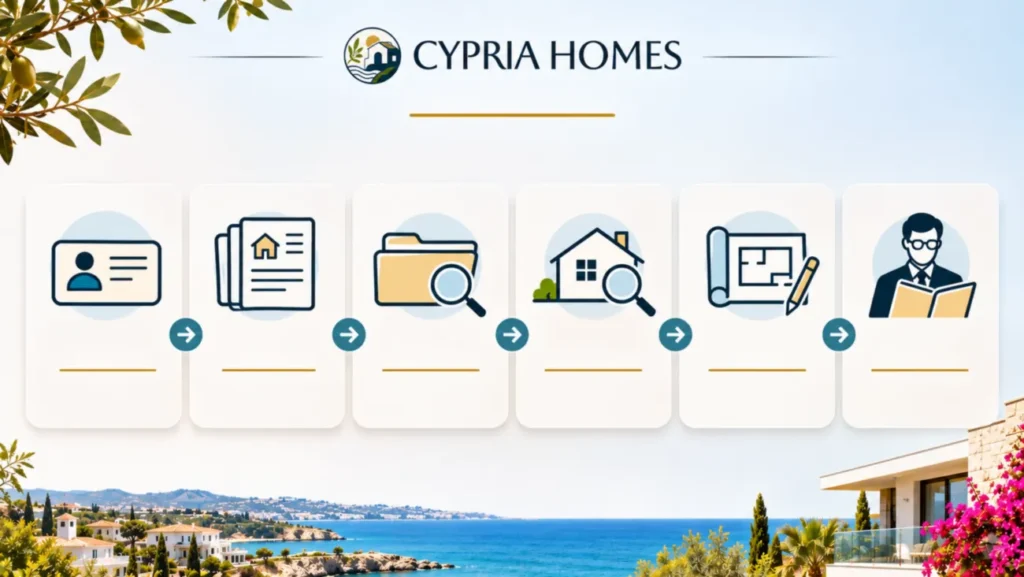
In the Republic of Cyprus, the Department of Lands and Surveys maintains a centralised, internationally recognised property registry. For contracts concluded after 12 December 2023, the seller is required to provide a Search Certificate of encumbrances and prohibitions, dated within five working days of the contract, as an integral part of the sale documentation. The buyer’s lawyer should also carry out independent checks. This system has its own known problems — including developer delays in issuing individual titles for apartment units, and outstanding developer loans that can encumber an entire building — but disputes are resolved within an internationally recognised judicial system with enforceable outcomes.
In the north, the koçan is the equivalent of a title deed. Its legal significance must be assessed in light of the land’s ownership history, registered encumbrances, the seller’s authority, planning compliance and any competing claims under Republic of Cyprus law.
North Cyprus Title Types
Property titles in the north fall into several broad categories based on the history of the land before and after 1974.
Pre-1974 Turkish Cypriot title covers land that was owned by Turkish Cypriots before the division. This category is generally considered to carry lower legal risk in terms of competing ownership claims from Greek Cypriot displaced persons, though it does not eliminate all questions about encumbrances, planning history or registration accuracy. Marketing material sometimes presents this category as inherently safe; independent verification remains necessary regardless of category name.
Exchange or equivalent title refers to land allocated to Turkish Cypriots displaced from the south in exchange for property they left behind. The legal position is more complex, as the basis for the exchange is disputed under international law and in Republic of Cyprus courts.
Allocation title (TMD) covers land distributed by authorities in the north to settlers or new owners after 1974. Allocation titles may involve significant competing-ownership risks, particularly where the land was owned by displaced Greek Cypriots before 1974. The legal exposure must be assessed for the specific plot rather than inferred solely from the title category.
Marketing descriptions often name these categories without explaining their implications. The category name alone is not sufficient for a legal assessment — the original land history, the specific plot, and any pending or historical claims must all be examined by an independent qualified lawyer.
In Apostolides v Orams (Case C-420/07), the Court of Justice of the EU ruled on 28 April 2009 that suspension of the acquis in the north did not prevent recognition and enforcement of the relevant Republic of Cyprus judgment in another member state. The case established that a Republic of Cyprus court order concerning a property purchased in the north could in principle be enforced in other EU member states under EU civil procedure rules. It does not mean that every northern property is subject to enforcement action. It does establish that purchasing property with a competing Greek Cypriot ownership claim creates a potential legal exposure that extends beyond Cyprus itself.
The Immovable Property Commission (IPC) was established in the north as a remedy mechanism allowing Greek Cypriot property owners to claim compensation, exchange or restitution for properties lost in 1974. Its existence demonstrates that the ownership question is formally acknowledged. It does not guarantee that a buyer will retain a property with a competing claim, nor does it extinguish all prior ownership rights. The UK Government’s guidance on property in Cyprus explicitly flags that transactions involving property owned by another person under Republic of Cyprus records may trigger civil claims and criminal-law exposure under Republic of Cyprus legislation. The Republic of Cyprus Ministry of Foreign Affairs has published its own guidance on the legal consequences for foreign citizens purchasing Greek Cypriot–owned property in the area administered by Turkey. Both advise buyers to seek independent legal advice specific to the plot before signing.
What Buyers Must Verify
Before signing any reservation agreement or paying a deposit, an independent lawyer — not one introduced solely by the developer or selling agent — should confirm all of the following in writing:
- The full ownership chain from the land’s pre-1974 origin to the current seller, with no unexplained gaps or unverifiable transfers.
- The legal status and authority of the seller, including whether they hold valid title and whether any other party has an interest in the property or the site.
- The land history and title category, with a specific written assessment of legal risk for that plot rather than a general opinion about the category.
- Registered encumbrances, including any mortgages taken by developers against the development site, charges, rights of way or other restrictions affecting the specific unit.
- Building permits, completion certificates and planning compliance for the specific unit or plot, confirmed as matching what has actually been built.
- Applicable restrictions on foreign buyers, including current Permission to Purchase requirements under Decree-Law 119/2026, published in Official Gazette No. 196 on 6 October 2026 — confirm its current validity, purchase caps, permit deadlines and property-specific eligibility against the official Gazette and with an independent locally qualified lawyer immediately before contracting.
- Potential exposure under Republic of Cyprus law or the law of your home country, particularly if the property falls into a title category associated with competing claims.
You may need separate legal input from a specialist in northern Cyprus law, a qualified lawyer in the Republic of Cyprus, and potentially a solicitor in your home jurisdiction if significant assets are involved.
Documents to Request Before Reserving a Property in Northern Cyprus
Ask the seller or developer to supply the documents below for review by an independent lawyer before paying a non-refundable reservation fee.
| Document | What your lawyer should verify |
|---|---|
| Current koçan / title record | Registered owner, title category and property identification |
| Pre-1974 ownership evidence | Land history and possible competing ownership claims |
| Encumbrance search | Mortgages, charges, restrictions and third-party interests |
| Planning and building permissions | Whether the development was lawfully approved |
| Completion and use permissions | Whether the completed building may lawfully be occupied |
| Individual-unit title information | Whether the apartment has a separate transferable title |
| Draft sale contract | Price, deadlines, remedies, refund conditions and title-transfer obligations |
| Foreign-buyer permission requirements | Eligibility, application deadlines and ownership limits under current rules |
| Developer’s financial and delivery records | Contractor obligations, construction financing and outstanding project commitments |
Red flag: if material documents are unavailable, inconsistent or cannot be independently verified, do not treat a developer’s reassurance as a substitute for legal evidence. The next step is to resolve the discrepancy with your lawyer, not to pay a reservation fee.
When Should You Walk Away From a Property Purchase?
A lower price should not override unresolved legal or contractual problems. Consider pausing or rejecting a purchase if:
- The developer cannot identify the registered landowner or provide verifiable title documentation.
- There is a material unresolved competing claim to the land.
- The seller cannot demonstrate authority to sell the specific property.
- The unit lacks necessary planning or completion documentation, with no independently verified path to resolution.
- The contract does not clearly explain when and under what conditions an individual title can be transferred.
- Reservation payments are described as non-refundable before independent legal checks are completed.
- The developer promises guaranteed returns without a clearly defined, enforceable agreement and financial evidence.
Not every missing document automatically makes a property unlawful. The critical question is whether the issue can be resolved and independently verified before the buyer becomes financially committed.
Explore Completed Properties in Northern Cyprus





Taxes and the True Cost of Buying
The asking price of a property is the starting point, not the endpoint. Both markets involve a range of transaction costs, annual charges and ongoing ownership expenses that add meaningfully to the total. Buyers who compare listing prices without accounting for these additional costs frequently discover a substantially different financial picture once the purchase completes.
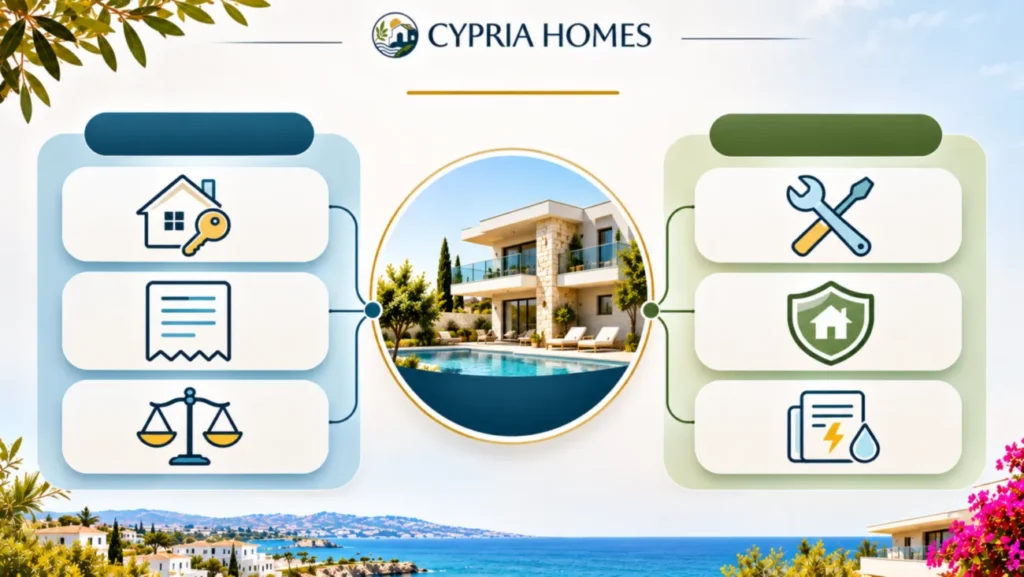
Two important notes before the comparison. For the Republic of Cyprus: the Republic of Cyprus abolished stamp duty for documents signed from 1 January 2026 under Law 239(I)/2025. Documents signed by at least one party by 31 December 2025 may remain subject to the previous rules. Additionally, in the Republic of Cyprus, qualifying VAT-taxable new residential transactions do not attract ordinary transfer fees, while transfer fees in many other cases benefit from a statutory 50% reduction, subject to exceptions. Do not use a single percentage estimate for south Cyprus transaction costs — the total depends materially on whether the purchase is VAT-taxable or not. Request a written, itemised cost schedule for the specific transaction.
In northern Cyprus, transaction costs depend on the applicable local rules, date of purchase, title-transfer status, property type and buyer profile. Foreign-buyer transfer tariffs may be temporary, so a written cost calculation should be requested shortly before the transaction.
| Cost Category | North Cyprus | South Cyprus | What to Verify |
|---|---|---|---|
| Transfer-related charges | Local transfer fees apply; rates vary by property type and transaction structure | Transfer fees based on registered value; statutory 50% reduction applies in many cases; not charged on VAT-taxable transactions | Confirm which scenario applies with a local lawyer before exchange |
| Stamp duty | Charged on contracts under local rules | Abolished for documents signed from 1 January 2026 (Law 239(I)/2025); documents signed by 31 December 2025 may still be subject to prior rules | Confirm signature date and applicable law |
| VAT | Local VAT rules apply; check with local lawyer | Standard rate 19% on qualifying new residential property; eligible acquisitions for use as a main and permanent residence may qualify for 5% VAT on the permitted portion, subject to statutory area, value and other conditions | Confirm whether the property qualifies and what conditions apply |
| Legal and conveyancing fees | Independent legal fees; typically a percentage of purchase price or fixed fee | Standard legal fees; varies by solicitor | Agree fees in writing before instructing |
| Permission to Purchase / acquisition permission | Required for foreign buyers; Decree-Law 119/2026 amended the framework — verify current validity, caps and deadlines | Non-EU nationals generally need permission under the Acquisition of Immovable Property (Aliens) Law; applications submitted to the relevant District Administration using form COMM 145 | Verify current requirements for your nationality before making any offer |
| Registration of sale contract | Confirm with local lawyer | For a contract signed in 2026, deposit with the Department of Lands and Surveys generally within six months of signature to benefit from statutory specific-performance protections | Confirm timescales with your lawyer; stamp duty does not generally apply to new 2026 contracts |
| Communal/service charges | Variable; depends on complex size and management quality | Variable; widely divergent between developments | Request historical service charge accounts for the specific complex |
| Utilities | Infrastructure varies; connection costs apply | Standard EAC and CYTA connections; ongoing monthly costs vary by use | Confirm connection status and current tariffs |
| Property insurance | Available through local insurers; check coverage scope in northern jurisdiction | Standard international insurers active; note potential exclusions for northern property | Check what risks are and are not covered under your specific policy |
| Ongoing local charges | Immovable property charges levied locally | Sewerage board charges and immovable property-related levies in some areas | Confirm current annual charges with your lawyer |
| Short-term rental registration | Local rules apply; verify with local lawyer | Operators of qualifying self-service tourist accommodation must obtain registration and a registration number from the Deputy Ministry of Tourism before advertising or renting | Check registration requirements before purchase if rental income is planned |
| Rental income tax | Local tax applies if renting; limited double-taxation treaty coverage | Cyprus-source rental income may be subject to income tax and, where applicable, a 2.65% GESY contribution, subject to the owner’s status and any exemptions. Special Defence Contribution on rental income was abolished from the 2026 tax year. From 1 July 2026, rental payments for immovable property in Cyprus must generally be made through recognised electronic payment methods. The final tax treatment depends on the owner’s status and circumstances. | Confirm tax position with a qualified tax adviser in your country of tax residence |
Example: Buying a €200,000 Property in North vs South Cyprus
The following examples isolate selected transfer-related charges to show how the same headline price can lead to different acquisition costs. They are not full quotations and do not establish that properties in the two markets are otherwise comparable.
| Cost | Northern Cyprus | Republic of Cyprus |
|---|---|---|
| Hypothetical purchase price | €200,000 | €200,000 |
| Buyer scenario | Eligible foreign buyer, first property, temporary October 2026 tariff | Resale purchase, no VAT, ordinary transfer-fee reduction |
| Illustrative title transfer charges | €8,000 (4%) | €4,600 |
| Illustrative stamp duty | €1,000 (0.5%) | €0 |
| Subtotal of illustrated charges | €9,000 | €4,600 |
| Legal fees, VAT where applicable, permissions and other costs | Not included | Not included |
The northern example assumes that the 4% tariff applies to the full stated value and that the 0.5% contract stamp duty applies. Its validity and any transitional treatment must be checked before payment. The Republic of Cyprus example applies the ordinary transfer-fee bands and the 50% reduction to an assumed chargeable value of €200,000, excluding exceptional circumstances.
Important: Temporary Northern Cyprus Transfer Fee Rules (2026–2027)
The temporary 4% first-property transfer tariff for eligible foreign buyers is set out in regulation A.E.955, published in Official Gazette No. 197 on 7 October 2026. The temporary schedule applies through 5 January 2027, subject to its conditions and transitional provisions. Buyers should confirm their eligibility, the applicable valuation basis and the required payment or registration deadlines with an independent local lawyer before relying on this rate.
This transfer-fee regulation is separate from Decree-Law 119/2026, which concerns the legal framework for foreign property acquisition.
A cheaper headline price does not necessarily mean a lower total acquisition cost. The buyer should compare the same property type, construction status, title-transfer position and full cost breakdown, including any VAT, legal fees, utility connections and service charges.
For current transfer fee information in the Republic of Cyprus, the government provides an online fee calculator. North Cyprus transaction costs should be confirmed through a qualified local lawyer. See also “North Cyprus Property Taxes” for a fuller breakdown.
Rental Yields, Financing and Resale
Gross yield and net yield are different numbers, and the gap between them is frequently larger than buyers expect. Gross yield is annual scheduled rent divided by purchase price. The table below illustrates an unlevered operating yield based on net operating income before taxes and financing, divided by purchase price; it is not an after-tax or leveraged return. What you actually keep after income tax and any loan interest is a further step of calculation.
Advertised rental yields may be based on gross rental income or occupancy assumptions that do not reflect the property’s actual operating costs. Buyers should request a transparent calculation showing vacancy, management fees, maintenance, taxes and financing costs. For example, a hypothetical 8% gross yield could fall substantially after those deductions; the actual outcome must be calculated for the individual property, not inferred from a marketing headline.
Gross yield, net operating yield and after-tax cash flow measure different aspects of an investment. A complete assessment should also consider financing costs, acquisition expenses, resale assumptions and capital risk.
Cyprus Rental Yield Benchmarks: Q2 2026
The RICS Cyprus Property Price Index with KPMG provides an independent benchmark for the government-controlled property market in the Republic of Cyprus.
| Property type | Reported rental yield, Q2 2026 |
|---|---|
| Residential apartments | 5.51% |
| Residential houses | 3.01% |
| Holiday apartments | 5.82% |
| Holiday houses | 2.85% |
These index figures represent market valuation-based rental yields, not guaranteed investor returns. They do not measure the northern Cyprus market and should not be treated as direct comparisons with developer-advertised yields in the north.
For northern Cyprus, request actual rental statements from comparable completed properties, including occupied nights, achieved rent, service charges, management fees and repair costs. If these records are unavailable, treat the projected yield as an assumption rather than proven performance.
The table below presents an illustrative rental calculation for a hypothetical property in each market, priced at £180,000. These are assumed figures, not market averages or forecasts. They are designed to demonstrate the structure of a yield calculation, using identical assumptions to allow comparison.
| Metric | North: Illustrative Case | South: Illustrative Case |
|---|---|---|
| Acquisition price | £180,000 | £180,000 |
| Annual gross rent (illustrative assumption) | £10,800 | £10,800 |
| Vacancy allowance (assumed 15%) | –£1,620 | –£1,620 |
| Property management (assumed 15% of collected rent) | –£1,377 | –£1,377 |
| Annual maintenance reserve (assumed 1% of purchase price) | –£1,800 | –£1,800 |
| Insurance and local charges (illustrative) | –£600 | –£700 |
| Net operating income (before tax and financing) | ~£5,403 | ~£5,303 |
| Illustrative unlevered operating yield | ~3.0% | ~2.95% |
These figures use identical assumptions for comparison purposes only and do not represent market data or typical outcomes. Actual results depend on location, property condition, management quality, real occupancy and applicable taxes. Acquisition costs are excluded from this table but would reduce effective yield if included in the calculation.
What the table does not capture is the risk dimension. Properties in the north where title history is complex or financing is restricted may appeal to a narrower set of eligible or willing buyers at resale. Ask for recent verified comparable sales and typical marketing periods before projecting an exit scenario — this is particularly important for properties with complex title histories or limited financing options. A higher calculated yield in the north does not automatically compensate for those constraints.
Financing is a material differentiator. In the south, local and international banks offer mortgages to qualifying foreign buyers. Loan-to-value ratios, interest rates and lending criteria vary, but the mortgage market is established and internationally accessible. In the north, cross-border mortgage options for properties registered in northern Cyprus may be limited. Buyers should verify available lenders, acceptable collateral, loan terms and eligibility directly rather than assume conventional mortgage finance will be available. Developer payment plans are one possible alternative, subject to project-specific contractual terms. Plan durations vary by project, construction stage and contract; buyers should obtain the full payment schedule, including any interest, penalties and conditions linked to completion or title transfer. Payment plans are not equivalent to a mortgage: they depend on the developer completing the project and carry different rights in a default scenario.
Off-plan purchases in the north carry an additional layer of risk: construction delays, changes in specification, developer insolvency and the question of whether a separate title will be issued in the buyer’s name on completion. See “North Cyprus Property Payment Plans” and “Buying Off-Plan Property in North Cyprus” for a fuller treatment.
Regarding short-term rentals: in the Republic of Cyprus, operators of qualifying self-service tourist accommodation must obtain registration and a registration number from the Deputy Ministry of Tourism before advertising or renting. Short-term letting in either market requires a separate legal and tax check before purchase.
Living in North vs South Cyprus
Property ownership on Cyprus brings very different day-to-day realities depending on which side of the Green Line you live on. For buyers planning to reside in the property — seasonally, full-time or in retirement — practical living conditions are as important as the balance sheet.
International flights are a good starting point. Larnaca and Paphos airports in the south offer direct services to a range of UK and European airports; availability varies by route, airline and season. Ercan Airport in the north operates primarily via Turkey; most routes require a connection in Turkey, and the airport is not recognised as an international port of entry by the Republic of Cyprus or the EU. For buyers who plan to travel frequently between the north and Europe, this adds time, cost and logistical complexity to every trip.
Transport within each area is largely car-dependent. Public bus networks exist but are limited in rural and coastal areas of both markets. The urban cores of Nicosia, Limassol and Larnaca in the south offer more walkable environments. Kyrenia town centre in the north is reasonably compact, though outlying developments require a vehicle for virtually all daily needs.
Healthcare access differs substantially. The south operates the General Healthcare System (GESY). GESY eligibility depends on nationality, ordinary residence and the applicable employment or residence-permit conditions; lawful residence or home ownership alone does not guarantee access — check eligibility criteria at GESY’s official site before relying on it. Private hospitals and specialist clinics are concentrated in Nicosia, Limassol and Paphos. In the north, healthcare operates under a separate system; specialist care is more limited, and access to certain specialist treatments may require referral or travel outside northern Cyprus, including to Turkey. Retirees and older buyers should verify the availability of the specific medical services they may need and whether their insurance covers treatment and medical transfers, before committing to full-time residence in the north.
School options, curricula and language of instruction vary by district on both sides of the island. Families should check the current list of licensed schools, age groups, teaching language and accreditation before choosing a location — do not rely on general descriptions of availability. English-medium international curriculum schools are present in several southern cities; the range on each side should be verified directly for the area you are considering.
Banking and payments warrant attention. South Cyprus banks operate within the EU banking system, support standard international transfers and are accessible with standard UK or EU banking arrangements. The banking system in the north is not connected to international networks in the same way, and buyers occasionally encounter practical difficulties with standard international transfers and card payments. This matters for both day-to-day living and for managing rental income from a distance.
Before committing to any location as a full-time or part-time residence, visit during both the peak tourist season and the quieter winter months. Infrastructure, services and local activity can differ substantially between July and January in many coastal areas of both north and south Cyprus.
Property ownership does not automatically grant EU residency or unrestricted residence rights in either part of Cyprus. In the south, the Republic of Cyprus offers residence permit programmes for non-EU buyers meeting specific investment criteria, but these are distinct from property ownership itself and subject to their own eligibility conditions and fees. In the north, a local residence permit allows extended stays but does not confer EU residency rights, freedom of movement in the EU or the right to work in any EU member state. Buyers planning to relocate should obtain specific immigration advice before purchasing, as the applicable rules differ by nationality and permit category. Do not conflate residing in the north of the island with obtaining a Republic of Cyprus residence permit; they are entirely separate processes.
For remote workers, internet connectivity in coastal areas of both markets has improved, though fibre availability varies significantly by development. Northern coastal areas can experience utility infrastructure gaps that southern developments of comparable age typically do not.
Does a €300,000 Property Purchase Qualify You for Cyprus Permanent Residence?
The Republic of Cyprus has an investor immigration permit pathway that includes qualifying investments of at least €300,000, excluding applicable VAT. The minimum investment alone is not sufficient: applicants must also meet the relevant property-category requirements, demonstrate the required funding and satisfy income and other eligibility criteria.
For residential houses or apartments, the applicable investor criteria generally concern qualifying first-sale properties purchased from development companies. Buyers should check the official rules before assuming that a resale property or any €300,000 apartment qualifies.
A residence permit issued by the Republic of Cyprus is not equivalent to unrestricted residence or work rights across all EU member states. A northern Cyprus residence permit is a separate local status and does not provide an EU residence permit.
Under the investor immigration-permit criteria, applicants must generally demonstrate secure annual income of at least €50,000, increased by €15,000 for a spouse and €10,000 for each dependent minor child, alongside the qualifying investment and other legal requirements. The investment threshold alone does not establish eligibility.
Best Areas to Compare
Geography shapes the character of a purchase more than almost any other single factor. Two properties at the same price in the same legal category can deliver very different day-to-day experiences depending on whether they sit within a year-round community or a seasonal resort, whether they are close to medical facilities or remote from them, and whether they are a short drive from an airport or require a lengthy transfer.
North Cyprus Locations
Kyrenia (Girne) is an established coastal town with a historic harbour, residential neighbourhoods, local services and a mixture of resale properties and new developments. The harbour area is compact and distinctive; there are restaurants, cafes and a reasonable range of local services. The surrounding hills and coastal strip have seen considerable development over the past decade. For buyers seeking an existing community rather than a new-build complex, Kyrenia offers more second-hand stock than other northern locations and a more established social infrastructure. Healthcare remains limited compared to the south, and Ercan Airport is the primary access point. This area suits buyers seeking established coastal town life with relatively good access to services by northern standards.
Esentepe is a quieter village area northeast of Kyrenia, popular with British buyers. The local community includes an established expat presence; golf facilities are nearby; properties tend toward villas and houses rather than large-scale apartment complexes. For buyers seeking a quieter environment with a small established English-speaking community, it is worth examining — though it requires a car for essentially everything and is some distance from Ercan Airport.
Iskele and the Long Beach corridor have seen substantial new development investment in recent years. This stretch is popular with developers targeting international investors, and new-build complexes with sea-facing positions are numerous. Access to independent facilities is growing but still largely tied to the development complex itself. Title due diligence and developer track record checks are particularly important in areas of rapid new construction.
Famagusta (Gazimağusa) is a university city with a significant student population. Whether rental demand, permitted use and achievable occupancy from that student presence suits your investment should be verified from current local data rather than inferred from university enrolment figures alone. The medieval walled town has genuine architectural character. Longer-term residential rental and shorter-term tourist letting appeal to different investor profiles, and the two should not be conflated.
South Cyprus Locations
Paphos has an established community of UK buyers and residents, with English-language services, known medical facilities, a wide range of property types and regular direct flight services from UK and European airports. The area operates year-round. It may be worth considering for buyers who prioritise an established international community and airport access, but property-specific costs, healthcare eligibility and transport needs should still be assessed individually.
Larnaca offers an international airport, year-round urban services and a range of residential neighbourhoods. The marina area has seen regeneration and the city has a more authentically local character than some coastal tourist areas. Buyers should compare current prices and transaction data with Paphos and Limassol rather than assume Larnaca is consistently more affordable — the gap depends on property type, location and market conditions at the time of search.
Limassol is one of the Republic of Cyprus’s major commercial centres and higher-priced property markets, with a substantial presence of international businesses and financial services. It reflects sustained demand from international businesses, financial services professionals and high-net-worth buyers. For buyers with standard holiday or retirement budgets, options are limited unless targeting specific sub-areas. For lifestyle investors comfortable with the price level, it is a distinct and economically active city with a different long-term demand profile.
Nicosia is the capital and operates year-round with an urban character entirely different from the coastal cities. It has no sea access; it does have the full range of urban services, international schools, hospitals and commercial activity. The city is divided by the UN buffer zone, and crossing to the north through Nicosia is straightforward at designated checkpoints. Property here is largely residential rather than investment-focused.
Protaras and Ayia Napa in the east of the island are established summer tourist destinations. Holiday-rental demand here is seasonal, but the scale of occupancy changes depends on the property and rental strategy. Buyers should review monthly occupancy and revenue data rather than extrapolate peak-season results across the full year. For buyers focused on long-term capital value rather than seasonal rental income, annual holding costs during the off-season should be factored into the calculation.
Not Sure Whether Kyrenia, Esentepe or Iskele Fits You?
Share your priorities — year-round living, seaside access, a holiday home or rental potential — and explore a personalised shortlist of northern Cyprus properties.
Compare Northern Cyprus Locations
How the Buying Process Differs
The sequence of steps in a property purchase looks broadly similar in both markets on paper, but the content of each step, the checks required and the legal consequences of skipping them are substantially different. Knowing where the processes diverge helps you allocate time and budget for due diligence correctly.
The following sequence applies to both markets, with key differences noted at each stage:
- Define your budget and intended use. Include total acquisition costs, not just the asking price. Deciding whether the property is for personal use, rental, investment or long-term relocation also affects which checks matter most and which costs apply. This decision should precede any property search.
- Research locations and shortlist properties. For the north, factor in Ercan Airport access, healthcare proximity and title category when shortlisting. For the south, compare both listing prices and registered transaction data where available.
- Appoint an independent lawyer before making any payment. In the north, this means a lawyer qualified in northern Cyprus property law who is completely independent of the developer or selling agent. In the south, appoint a Cypriot-qualified solicitor registered with the Cyprus Bar Association. The UK Government’s property guidance explicitly advises independent legal representation for all Cyprus property transactions. The cost of a good lawyer is not a saving to look for.
- Carry out full title and seller verification. In the north, this means tracing the land history, confirming the koçan category, checking for encumbrances and obtaining a written assessment of the specific legal risk. In the south, your lawyer carries out searches at the Department of Lands and Surveys to confirm title; for contracts concluded after 12 December 2023, the seller must provide a Search Certificate of encumbrances and prohibitions, dated within five working days of the contract. The buyer’s lawyer should also conduct independent checks.
- Confirm foreign buyer permissions and applicable restrictions. In the north, Permission to Purchase is currently required for foreign nationals. As of 6 November 2026, the northern administration’s foreign-acquisition framework includes Decree-Law 119/2026, published in Official Gazette No. 196 on 6 October 2026, amending the framework of Law 52/2008. Buyers should verify the operative provisions, applicable property limits, registration deadlines and current legal status against the official Gazette and with an independent locally qualified lawyer immediately before contracting. See “North Cyprus Permission to Purchase” for guidance. In the south, non-EU nationals generally need permission under the Acquisition of Immovable Property (Aliens) Law even for a first qualifying purchase; applications are submitted to the relevant District Administration using form COMM 145. The Ministry of Interior publishes current guidance on the procedure.
In the Republic of Cyprus, the Ministry of Interior states that qualifying non-EU buyers may obtain permission for up to two units, subject to the permitted property types and other conditions, or for an eligible plot of up to 4,000 m² intended for an owner-occupied dwelling. Applications use form COMM 145 and are submitted to the relevant District Administration. The government currently indicates that the permission application is free and usually takes approximately two to three weeks to process. These conditions should be checked again before contracting. - Review the reservation agreement and purchase contract carefully. In the north, understand what happens to your deposit if the transaction does not complete, what the payment schedule is for off-plan properties, and whether the contract specifies title transfer obligations and timescales. In the south, for a contract signed in 2026, the buyer should arrange timely deposit of the sale contract with the Department of Lands and Surveys, generally within six months of signature, to benefit from the statutory specific-performance protections. Stamp duty does not generally apply to newly signed 2026 contracts.
- Arrange payments through compliant channels. Anti-money laundering requirements apply in both markets. All payments should be made by traceable bank transfer with records maintained. Never make cash payments outside the documented transaction structure.
- Complete the transfer and verify that ownership records reflect your name. In the south, the formal transfer of title at the Department of Lands and Surveys is the conclusion of the process. In the north, confirm that the koçan has been updated to your name, that any conditions attached to the Permission to Purchase have been fulfilled, and — for completed developments — that an individual title for your specific unit exists rather than a site-wide document. See “How to Buy Property in North Cyprus” for a fuller walkthrough.
Do not pay a non-refundable deposit, sign a reservation agreement, or commit any funds until your independent lawyer has reviewed the title, confirmed the seller’s authority, and provided a written assessment of the specific risks involved. Reservation fees can be presented as routine paperwork, but they create contractual obligations. The terms of a reservation agreement — particularly around deposit refundability — are negotiable and should be reviewed before signing.
Which Market Fits Your Goals?
North or South Cyprus: Which Should You Shortlist First?
| Your priority | Where to start your search | What could change the decision |
|---|---|---|
| Lower initial property budget | Compare northern listings alongside lower-priced southern areas | Legal risk, total taxes, financing and construction status |
| Mortgage from a conventional bank | Republic of Cyprus | Individual borrowing eligibility and lender terms |
| EU residence pathway | Republic of Cyprus | Eligibility under a specific immigration route |
| Holiday home with frequent European flights | Paphos or Larnaca, plus northern alternatives if relevant | Flight schedules, total travel time and seasonal availability |
| Off-plan purchase with instalments | Northern developments may offer options | Developer solvency, title transfer and contract protection |
| Retirement with specialist healthcare needs | Compare locations close to verified medical services | GESY eligibility, insurance and specialist availability |
| Rental investment | Model individual properties in both markets | Verified net income, rental legality and exit risk |
This is a starting framework, not a ranking of investment safety or expected returns.
Choosing between north and south Cyprus should follow from a clear assessment of what you need, not from which listing price appears more attractive. Four common buyer profiles illustrate how the priorities differ in practice.
The holiday-home buyer who plans to visit four to six weeks a year and rent the property otherwise must consider flight access, rental management infrastructure and legal security equally. For buyers based in the UK or EU, direct flight access to Paphos or Larnaca varies by route and season but is generally better than the routing via Turkey required for northern Cyprus. If ease of access and legal simplicity matter more than price, the south’s established holiday market is the more practical choice.
The retiree planning full-time or long-term residence must prioritise healthcare, services and practical infrastructure above investment metrics. The south’s access to GESY health coverage (subject to eligibility requirements), English-language services, direct European flights and established expat communities makes it considerably more practical for year-round living. The north can be appropriate for retirees who have thoroughly researched a specific area, have visited out of season, understand the healthcare limitations and have confirmed their residency position with an immigration specialist.
The rental investor seeking yield must model net operating income carefully, accounting for real vacancy rates, management costs and financing structure. A higher gross yield in the north does not automatically translate to a superior investment once legal costs, potential financing constraints, and the characteristics of the resale pool are factored into a five- to ten-year holding scenario.
The family planning long-term relocation needs to place education, healthcare, employment rights and legal residency at the top of the assessment. For non-EU families who want EU residency options, the Republic of Cyprus is the relevant market. Northern residence permits carry no EU mobility rights.
A short set of questions to work through before deciding:
- What is my total available budget, including all costs?
- Do I need to finance part of the purchase? If yes, the south offers substantially more options.
- How much legal complexity am I prepared to understand and accept?
- Is EU residence status part of my current or future plans?
- Do I intend to rent the property, and what is a realistic occupancy assumption for the specific location?
- How important is it to be able to resell, and have I checked comparable sales data for this property type?
If your answers lean towards financing access, EU legal protections, healthcare quality or broad resale options, the Republic of Cyprus deserves priority consideration. If you are drawn to specific locations, property types or price points in the north, and are prepared to undertake thorough legal due diligence with full awareness of the risks involved, the northern market may warrant further investigation.
Making the Right Property Decision
Cyprus offers two markets that share a coastline and a climate but diverge on almost every dimension that matters to a property buyer. Working through those differences clearly, rather than reacting to listing prices, is the starting point for a sound decision.
On budget, the north frequently offers lower headline prices, but total purchase cost — acquisition fees, annual ownership expenses and financing options — must all be factored in before that comparison becomes meaningful. Transaction costs vary materially by jurisdiction, purchase date, title status, VAT treatment and buyer profile; a written, itemised cost schedule for the specific transaction is more reliable than any general estimate.
On legal security, the Republic of Cyprus provides an internationally recognised title system and a judicial framework connected to EU law. The north provides a local registration system whose standing under international law is contested in certain title categories, and certain Republic of Cyprus judgments concerning northern property may be enforceable in other EU member states. This demands a higher level of due diligence, independent legal assessment and clear-eyed acceptance of the risks specific to each property.
On intended use, practical factors — flight access, healthcare eligibility, education and residency rights — often favour the south for buyers planning to live on the island, retire there or travel frequently. The north can work well for buyers who have researched a specific area thoroughly, understood the infrastructure realities and are not dependent on EU-status rights.
On long-term flexibility — the ability to sell, remortgage, let legally and pass property on — the south offers more certainty. The north requires case-by-case assessment, particularly regarding the continuing legal position of the specific title and the characteristics of the available buyer pool.
The most useful next step is not to choose a market, but to build a shortlist of specific properties, request the full title documentation for each, and obtain a written legal assessment of each title before any financial commitment. Cypria Homes works with buyers exploring northern Cyprus options and can help you identify properties that match your location preferences, property type and intended use — alongside the independent legal checks that any responsible purchase requires.
Still Deciding Between North and South Cyprus?
Tell us your budget, preferred location and buying goal. Cypria Homes can help you explore available Northern Cyprus properties and prepare a shortlist for independent legal and financial review.
Get My Northern Cyprus Property Shortlist
The information in this article reflects the position as understood at November 2026 and is provided for general guidance only. It does not constitute legal, financial or investment advice. Buyers should obtain independent legal advice from a qualified specialist before entering into any property transaction in Cyprus.
 Real estate in Georgia
 Real estate in Montenegro
 Real estate in the UAE
 Real estate in Bali
 Real estate in Thailand
 Real estate in Spain
 Real estate in Saudi Arabia
 Real estate in Turkey
 Real estate in Zanzibar
 +90 533 888 29 50
 hello@cypria.homes
 Karsıyaka Sokak 8, Girne




 Get catalogue of TOP-7 objects