
 +90 533 888 29 50



If you are considering buying property in North Cyprus, one of the first things you will notice is that many developers offer staged payment arrangements rather than requiring the full purchase price upfront. These North Cyprus property payment plans allow buyers to pay a deposit at the start, then spread the remaining balance across a period of months or years — often without interest. The appeal is clear: you can secure a property while retaining working capital, and in the case of off-plan purchases, you may begin paying before the building is even complete.
That said, the specific terms vary considerably between developers, projects and individual properties. A plan described as “interest-free” still requires a substantial initial payment, and the monthly instalments are only one part of the total financial commitment. Taxes, legal fees, registration costs and currency conversion can each add meaningfully to your outlay. There are also contractual and legal considerations — particularly around when you gain physical possession and when legal ownership formally transfers — that deserve careful attention before any money changes hands.
This guide explains how the different types of payment plan work, how to calculate your actual financial obligations, what additional costs to anticipate, what legal checks must come before your first payment, and how to compare plans systematically across different projects.
North Cyprus Property Payment Plans at a Glance
Many developers in North Cyprus offer instalment plans that allow buyers to pay an initial deposit and spread the remaining purchase price over construction or, for selected projects, beyond handover. Interest-free plans are available, but the exact terms depend on the property and developer.
| Key question | What buyers should know |
|---|---|
| Initial deposit | Published developer examples commonly show 30–50%, but this is not a mandatory market-wide range |
| Reservation fee | Some developers advertise approximately £1,000–£5,000; refund conditions vary |
| Interest rate | 0% on eligible developer instalment plans; other financing arrangements may charge interest |
| Repayment period | Examples include 24–48 months, with longer plans available on selected projects |
| Payment frequency | Monthly, quarterly or construction-milestone payments |
| Currency | GBP is widely used for property pricing and contracts |
| Keys before final payment | Possible under selected post-handover plans, subject to the contract |
| Title deed transfer | Separate from key handover and subject to payment, legal and permission requirements |
| Other expenses | Taxes, legal fees, registration charges, utilities, service charges and currency conversion |
| Foreign-buyer requirements | Acquisition restrictions, contract registration and Permission to Purchase rules apply |
Example: On a £150,000 property with a 35% deposit and 36 equal interest-free monthly payments, the initial deposit is £52,500 and the monthly payment is £2,708.33, excluding additional purchase costs.
Figures are illustrative or taken from published developer examples, not a universal offer. Confirm the current written schedule and legal requirements for the specific property before making a payment.
Find a Property with a Payment Plan That Fits Your Budget
Compare available homes by price, deposit and repayment period. Tell us your budget and preferred location, and we can help you review suitable offers.
Find My Properties
How Property Payment Plans Work
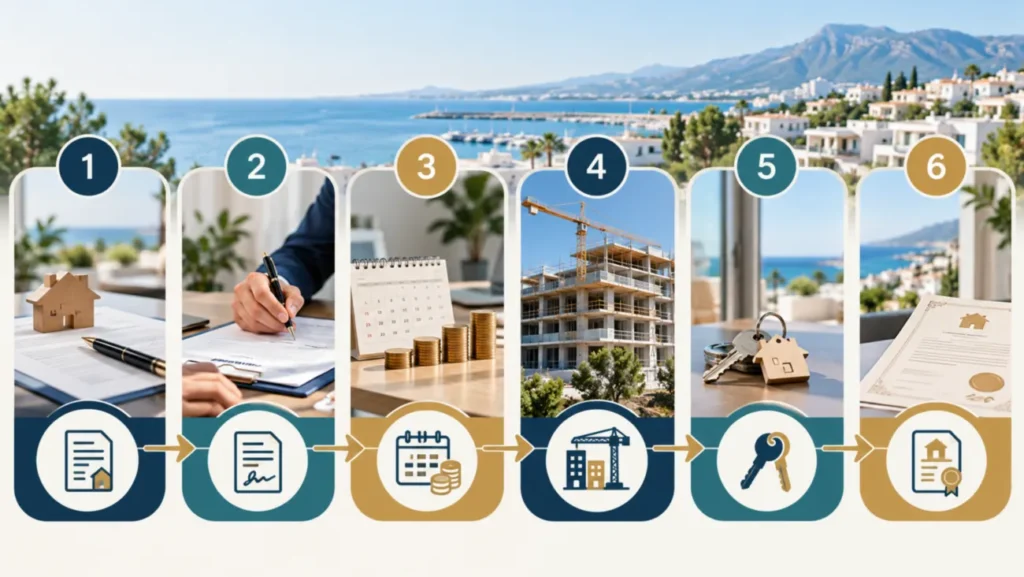
When you find a property you want to buy in North Cyprus, the transaction does not begin with a single large transfer. It follows a sequence of stages, each carrying its own payment, documentation and verification requirement. Understanding that sequence from the outset helps you plan your cash flow and avoid being caught unprepared at a critical point.
The process typically starts with a reservation fee — a relatively small sum, often a few thousand pounds or equivalent, paid to take the property off the market while you and your lawyer review the developer’s terms. This amount is usually deducted from the purchase price but is not always refundable if you choose not to proceed; the exact conditions depend entirely on the developer’s agreement.
Once the reservation is confirmed and your lawyer has reviewed the contract, you move to the initial deposit — sometimes called the down payment. This is a more significant sum, with the exact percentage set by the developer’s commercial terms and varying widely between projects and stages of construction. After the deposit is paid and the sale contract is signed, the remaining balance is divided into instalments paid at agreed intervals — monthly, quarterly or tied to construction milestones — until the full purchase price is settled.
Receiving the keys — the handover — is a separate event from the legal transfer of ownership. A buyer may take possession of a completed property and begin living in it or renting it out while the title deed is not yet formally transferred into their name. These two events can be separated by months or longer, depending on the project, outstanding payments, the Permission to Purchase process for foreign buyers, and the administrative position of the development. You can read more about the full buying process in our guide to “How to buy property in North Cyprus“.
Payment Plan Stages
| Stage | What the buyer pays | What to verify | Main risk |
|---|---|---|---|
| Reservation | Reservation fee (fixed amount) | Refund conditions in writing | Non-refundable if you withdraw |
| Contract signing | Initial deposit (percentage varies by contract) | Developer’s legal title, contract terms, registration intention | Money paid before full legal checks are complete |
| Instalment period | Scheduled payments (monthly or milestone-based) | Construction progress or calendar dates match contract | Missing a payment triggering penalty or termination clause |
| Handover | Final or near-final balance (varies by contract) | Snagging list, completion certificate, utilities connected | Receiving keys without title transfer being imminent |
| Title transfer | Any outstanding balance plus transfer fees | Permissions, outstanding encumbrances cleared, contract closed | Transfer delayed due to outstanding developer obligations or permissions |
After each payment, obtain a written receipt from the developer confirming the amount, date, currency, the property it relates to and the remaining balance. If payments are made by bank transfer, retain the transfer confirmation from your bank as well. Your lawyer should hold copies of all these documents alongside your registered contract.
Types of Property Payment Plans
Developers in North Cyprus use several distinct financing models, and the differences between them matter significantly to your total cost and financial exposure. It is worth understanding each model before comparing specific projects.
Interest-Free Instalments
Direct developer instalment plans are available on selected off-plan and new-build properties in North Cyprus. Under an advertised 0% plan, the agreed price is divided between an initial deposit and scheduled payments without explicit interest being charged. However, the instalment price may differ from the developer’s cash price. Always compare the total amount payable under each option.
The length of the interest-free period varies between projects and developer programmes; some run only for the duration of construction, while others extend for a further period after handover. The terms are set by the developer and may differ between units in the same development, let alone between different projects.
Post-Handover Payment Plans
Some developers offer plans under which a portion of the purchase price remains payable after the keys are handed over. This can be attractive for buyers who intend to use rental income to help meet subsequent instalments, or for those who need time to realise other assets. However, post-handover payments often come with additional contractual conditions: the buyer may be restricted from selling or transferring the property until all instalments are complete, and some contracts impose interest on any balance that remains outstanding beyond a certain point.
Before agreeing to a post-handover arrangement, confirm in writing exactly what rights you have over the property during the period when payments are still ongoing — including whether you can let it, whether the title transfers immediately at handover or only when the final payment clears, and what happens if you fall behind.
Developer Financing and Mortgages
A minority of developers offer formal financing arrangements that function more like a loan than a staged purchase: the balance carries a stated annual interest rate, the term can extend well beyond construction completion, and monthly payments are calculated accordingly. This differs from an interest-free instalment plan in that the total amount repaid exceeds the original agreed price.
Bank mortgages for property in North Cyprus are a separate category. Some local banks do offer mortgage products to foreign buyers, though availability, eligibility criteria, loan-to-value ratios and interest rates vary and are not universally accessible. A foreign buyer should not assume that bank financing will be available or that it will be comparable in cost to mortgage products in their home country. Independent financial advice on this point is advisable.
Is a developer payment plan the same as a mortgage?
No. With a standard developer payment plan, the developer agrees to receive the purchase price in instalments under the sale contract. With a bank mortgage, a lender provides financing under a separate credit agreement, usually subject to income, valuation, security and eligibility requirements.
A longer-term developer financing arrangement may resemble a loan, especially if interest is charged. The label used in marketing is less important than the actual contract terms, security arrangements, total repayment amount and remedies if payments are missed.
Financing Options Compared
| Financing method | Upfront payment | Repayment period | Interest | Main advantage | Main drawback |
|---|---|---|---|---|---|
| Interest-free developer instalments | Deposit set by developer’s terms (varies by project) | Duration of construction (and sometimes beyond) | None on purchase price under stated terms | No explicit financing premium added to agreed price | Requires meaningful upfront capital; instalment price may differ from cash price; conditions vary by contract |
| Post-handover instalments | Varies by contract | Beyond handover, sometimes years | Often none initially; interest may apply later | Reduces cash needed before completion | May restrict sale or rental until balance is cleared |
| Developer financing (with interest) | Varies by contract | Varies by contract | Yes, at agreed rate | Lower initial outlay than full cash payment | Total repayment exceeds purchase price |
| Bank mortgage | Varies by lender | Varies by bank, product and borrower eligibility | Yes, at prevailing rate | Potentially long term; frees capital | Subject to eligibility, valuation, lender criteria |
| Full cash purchase | 100% from buyer’s own funds, payable according to the agreed contract terms | None | None | Simplest structure; no outstanding instalment or mortgage obligations under the purchase arrangement | Requires the full purchase price from the buyer’s own funds |
For buyers with limited savings but steady income, interest-free instalments over a longer term may ease cash flow. Buyers with larger capital reserves should calculate whether a full cash payment or a larger deposit produces a cleaner contractual position. Investors focused on rental income should be cautious about assuming that income will reliably service outstanding instalments — rental yields and occupancy are not guaranteed.
Examples of Developer Payment Plans in North Cyprus
The following examples illustrate how different developers structure their published payment plans. They are not necessarily available for every property or buyer.
| Developer / example | Published deposit | Instalment structure |
|---|---|---|
| Döveç Group — eligible projects | 35% | Remaining 65% on an interest-free schedule agreed for the project and unit |
| Cyprus Constructions — selected projects | 35% | Remaining 65% until construction completion |
| Carrington Group — selected plans | 35% or 50% | Remaining balance over approximately 12–36 months, depending on the plan |
| Afik Group — Caesar Blue example | 30% | Instalments over up to 36 months |
| Kensington Cyprus — K-Islands example | Project-specific | Published 24-month interest-free schedule |
Sources: developer websites and published project information, reviewed October 2026. Offers may change, expire or apply only to selected units. Request a current written quotation before relying on any of these terms.
What to compare: The deposit alone is not enough. Ask whether instalments continue after handover, whether a lower cash price is available, whether payment dates depend on construction progress and when the title deed may be transferred.
Explore at residential developments in Northern Cyprus from the developer


 Iskele
 from 61м²
 Iskelefrom 56м²
 Kyreniafrom 80м²
Deposits and Monthly Instalments
The deposit and the monthly payment are the two figures that most buyers focus on first. But understanding the full picture means working through the numbers more carefully than a single advertisement allows.
The deposit is the share of the purchase price you pay before or at contract signing. Deposit requirements are generally set in the developer’s commercial terms, subject to applicable law, and reflect the project’s funding needs, the stage of construction and the competitive market at the time. Deposit requirements vary widely between developers, projects and individual units. Some published developer plans require deposits of around 30–50%, but lower or higher amounts may be available. Buyers should rely on a current written offer for the specific property rather than assuming a standard market-wide deposit. The deposit is generally non-refundable if you withdraw without cause, which is why legal checks before payment are essential.
The financed balance is simply the purchase price minus the deposit. This is divided by the number of instalments to produce the regular payment. Most interest-free plans use equal monthly instalments, though some use quarterly payments or milestone-linked amounts.
To illustrate how the numbers work in practice, consider three hypothetical scenarios based on a property priced at £150,000. These figures are for illustration only and do not represent the published terms of any specific developer. They exclude taxes, legal fees and all other costs beyond the purchase price.
£150,000 Property Payment Scenarios
| Scenario | Deposit | Balance | Term | Monthly instalment | Total property price |
|---|---|---|---|---|---|
| A — 30% deposit, 36 months | £45,000 | £105,000 | 36 months | £2,916.67 | £150,000 |
| B — 40% deposit, 48 months | £60,000 | £90,000 | 48 months | £1,875.00 | £150,000 |
| C — 50% deposit, 24 months | £75,000 | £75,000 | 24 months | £3,125.00 | £150,000 |
These are illustrative examples only, excluding taxes, legal fees and all additional costs. They do not represent the terms of any specific project or developer.
How Much Cash Do You Need in the First 12 Months?
For a £150,000 property, the first-year commitment can differ substantially even when the overall purchase price is identical.
| Scenario | Initial deposit | First 12 instalments | Total in first year |
|---|---|---|---|
| A — 30%, 36 months | £45,000 | £35,000 | £80,000 |
| B — 40%, 48 months | £60,000 | £22,500 | £82,500 |
| C — 50%, 24 months | £75,000 | £37,500 | £112,500 |
Calculated using the illustrative payment schedules above. Figures exclude taxes, legal and registration fees, currency conversion and other costs.
What does this mean? Scenario B has the lowest monthly payment but requires £82,500 in the first year. Scenario A requires £80,000, despite its higher monthly instalment. Scenario C has the largest first-year commitment at £112,500.
Before choosing a plan, calculate your deposit, all payments due in the first 12 months and a separate reserve for transaction costs and unexpected expenses.
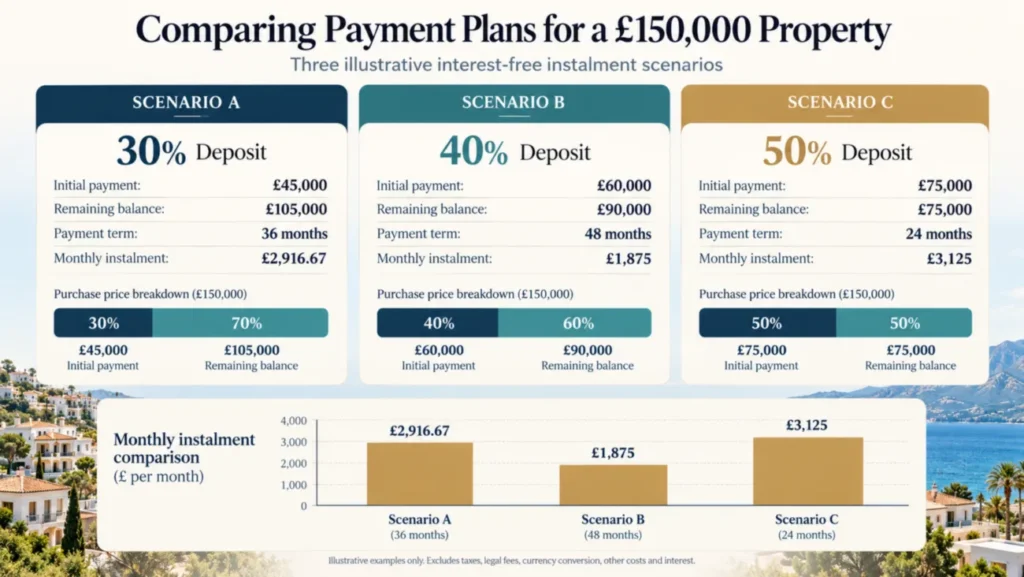
The numbers reveal something that is not always obvious from promotional material: a lower monthly payment does not necessarily indicate a more favourable financial position. Scenario B has the lowest monthly instalment and the longest repayment period, while Scenario C requires the largest deposit but clears the balance fastest. None of these is objectively better — the right choice depends on how much capital you can commit upfront, what cash flow your monthly budget can absorb, and how quickly you want to hold the property unencumbered.
Before comparing payment plans across different projects, calculate the total financial commitment for each one — not just the monthly instalment. A plan that looks comfortable on a monthly basis may require considerably more capital in the first twelve months than you had anticipated.
When reviewing a developer’s payment schedule, ask for the full breakdown in writing: exact deposit amount, payment dates, instalment amounts and the conditions under which the final balance triggers the transfer of title or keys. Verbal agreements are not the basis for managing a multi-year financial commitment.
Take a look at affordable real estate in Northern Cyprus




Costs Beyond the Purchase Price
The purchase price and the payment plan define the cost of the property itself. They do not capture the full financial commitment of buying in North Cyprus.
Costs that arise at or around the time of purchase typically include:
- Stamp duty on the sale contract, payable at a rate set under applicable regulations and usually due within a short window of contract signing. The exact rate and calculation basis should be confirmed with your lawyer, as rules are subject to change and depend on the specific transaction.
- VAT (KDV): VAT treatment depends on the seller’s tax status, the nature of the transaction and the applicable legislation. Buyers should obtain written confirmation of whether VAT is chargeable, the applicable rate and whether it is included in the advertised purchase price.
- Title deed transfer fees: These depend on the buyer’s status, the number and type of properties acquired, and the legislation in force at the relevant stage. Fee regulations were amended in October 2026. Buyers should obtain a written transaction-specific calculation from their lawyer, identifying the applicable rate, payment deadline and any amounts payable before the formal title transfer.
- Legal fees for your independent lawyer. These vary by firm and scope of work. Instructing a lawyer who does not represent the developer is not optional — it is the practical foundation of buyer protection.
- Contract registration fee, for recording your sale contract at the relevant registry, which is an important protective step.
Some taxes and fees may have to be settled before the sale contract can be registered, rather than being deferred until handover or title transfer. The timing and allocation of these payments should be confirmed for the specific transaction.
Contractual costs may include a reservation fee that is not deducted from the purchase price, any service charges or sinking fund contributions required under the development’s management structure, and connection fees for utilities where these are not already installed.
Ongoing costs after completion include maintenance and communal service charges, property insurance, and any costs associated with furnishing or fitting out the property if it is delivered as a shell. Management fees may also apply if you appoint a third party to let, maintain or oversee the property.
The party legally responsible for a tax or fee may differ from the party contractually required to fund it. Both must be checked before signing.
Currency conversion is a cost that buyers sometimes underestimate. Most North Cyprus properties are priced in British pounds sterling, but buyers with income in euros or US dollars will pay exchange rate-related costs on every transfer. These include the conversion spread between the mid-market rate and the rate your bank applies, and potentially wire transfer fees. Over a 36- or 48-month instalment period, exchange rate movements can alter the real cost of each instalment significantly. The Northern Cyprus Central Bank’s exchange rate data provides a useful reference point for historical rate movement, but the official reference rate is not the same as the rate a commercial bank will offer for your transaction.
You can find a detailed breakdown of applicable taxes in our guide to “North Cyprus property taxes“.
The key practical point is this: the monthly instalment figure you see in an advertisement reflects the developer’s instalment structure, not your total monthly outgoing. A budget built only on the advertised payment schedule will fall short of the actual financial requirement.
Payment Schedule and Handover
How instalments are structured within a payment plan has direct implications for your risk exposure, especially when the property is still under construction.
There are two broad approaches. Fixed-date (calendar-linked) schedules require payment on specified dates — for example, the first of each month — regardless of how construction is progressing. These give buyers predictable cash flow planning but create a structural tension: you may be obliged to make a scheduled payment even if the development has fallen behind the anticipated timetable.
Milestone-based (construction-linked) schedules tie each payment to the completion of a specified stage: foundation, structure, roof, fitting-out, handover. In principle, this means money flows to the developer only when verifiable progress has been made. In practice, it requires a clear definition in the contract of what each milestone means, how it is confirmed, and who is responsible for verifying it. An independent inspection at key stages is good practice and something worth discussing with your lawyer before signing.
A typical off-plan construction sequence might progress through the following stages, though the exact order and what each involves is specific to the project:
- Contract signing
- Foundation and groundwork
- Structural frame
- External envelope (roof, windows)
- Internal fit-out and services
- Building completion and snagging
- Handover of keys to buyer
- Title deed transfer (at this point or later, subject to permissions and outstanding balances)
The handover of keys and the formal transfer of title are not the same event. A buyer may receive the keys and begin using the property before the title deed is registered in their name. The gap between these events can be weeks, months or longer, depending on whether outstanding permissions, payments or administrative steps remain. This is not unusual in the North Cyprus market, but it should be anticipated and understood before you sign.
Fixed-Date vs Milestone-Based Payments
| Factor | Fixed-date schedule | Milestone-based schedule | Buyer consideration |
|---|---|---|---|
| Payment trigger | Calendar date | Defined construction stage | Milestone-based reduces risk of paying for work not yet done |
| Predictability | High — easy to plan cash flow | Lower — timeline depends on construction | Fixed-date schedules are simpler to budget for |
| Developer delay impact | Buyer still pays on schedule | Payment may be deferred if milestone not reached (subject to contract) | Contract must define what happens when milestones are delayed |
| Verification requirement | None — date-driven | Independent inspection or developer certificate | Buyers should require evidence before milestone payment |
| Dispute risk | Low regarding trigger; higher if construction stalls | Higher if milestone definition is ambiguous | Clear contract language on milestone criteria is essential |
Example: Construction Milestone Payment Schedule
The example below shows how a £150,000 property purchase could be structured with payments linked to construction progress.
| Payment trigger | Share of price | Amount | Cumulative paid |
|---|---|---|---|
| Contract signing, after legal checks | 30% | £45,000 | £45,000 |
| Verified foundation completion | 15% | £22,500 | £67,500 |
| Verified structural frame completion | 20% | £30,000 | £97,500 |
| Roof, external walls and windows completed | 15% | £22,500 | £120,000 |
| Completion inspection and agreed handover conditions | 15% | £22,500 | £142,500 |
| Final contractual milestone | 5% | £7,500 | £150,000 |
Hypothetical example only. This is not a published developer offer or a legally prescribed payment schedule.
Before paying a construction-linked instalment, ask what evidence confirms that the milestone has been reached. The contract should identify the required documents, inspection method, payment deadline and procedure if the buyer disputes completion.
Important: A final contractual payment does not automatically guarantee that the title deed will be transferred at the same time. Title transfer may depend on separate permissions, registration requirements and other obligations.
If a calendar-based payment date arrives and the project is significantly delayed, the options available to you depend on the contract and the applicable law. A construction delay does not necessarily entitle the buyer to suspend scheduled payments. Whether payments can be withheld, the contract terminated or compensation claimed depends on the agreement, the applicable law and the specific circumstances. Buyers should obtain legal advice before withholding an instalment, as doing so without a valid basis could constitute a contractual breach. Contracts that address delay should specify acceptable delays, remedies available to the buyer, and the conditions under which either party may exit the agreement. Contracts that are silent on delay leave the buyer in a significantly weaker position.
For more detail on what to expect when buying before a property is built, see our guide to “Buying off-plan property in North Cyprus“.
The terms governing construction delays, milestone confirmation and payment obligations should be agreed in writing before you sign the contract — not negotiated after a problem arises. Vague language about “best efforts” or “estimated completion dates” is not a contractual protection.
Legal Checks Before Paying
No payment plan, however attractive its monthly figures, compensates for a legal problem with the underlying property. The due diligence you carry out before signing — and before paying — is the most consequential step in the entire transaction.

The legal landscape in North Cyprus requires particular care. The territory has a specific international legal status that differs from the Republic of Cyprus, and property rights on the island have a complex history. Property ownership in Northern Cyprus involves legal risks that extend beyond the rules administered locally. Some properties are situated on land claimed by people displaced in 1974. Depending on the property’s history and the circumstances of the transaction, buyers may face ownership disputes, proceedings in the Republic of Cyprus or attempts to enforce judgments in other jurisdictions. Certain transactions involving property without the legally recognised owner’s consent may also have criminal-law implications under Republic of Cyprus legislation. The UK Government’s guidance on buying property in Cyprus directly addresses these risks and recommends that buyers seek independent legal advice before committing. An independent lawyer should investigate the property’s title history and explain the risks applicable to the specific property before the buyer commits funds.
Your lawyer should act independently in your interests and should not simultaneously represent the developer or seller in a way that creates a conflict of interest. If a lawyer is recommended by an agent, check their independence, professional credentials and any referral or financial arrangements before instructing them.
What your independent lawyer should verify before you pay:
- Title status: What type of title deed is associated with the property? What is its origin? Are there any competing claims or unresolved disputes connected to the land?
- Developer’s legal authority to sell: Does the developer own the land, or do they have a legally sound arrangement that entitles them to sell units?
- Encumbrances and charges: Is the land subject to any mortgage, charge, lien or third-party claim that could affect the buyer’s ability to secure clean title?
- Planning and building permissions: Does the development have the relevant approvals? Are the permissions consistent with what is being built and sold?
- Contract registration: For foreign buyers entering into new purchase agreements, registration of the duly stamped sale contract with the relevant District Land Registry is a time-sensitive legal requirement. Under Decree-Law 119/2026, the applicable procedure generally requires registration of the contract and submission of the Permission to Purchase application within one month, together with payment of the taxes and fees required at that stage. Failure to comply may result in the contract becoming automatically void. Different transitional provisions may apply to older agreements. Your independent lawyer should confirm the applicable deadlines, payment obligations and registration requirements before signing.
- Permission to Purchase: Foreign buyers in North Cyprus are generally required to apply for permission from the relevant ministry before a title deed can be transferred into their name. Has this been initiated? What is the expected timeline? You can find more detail on this in our guide to “North Cyprus Permission to Purchase“.
- Title transfer conditions: Under what conditions and at what point does the contract provide for title to transfer? Is this at handover, at final payment, upon receipt of Permission to Purchase, or some combination?
- Restrictions on use or disposal: Does the contract restrict your ability to let, sell or otherwise deal with the property before the final payment is made and title has transferred?
The relevant official procedural information for foreign buyers in North Cyprus — including matters related to Permission to Purchase applications — is published by the Immovable Property Unit of the Northern Cyprus Ministry of Interior. The acquisition rules currently in force were introduced by Decree-Law 119/2026, published in Official Gazette № 196 of 6 October 2026, with related fee regulations set out in Official Gazette № 197 of 7 October 2026. Your lawyer should verify the current applicable provisions at the time of your transaction.
A principle worth holding clearly in mind:
Payment of the purchase price, physical possession of the property and registration of legal ownership are three distinct events. Each may happen at a different time. Until title is formally registered in your name, the legal protections available to you depend on what your registered contract says — not simply on how much you have paid or whether you are living in the property.
For detailed guidance on property title categories in North Cyprus, see our article on “North Cyprus title deeds explained“.
Questions to put to your independent lawyer before paying the initial deposit:
- What type of title deed does this property carry, and what is its origin?
- Is the developer’s right to sell this property legally clear and documented?
- Are there any charges, mortgages or third-party claims registered against the land?
- Has the development received all required planning and building permissions?
- What is the statutory deadline for registering my contract, who will complete the registration, and when will I receive documentary proof?
- What are the precise conditions under which title transfers to me?
- What restrictions apply to my use or disposal of the property while payments are outstanding?
- What is the position on Permission to Purchase for a buyer in my circumstances?
- If the developer fails financially or the project is abandoned, what contractual protections do I have?
Want to Compare Properties Before Making a Deposit?
Tell us your preferred location, budget and deposit range. Cypria Homes can help you shortlist available properties and request written payment schedules. Independent legal checks should be completed before committing funds.Compare Available Properties
Risks and Contract Clauses
Understanding the risks attached to property payment plans helps you recognise what to look for in a contract — and what to push back on — before you commit.
Construction delay is an important risk in off-plan purchases. Delays can arise from contractor issues, material supply, planning complications or the developer’s own financial position. Unless the contract addresses delay explicitly, the buyer may have limited recourse.
Project failure is a more serious scenario. If a developer encounters significant financial difficulty and construction stops, buyers who have already made substantial payments face a difficult position. Buyers should not assume that their payments are protected by an escrow arrangement or government guarantee — such mechanisms are not universal and cannot be presumed to exist without explicit verification in the specific project. The protections available to a buyer in this situation depend on what the contract says, whether the contract is registered, whether any security was provided, and what assets the developer holds.
Late payment by the buyer typically triggers the penalty provisions in the contract. These may include a stated rate of interest on overdue amounts, a formal notice period, and ultimately a termination clause allowing the developer to cancel the contract. A contract may provide for penalties, deductions or forfeiture of payments following termination. However, whether a particular provision is legally enforceable depends on the applicable law, the wording of the agreement and the circumstances of the dispute. Buyers should have these clauses independently reviewed rather than assuming that every contractual penalty will automatically be enforceable.
Assignment — selling your contractual interest to another buyer before completion — may or may not be permitted by the contract. If you are buying speculatively with the intention of assigning before handover, this must be explicitly addressed in the agreement.
Currency risk: Exchange-rate movements can materially affect the cost of a multi-year instalment plan when the buyer’s income and contractual payments are denominated in different currencies. Even when the sterling instalment remains fixed, its cost in the buyer’s home currency may increase or decrease substantially. Buyers should stress-test their budget against adverse exchange-rate movements rather than planning on current rates holding.
Contract Clauses to Check Before Signing
- Deposit refund conditions: Under what circumstances, if any, is the deposit refundable? What notice or process is required?
- Delay provisions: What counts as an acceptable delay? What remedy does the buyer have if the project is materially late?
- Late payment penalty: What interest rate applies? After what period? Is there a cure period before termination can be invoked?
- Termination and forfeiture: If the contract is terminated by the developer, how much of the money paid does the buyer recover?
- Title transfer conditions: Is transfer contingent on final payment only, or on other conditions such as Permission to Purchase?
- Assignment rights: Can you transfer your contractual position to another buyer? Under what conditions?
- Developer insolvency: Is there any provision — escrow, bond, bank guarantee — that protects buyer payments if the developer fails? (Do not assume this exists; ask explicitly.)
- Variation of contract terms: Under what conditions, if any, can the developer modify the specification, layout or completion timeline?
- Post-handover restrictions: If payments continue beyond handover, what are you prohibited from doing with the property?
- Dispute resolution: Which law governs the contract, and what mechanism applies in the event of a dispute?
For a fuller discussion of legal exposure, see our guide to “Risks of buying property in North Cyprus“.
Choosing the Right Payment Plan
Once you understand the mechanics, types and risks of different plans, the question becomes which structure suits your particular financial position and purpose.
Buyer A — Limited Upfront Capital
If your savings are modest but your income is stable, the key figure to focus on is the monthly instalment relative to your disposable income — not the total purchase price or the deposit as an abstract percentage. A lower deposit requirement makes entry possible, but a longer term with lower monthly payments may stretch the commitment beyond what is comfortable for an extended period.
For this profile, compare the total amount required in the first twelve months across different plans — deposit plus the first year of instalments. That figure, not the monthly payment alone, reveals the real initial burden. Also consider: if income dips for any reason, what is the contractual position if you miss or delay a payment?
Main risk: monthly payment obligations becoming difficult to sustain if circumstances change. Reason to look beyond 0%: the headline rate tells you nothing about the refund terms, milestone protection or what happens if the developer runs into difficulty.
Buyer B — Larger Savings
Buyers with substantial capital available face a different question: is it better to pay a larger deposit, negotiate a cash discount or use the instalment plan and retain capital for other purposes? A developer may be willing to offer a reduced price for a higher upfront payment, particularly for completed or near-completed stock. Even at 0% interest, the financial attractiveness of an instalment plan depends on the price compared with a cash purchase, the timing of payments and the alternative uses of the buyer’s capital. A payment plan may preserve liquidity, while an upfront payment may qualify for a discount. Both options should be compared using their total costs and payment schedules.
Main risk: committing a large deposit to a project before legal checks are complete. Reason to look beyond 0%: a larger upfront payment might unlock a better price, but only if the contractual and legal position is sound.
Buyer C — Rental Property Investor
An investor intending to let the property needs to reconcile the instalment schedule with rental income expectations — and keep the two firmly separate in their planning. Rental income from North Cyprus property is not guaranteed, and it fluctuates with occupancy, management quality, the market and the condition of the property. Using projected rental income as the assumed source of instalment payments creates a material risk if the property sits empty, requires unexpected maintenance or the buyer is not permitted to let the property under the applicable contract or regulations. Rental use may be restricted by the purchase contract, the development’s management rules, licensing requirements or other applicable rules. Buyers should not assume that receiving the keys automatically gives them an unrestricted right to let the property.
Main risk: assuming rental income that does not materialise at the level or timing needed to service ongoing payments. Reason to look beyond 0%: restrictions on letting during the payment period may mean the property generates no income at precisely the period when commitments are highest.
The location of the property you are considering will influence its practical use, potential rental demand and resale market — factors explored in our guide to the “Best areas to buy property in North Cyprus“.
How to Buy with Instalments
The following sequence applies to most instalment purchases in North Cyprus, though the precise steps and their order will be shaped by the specific transaction.
- Define your total budget. Before viewing properties, establish the full amount you can allocate — not just the deposit, but the combined cost of deposit, all instalments, taxes, legal fees and currency conversion. This prevents you from selecting a property on the strength of the monthly payment alone.
- Compare available properties and payment terms. Request written payment schedules from developers or agents for any property you are seriously considering. A verbal summary is not sufficient for financial planning.
- Request a written payment schedule. This should specify the deposit amount and due date, each instalment date and amount, the currency, and the conditions triggering the final balance. If a schedule is not available in writing, that is itself a signal worth noting.
- Appoint an independent lawyer. Instruct an independent local lawyer who acts in your interests and has no conflict of interest with the developer, seller or agent before committing to any payment. Initial legal advice is available before you travel to North Cyprus, and there is no need to sign a contract under time pressure.
- Complete property and developer checks. Your lawyer should verify the title position, developer’s authority, encumbrances, permissions and the contract’s protective provisions before you pay a non-refundable amount. If a reservation fee is proposed before full due diligence, require clear written refund conditions, confirm who holds the funds and have your lawyer review the arrangement.
- Review the sale contract. Read the full contract, not just the headline terms. Pay particular attention to the clauses identified in the previous section. Ask your lawyer to explain any provision you do not understand.
- Verify payment instructions and recipient details. Before making any transfer, verify the recipient’s bank details through an independent communication channel, such as calling a previously verified telephone number. Do not rely solely on payment instructions received by email or messaging apps. Conveyancing fraud — where criminals intercept payment instructions and substitute their own account details — is a known risk in international property transactions.
- Make payments and retain documentation. For each payment, obtain a written receipt from the developer and retain your bank’s transfer confirmation. These documents form your record of what has been paid and when.
- Complete handover and ownership formalities when applicable. When the property is ready and all relevant steps have been completed, attend the handover with your lawyer, carry out a snagging inspection, and ensure you understand what steps remain before title formally transfers into your name.
For buyers purchasing from outside North Cyprus, international bank transfers are one method used for overseas property purchases, but banking availability, compliance checks, fees and processing requirements vary. Confirm that both the sending and receiving banks can process the proposed transaction before committing to payment deadlines. Additional identity verification and documentation of the source of funds may be required by your bank or the receiving bank.
Ready to Find a North Cyprus Property with Instalments?
Start with your budget, available deposit and preferred payment period. We will help you compare suitable properties, subject to current availability and developer terms.
Get a Personalised Property Selection
Final Thoughts
A payment plan that suits your situation is not simply the one with the smallest monthly instalment or the lowest advertised deposit. The right plan balances what you can pay upfront, what you can reliably commit to each month, how long you are comfortable carrying the obligation, and — critically — how well the underlying property and contract hold up to scrutiny.
Before comparing headline payment terms across projects, ensure that the legal foundation is sound. A favourable instalment schedule on a property with title problems, an unregistered contract or inadequate protection against developer delay is not a good outcome at any price.
Compare the total cost over the full instalment period, account for taxes and fees, factor in currency if your income is not in sterling, and verify in writing what happens at handover, at final payment and at title transfer. Review the contract with an independent lawyer before you pay anything that is not fully refundable.
The developers and payment plans worth working with are those willing to provide clear written documentation at every stage and whose contractual terms reflect a straightforward transaction between parties dealing in good faith. If terms are vague, pressure is applied to sign quickly, or written documentation is slow to materialise, those are signals to pause and verify rather than reasons to move faster.
North Cyprus offers genuine variety of property types, locations and price points — alongside a property market that rewards buyers who take the time to understand what they are committing to before they commit.
 Real estate in Georgia
 Real estate in Montenegro
 Real estate in the UAE
 Real estate in Bali
 Real estate in Thailand
 Real estate in Spain
 Real estate in Saudi Arabia
 Real estate in Turkey
 Real estate in Zanzibar
 +90 533 888 29 50
 hello@cypria.homes
 Karsıyaka Sokak 8, Girne




 Get catalogue of TOP-7 objects