
 +90 533 888 29 50


Last reviewed: August 2026. Foreign-buyer property rules in North Cyprus have changed repeatedly in recent years. Always verify the current requirements before entering a transaction.
A sea-view apartment may look straightforward until the buyer asks a more important question: what exactly is registered at the Land Registry?
North Cyprus Title Deeds: Quick Answer
| Question | Short answer |
|---|---|
| What is a Koçan? | The Land Registry document recording registered ownership of immovable property. |
| What title labels will I commonly see? | Pre-1974 Turkish/Turkish Cypriot, Exchange/Eşdeğer and Tahsis/TMD, plus some pre-1974 foreign ownership histories. |
| Is one title automatically “safe”? | No. Historical title type is only one part of the assessment; the current owner, encumbrances, planning status, unit registration and pre-1974 history must also be checked. |
| Is a sales contract the same as ownership? | No. A contract does not itself make the buyer the registered owner. |
| Can a foreign buyer receive the title in their own name? | Yes, subject to the Permission to Purchase rules and other transfer requirements in force at the time. |
| Can an off-plan apartment have no final individual deed yet? | Yes. The buyer should check the underlying land title and whether kat irtifakı or another recognised registration exists. |
| What should happen before a substantial deposit? | Independent verification of the registered owner, parcel, encumbrances, unit status, planning approvals and the seller’s authority to sell. |
The Title Check in 7 Questions
- Who is registered as owner?
- Which parcel is registered?
- Are mortgages or charges recorded?
- What is the title’s historical origin?
- Does the exact unit have an individual title or kat irtifakı?
- Are planning and construction approvals in place?
- What must still happen before transfer into the buyer’s name?
If one of these seven questions cannot be answered clearly, the buyer does not yet have enough information to judge the title.
The key point: “The property has a Koçan” is not enough. A buyer needs to know which property is registered, whose name it is in, what affects it, and whether the exact unit being purchased can ultimately be transferred.
A North Cyprus title deed, commonly called a Koçan, records registered ownership of immovable property. Buyers should distinguish the historical category of the underlying title from the registration status of the specific apartment or villa, and verify both through independent legal due diligence.
Two properties on the same street can carry entirely different title histories. One may sit on land registered to a Turkish Cypriot owner from before 1974. Another may carry a post-1974 exchange or allocation title, with the individual apartment not yet separated into a standalone deed at all. From the outside, both look like “titled properties.” From a legal standpoint, they raise very different questions.
This guide works through the terminology buyers encounter, explains what it means in practice, shows how to read the key fields on a title document, and sets out what an independent lawyer should verify before any substantial payment is made. The UK Government’s guidance on buying property in Cyprus recommends obtaining independent legal advice, and notes specific considerations for buyers in the north of the island — advice that applies regardless of which title category a property carries.
Not sure which North Cyprus properties fit your budget and buying scenario?
Answer 4 short questions and receive a personalised selection of projects to compare.
[Start property selection →]
What Is a Koçan?
In North Cyprus, the word Koçan refers to the official title deed document issued by the Land Registry (Tapu Dairesi). It records registered ownership of a specific piece of immovable property — a plot of land, a house, a villa, or in some cases an individual apartment unit.
Holding a Koçan is not the same as being free from risk. The document records ownership as it stood at registration. It does not automatically confirm that no mortgage, charge, restriction or third-party claim has since been registered against the property. For that, a current Land Registry search is required.
Three concepts that buyers frequently conflate are worth separating clearly:
- The Koçan (title deed): the document recording registered ownership at a point in time.
- The sales contract: a legal agreement between buyer and seller, but not itself proof of ownership transfer.
- Registered ownership: the legal status that exists when the title has been properly transferred and recorded in the buyer’s name at the Land Registry.
Signing a contract does not make the buyer the registered owner. Receiving a copy of the seller’s Koçan does not confirm what encumbrances currently affect the property. A copy of the deed shown by a seller or agent must be verified against current Land Registry records, not taken at face value.
A title deed category describes part of the property’s legal history. It does not replace a current Land Registry search.
Main Title Deed Types
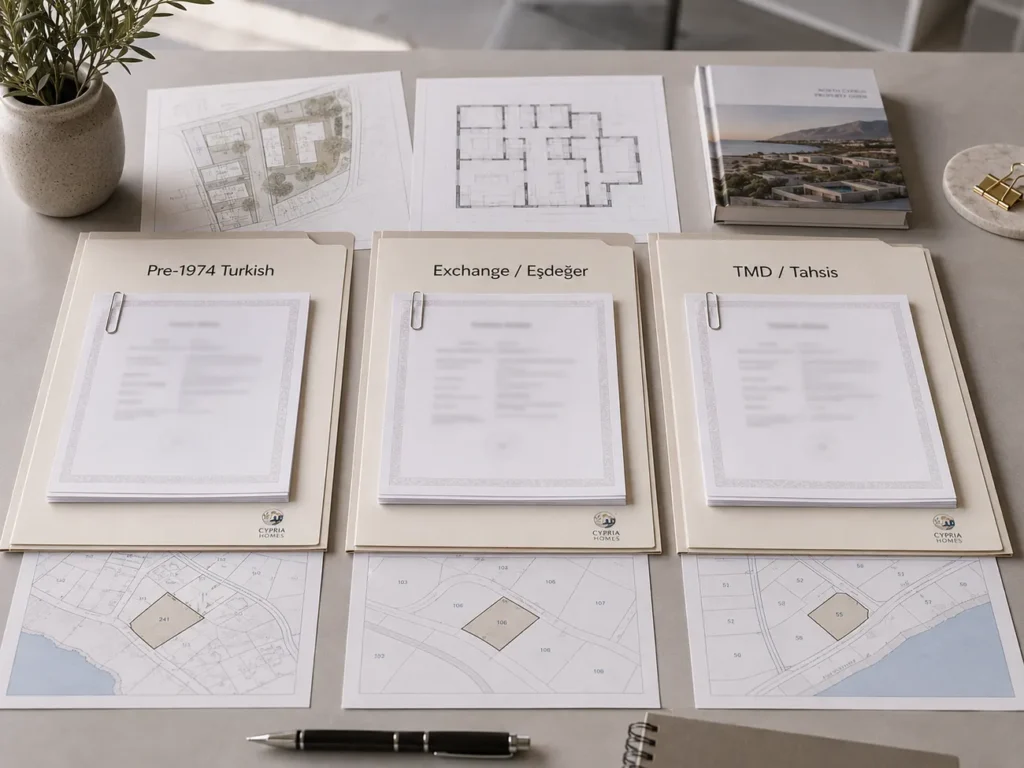
Property advertisements and advisers commonly use several labels to describe the historical origin of a title, including Pre-1974 Turkish/Turkish Cypriot title, Exchange/Eşdeğer and Tahsis/TMD. Pre-1974 foreign ownership may also appear in the historical record of a given parcel. These labels should be treated as a starting point for due diligence rather than as an exhaustive statutory classification — different agents and developers use them inconsistently, and the terminology does not always map neatly to a single official legal category.
Understanding why these categories exist matters as much as knowing their names. A category label on its own does not tell the buyer whether this particular property, this particular parcel, and this particular seller’s interest are free of charges, restrictions or complications.
Title Types at a Glance
| Market label | Historical background | What it does not tell you | Buyer’s next question |
|---|---|---|---|
| Pre-1974 Turkish/Turkish Cypriot | Registered to a Turkish Cypriot owner before 1974 | Whether there are current mortgages, restrictions or unit-registration problems | Is this exact property clear and transferable today? |
| Exchange / Eşdeğer | Linked to post-1974 exchange arrangements | Whether historical claims or current encumbrances affect this parcel | What is the pre-1974 history and current Land Registry position? |
| Tahsis / TMD | Linked to post-1974 allocation | Whether the specific allocation history creates additional issues | What is the exact legal basis and registration history? |
| Pre-1974 foreign ownership | Foreign ownership appearing in the pre-1974 record | Current ownership and current encumbrances | Does the historical record match the present Land Registry record? |
Do not choose a property solely by the label printed in an advertisement. The title history and the current registration position are separate questions.
Pre-1974 Turkish Title
A Pre-1974 Turkish — or Turkish Cypriot — title deed refers to land or property that was registered in the name of a Turkish Cypriot owner prior to the events of 1974. The historical ownership chain predates the division of the island, which means it does not involve a post-1974 exchange or state allocation.
Some market participants describe this category as carrying fewer complications than post-1974 titles. That characterisation has a basis in the historical record, but it does not license replacing legal due diligence with a category label. Even a Pre-1974 Turkish title deed does not automatically confirm the absence of mortgages, registered charges, planning violations, shared ownership interests, or unresolved encumbrances. Nor does the historical category address whether the specific apartment being purchased has its own individual deed, or whether the seller has the legal authority to complete the transaction.
The UK Government’s guidance on buying property in Cyprus specifically draws attention to ownership questions in the north of the island and advises buyers to seek independent legal advice regardless of which category of title deed is presented.
Exchange / Eşdeğer Title
The Exchange title — sometimes written as Eşdeğer (meaning “equivalent” in Turkish) — originates in post-1974 property arrangements, under which properties in the north were allocated to or exchanged with Turkish Cypriot families who had left properties in the south. The underlying principle was one of equivalence: land or property of comparable value assigned in exchange.
Exchange-titled properties are actively traded in the local market, but the existence of such transactions should not be treated as evidence that every parcel carries the same legal risk profile. Describing an Exchange title as “identical to a Turkish title” oversimplifies a distinct legal history. The category reflects a post-1974 administrative process, and the specific circumstances of each parcel can differ.
The pre-1974 history of the underlying land, the current registered owner, the presence of any encumbrances, and the registration status of the individual unit all require separate verification. No blanket category verdict replaces case-specific legal analysis. The cross-jurisdiction dimension of Exchange-titled property is addressed in the section on pre-1974 ownership below.
Tahsis / TMD / Allocation Title
Tahsis — meaning allocation in Turkish — refers to property assigned through a post-1974 administrative process, typically by state authority. The label TMD is a market term commonly used in connection with such property; buyers should ask their independent lawyer to confirm the exact legal basis, registration history and current Land Registry status of the specific parcel rather than relying on the label alone.
No universal rule applies here. The legal position of an allocation-related property depends on the specific registration history, underlying rights and current Land Registry record. Both the historical origin and the current registered position require independent verification.
Which Title Type Should a Buyer Prefer?
There is no title label that removes the need for due diligence.
A Pre-1974 Turkish/Turkish Cypriot ownership history may be perceived as more straightforward because the historical chain predates the post-1974 exchange and allocation systems. That does not establish that the present property is free of mortgages, planning issues or registration problems.
An Exchange/Eşdeğer property requires the buyer to understand both the current Land Registry position and the pre-1974 history of the underlying parcel.
A Tahsis/allocation-related property requires case-specific review of the basis on which the property was allocated and its subsequent registration history.
For a buyer, therefore, the more useful hierarchy is not “best title → worst title”, but:
- Can the exact registered property be identified?
- Is the seller entitled to sell it?
- Are there mortgages, charges or restrictions?
- Does the individual apartment or villa have the required registration?
- Are its planning and construction approvals in order?
- What does its pre-1974 history mean for this particular transaction?
- Can the buyer satisfy the current transfer and PTP requirements?
A historically straightforward title with a current mortgage or registration problem may be a worse purchase than another title that has been fully investigated and properly structured.
Explore current North Cyprus projects





Other Terminology Buyers May Encounter
Market materials are not standardised. Buyers may also encounter references to former Greek Cypriot-owned property and to property registered to foreign or British owners before 1974. These descriptions concern the historical ownership record and should likewise be verified against the relevant Land Registry records. If a developer or agent uses a title category term not covered here, that is a reason to ask for the precise Land Registry designation — not to assume equivalence with a familiar category.
How to Read a Title Deed

Terms You May See on a Koçan
| Term | What the buyer should identify |
|---|---|
| Koçan No | The registration/title reference |
| Kaza | District |
| Köy / Mahalle | Village or locality |
| Pafta / Harita No | Map or cadastral-sheet reference |
| Parsel No | Parcel number |
| Mal Sahibi / registered owner details | The person or persons recorded as owners |
| Hisse / share | Whether ownership covers the whole property or only a proportional interest |
| Property description | Whether the record concerns land, a building or an individual unit |
Do not compare only the owner’s name. The Koçan number, cadastral references and parcel details should be cross-checked against the contract, cadastral plan and the physical property being sold.
Understanding what a Koçan actually contains gives buyers a better foundation for the conversation with their lawyer. While specific formats and fields can vary, a North Cyprus title deed will typically record information across several key areas.
Table 2 — Reading a Koçan
| Field / information | Meaning | Buyer check |
|---|---|---|
| Koçan / registration number | Unique identifier for this registration | Confirm number matches official Land Registry records |
| District and village/locality | Geographic registration area | Matches property address and cadastral plan |
| Plot or parcel details | The specific land parcel registered | Verify parcel boundaries match what is being sold |
| Registered owner | Name(s) of the legal owner on record | Must match the seller; any discrepancy requires explanation |
| Shares / proportional interest | Ownership proportion (relevant for shared titles) | Confirm share being sold and total ownership structure |
| Acquisition information | How the current owner obtained the property (purchase, inheritance, etc.) | Part of the ownership chain review |
| Previous registration references | Prior registrations linked to this parcel | Supports full chain verification |
| Property description | Type of property registered (land, building, apartment) | Must correspond to the unit being purchased |
Close examination of the registration number, parcel details and registered owner name forms the minimum starting point. The document shown by a seller must correspond to the exact parcel and ownership interest being sold — not an adjacent plot, a larger parcel of which a unit forms only a part, or a deed in the name of a third party.
Title Deed vs Individual Property Title: What Is the Difference?
One of the most common sources of confusion in the North Cyprus property market is the conflation of two separate questions.
The first is the historical origin label of the title: Pre-1974 Turkish, Exchange, or Tahsis. The second is the registration status of the specific unit being purchased — whether an individual title deed exists for that apartment or villa, or whether the buyer is purchasing within a development where the land has a title but individual units have not yet been formally separated.
These two questions are independent of each other and both require answers.
A developer may own land with a clear Pre-1974 Turkish title. That tells the buyer something about the land’s historical ownership chain. It says nothing about whether an individual apartment deed has been issued for Unit 12 on Floor 3 — or whether one can be issued under current planning and construction approvals.
Three scenarios illustrate why this distinction matters:
Buyer A purchases a completed resale apartment with an individual title deed registered in the seller’s name. The relevant questions are: who is the registered owner, are there charges against this specific unit, does the parcel match the apartment, and what is required to transfer?
Buyer B purchases an apartment in a completed development where the developer holds a land title but individual unit deeds have not been separated and registered. The land title category tells part of the story. The buyer also needs to understand the subdivision process, what approvals are outstanding, whether any mortgage against the land has been discharged for individual units, and what the contractual mechanism for eventual transfer looks like.
Buyer C buys off-plan before construction is complete and before a final individual unit title can exist. The buyer is relying on the developer’s land title, the terms of the contract, and a future process that has not yet occurred.
Developer ownership of titled land does not automatically mean the buyer already has an individual apartment title.
Three Very Different Buying Situations
| Situation | What exists today | What the buyer relies on | Main checks |
|---|---|---|---|
| Completed resale with individual deed | Separate title already registered for the unit | Existing registered title | Owner, encumbrances, parcel/unit match, PTP and transfer |
| Completed development without individual title | Development land/title exists but unit separation is incomplete | Land registration + contract + subdivision/registration process | Land mortgage, approvals, subdivision status, developer obligation |
| Off-plan property | Final unit title may not yet exist | Land registration, contract, permits and any kat irtifakı | Landowner, charges, permits, kat irtifakı, completion and title-transfer obligations |
For a first-time foreign buyer, the phrase “title deed available” should always be followed by one question: “Title deed for what exactly — the land, the development, or my individual unit?”
North Cyprus legislation recognises kat mülkiyeti (ownership of an independent unit) and kat irtifakı — a legally recognised easement established in relation to independent sections of a building that is planned or under construction, with a view to future kat mülkiyeti — under Law No. 35/2010. Buyers should ask their lawyer to establish whether either form of registration has already been created for the property, what rights that registration gives them at the relevant stage of the development, and what is required before full individual ownership can be transferred.
Why Pre-1974 Ownership Matters
The division of the island in 1974 created a property situation with consequences that remain legally relevant. Prior to 1974, Cyprus was administered as a single territory. Property ownership — whether by Greek Cypriots, Turkish Cypriots, British nationals, or others — was recorded under a unified system.
After 1974, the northern part of the island came under separate administration, and properties were redistributed through various allocation and exchange mechanisms. Greek Cypriot owners who had left properties in the north, and Turkish Cypriot owners who had left properties in the south, were affected differently depending on their individual circumstances.
This history explains why North Cyprus title deeds are categorised the way they are. Pre-1974 Turkish titles reflect ownership that predates the division. Exchange titles reflect post-1974 redistributions. Allocation titles reflect administrative assignments of property.
The Immovable Property Commission (IPC) operates under Law No. 67/2005 as a domestic mechanism for claims concerning certain properties affected by the events of 1974, with remedies including compensation, exchange and, where applicable, restitution. The continued existence of this claims mechanism means pre-1974 ownership history remains relevant to legal due diligence.
A locally registered title and the pre-1974 history of the land answer two different legal questions. Buyers should understand both.
Buyers should also understand that registration in the land system administered in Northern Cyprus does not by itself resolve every question concerning pre-1974 ownership claims. Some properties in the north remain subject to competing claims arising from the events of 1974. The UK Government advises prospective purchasers to consider the potential legal and financial implications of property in the north that was owned by Greek Cypriots before 1974 and was subsequently classified as exchange or “gift” property. It also warns that purchasers could face proceedings in the courts of the Republic of Cyprus and attempts to enforce judgments in other jurisdictions. Independent legal advice should therefore consider both the current local registration and the property’s pre-1974 history.
How to Verify a Title Before Buying

The sequence below reflects what a buyer — working with an independent lawyer — should establish before committing substantial funds, particularly any payment described as non-refundable. A Land Registry search, review of the title document, and confirmation of the registered position are not formalities to complete after the decision is made; they are the basis on which an informed decision can rest.
Before paying a substantial deposit, establish who owns the property, what exactly is registered, and whether any charges affect it.
Due diligence checklist:
- Obtain a copy of the correct title deed — ideally through a direct Land Registry request, not solely from the seller or agent.
- Verify the registered owner’s name and confirm it matches the seller.
- Match the parcel and location details on the deed to the property being offered.
- Confirm that the seller has the legal authority to sell (sole owner, authorised representative, or other basis).
- Have an independent lawyer obtain or arrange the appropriate Land Registry searches for mortgages, registered charges, and any financial encumbrances against the property.
- Check for any restrictions, easements, rights of way or other registered interests affecting use or transfer.
- Establish the historical title category and understand its implications for this specific parcel, including any pre-1974 ownership considerations.
- Verify planning permissions and building approvals relevant to the structure being purchased, using records of the competent planning, building and local authorities.
- Establish whether the unit has an individual title deed, a kat irtifakı, or whether the buyer is purchasing within a shared or undivided structure.
- Understand what steps are required to complete the transfer — including any approvals that remain outstanding.
- Have the sales contract reviewed independently before signing, and confirm the applicable deadline, formalities and legal effect of any contract registration with the Land Registry.
- Confirm Permission to Purchase requirements applicable to the buyer’s nationality and circumstances under the rules in force at the time of the transaction.
Table 3 — Title Due Diligence
| Check | Why it matters | Evidence / document to verify |
|---|---|---|
| Registered owner | Confirms seller has title to sell | Land Registry record / current title deed |
| Parcel match | Ensures deed covers what is being sold | Cadastral plan cross-referenced with deed |
| Encumbrances | Reveals mortgages, charges or restrictions | Land Registry encumbrance search |
| Seller’s authority | Confirms right to transact | Power of attorney, probate or company authority if applicable |
| Title category and pre-1974 history | Historical and cross-jurisdiction context for the parcel | Deed classification, ownership history and independent legal review |
| Individual unit / kat irtifakı status | Confirms what registered interest exists for this unit | Land Registry registration / developer documentation |
| Planning and construction | Confirms legal structure and permitted use | Records of competent planning, building and local authorities |
| PTP requirement | Determines path to legal ownership transfer | Ministry of Interior guidance and application status under current law |
This checklist is a framework. It is not a substitute for legal representation. Buyers are strongly advised to instruct a lawyer who acts independently from the seller, developer and agent — not a lawyer recommended solely by the party selling the property.
What Should You Have After Legal Due Diligence?
Before committing substantial funds, ask your lawyer what documentary evidence supports each conclusion.
| Question | Evidence to ask for or have confirmed |
|---|---|
| Who owns the property? | Current Land Registry/title record |
| Does the deed cover my property? | Koçan details matched against cadastral plan and contract |
| Is it mortgaged or charged? | Current Land Registry search |
| Can the seller legally sell? | Ownership record, POA, probate or company authority where relevant |
| Is my apartment separately registered? | Individual title or kat irtifakı status |
| Is the building legally approved? | Relevant planning and construction approvals |
| What is the pre-1974 history? | Ownership/history review appropriate to the parcel |
| What remains before transfer? | Written explanation of PTP, registration, outstanding approvals and completion conditions |
A buyer should not leave due diligence with only the sentence “the title is fine.” The conclusion should be traceable to identifiable records and documents.
For a wider view of the purchasing process, including contract structures and professional fees, see “How to buy property in North Cyprus“.
Found a property but not sure what its title status means?
Start with a shortlist matched to your budget, preferred location and property type — then apply the due-diligence checklist above before making a decision.
[Get my property shortlist →]
Permission to Purchase and Transfer
Typical Route for a Foreign Buyer
Property selected → Independent title checks → Sales contract → Applicable contract registration → Permission to Purchase application → Outstanding transfer conditions completed → Title transferred and registered in buyer’s name
This is a simplified sequence, not a guaranteed timetable. The applicable steps, deadlines and foreign-buyer rules should be checked under the legislation in force on the transaction date.
Contract, PTP and Koçan Are Not the Same Thing
| Document/status | What it does | What it does not do |
|---|---|---|
| Sales contract | Records the contractual agreement between buyer and seller | Does not itself make the buyer the registered owner |
| Contract registration, where applicable | Gives the contract the legal effect provided by the applicable registration regime | Does not by itself replace title transfer |
| Permission to Purchase | Satisfies the foreign-buyer permission requirement where applicable | Does not itself transfer ownership |
| Koçan registered in buyer’s name | Records the completed transfer of registered ownership | Does not retrospectively replace due diligence |
Foreign buyers are subject to the rules governing acquisition of immovable property by non-citizens, including the applicable purchase-permission process. Because those rules have been amended repeatedly — including through legislation and decrees issued since 2024 — the permitted property type, application requirements, transitional rules and transfer deadlines should all be checked against the law in force on the date of the transaction, with the assistance of an independent lawyer.
A typical transaction may involve the following sequence, although the applicable steps and timing should be confirmed under the rules in force at the date of purchase: the parties agree terms and sign a sales contract; depending on the transaction and the law in force, the sales contract may need or be eligible to be registered with the relevant Land Registry — the buyer’s lawyer should confirm the applicable deadline, formalities and legal effect of registration for that specific contract; the buyer applies for Permission to Purchase (PTP) through the Ministry of Interior; once permission is granted and all conditions for transfer are met, the title deed can be formally transferred and registered in the buyer’s name.
Signing a contract does not make a foreign buyer the registered owner. Physical occupation does not either. Registered ownership in the buyer’s name occurs only at the point of formal transfer following the completion of the required permissions and all other applicable conditions.
The TRNC Ministry of Interior provides an online service for Property Permission (Taşınmaz Mal) applications and Land Registry appointment booking. Applications can be submitted by the applicant directly, by a lawyer, or by an authorised representative. The existence of an online application route does not mean the process is instantaneous or that approval is automatic.
Processing timeframes vary and should be treated as estimates reflecting current practice, not guaranteed deadlines. Rules affecting foreign buyers are subject to change; any published guide — including this one — should be verified against the legislation and decrees in force on the date of purchase.
Title Deeds for Off-Plan Property

Purchasing a property that does not yet exist — or is under construction — introduces a distinct set of title deed considerations that are not present when buying a completed resale unit.
In an off-plan transaction, a final individual ownership title may not yet have been issued for the completed unit. Buyers should establish whether kat irtifakı or another legally recognised registration already exists for the property, who owns the underlying land, and what must occur before full individual ownership can be transferred.
The development land will have a registered ownership position that must be verified. The registered owner may be the developer or another landowner, and the buyer’s lawyer should establish the relationship between that owner and the party selling the unit.
Before committing to an off-plan purchase, buyers should establish answers to the following:
- Who is the registered owner of the development land, and what title category does it carry?
- Is the land subject to any mortgage or charge, and if so, will it be discharged for individual units before transfer?
- Has kat irtifakı been registered for the relevant unit, and if so, what does that registration cover?
- What planning and construction permissions have been obtained, and are any still outstanding?
- What is the expected timeline for construction completion and individual unit subdivision?
- What contractual obligation does the developer have to transfer the individual title deed once it exists?
- What happens if the developer fails to complete or cannot deliver the individual title?
The path from development land to individual buyer title runs through several stages: land ownership, construction, regulatory approvals, subdivision of the land into individual parcels, issuance of individual unit title deeds, and finally transfer into the buyer’s name following Permission to Purchase. Each stage involves separate processes and potential points of delay.
Buying off-plan before an individual deed exists is not the same scenario as buying a resale property with an individual deed already registered. Both require due diligence, but the questions — and the risks — are materially different.
Five Questions to Ask Before You Even View the Property
- Whose name is currently on the Land Registry record?
- Does the Koçan cover the individual apartment/villa or only the underlying land?
- What historical title description is being used for the parcel?
- Are there any mortgages or charges against the land or unit?
- If there is no individual deed yet, what registration and contractual mechanism leads to the eventual transfer?
An agent does not replace legal due diligence. These questions are simply a way to identify early whether the property is worth progressing to independent legal review.
If you are considering an off-plan purchase from outside North Cyprus and need to manage legal checks remotely, see “How to buy property in North Cyprus remotely” for guidance on Power of Attorney and remote verification.
Exploring new-build property in Famagusta




 Famagusta
 from 100м²
 Famagustafrom 65м²
Red Flags Buyers Should Not Ignore
The following situations are not automatic proof of fraud or malpractice. Each is, however, a reason to pause and investigate further before making any payment.
- The seller or agent declines to provide the title deed for independent review.
- The name on the deed does not match the name of the person selling the property, with no clear explanation.
- The agent cannot clearly state whether the deed covers the land, the development, or the specific unit being sold.
- A mortgage or charge appears on the Land Registry record with no confirmation it will be discharged before transfer.
- There is pressure to pay a deposit or reservation fee before legal checks are complete.
- The property is described as having a “100% safe” or “guaranteed” title without documentation to support that claim.
- The subdivision status of the development is unclear, and no timeline or contractual mechanism for individual title or kat irtifakı issuance exists.
- The developer offers assurances about future title transfer but the sales contract contains no enforceable obligation.
- The boundaries, parcel numbers or property description in the contract do not match the deed.
- A buyer is told that independent legal review is unnecessary, that the agent’s lawyer will handle everything, or that due diligence is just a formality.
Never treat “100% safe title” as a substitute for independent legal due diligence.
Prefer to compare several options before committing to one project?
Complete the Cypria Homes quiz and receive a shortlist based on your budget, location preferences and buying goals.
[Answer 4 questions →]
Title Deed Buyer Checklist
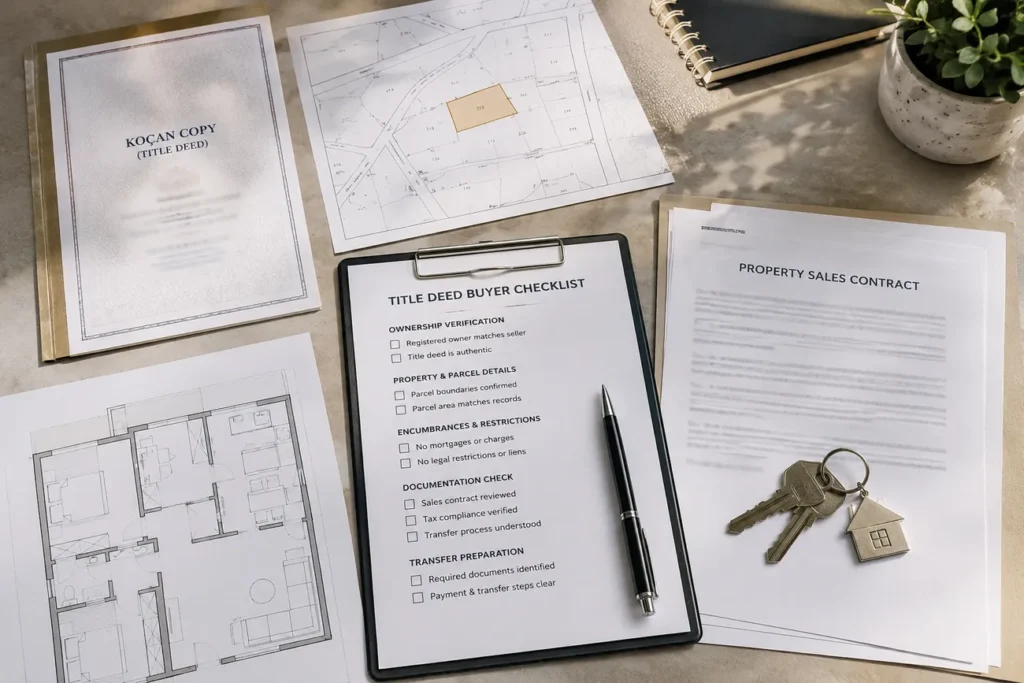
Table 4 — Buyer Checklist by Stage
| Before paying any deposit | Before signing the sales contract | Before title transfer |
|---|---|---|
| Obtain and verify the correct title deed | Have the contract reviewed by an independent lawyer | Confirm Permission to Purchase has been granted |
| Confirm registered owner matches the seller | Confirm parcel details match the property | Verify all outstanding approvals are in place |
| Arrange Land Registry encumbrance search | Check title category, pre-1974 history and any cross-jurisdiction implications | Confirm no charges remain against the property |
| Establish individual unit / kat irtifakı registration status | Review subdivision / transfer mechanism and developer’s obligations | Confirm transfer taxes and fees with your lawyer |
| Confirm seller’s legal authority to sell | Confirm contract registration deadline, formalities and legal effect | Verify deed will be registered in buyer’s name |
| Clarify current PTP requirements for your nationality | Confirm deposit refund terms if title cannot transfer | Check all conditions for completion are satisfied |
This checklist covers the primary verification steps. Specific transactions may involve additional considerations — particularly for off-plan purchases, shared ownership structures, or buyers using Power of Attorney.
Why Title Status Matters When You Sell or Finance the Property
A title issue does not only affect the original purchase. It may also become relevant when the owner later wants to sell, refinance or mortgage the property.
A future buyer, lawyer or lender may ask the same questions you should ask today:
- Is the seller the registered owner?
- Does the individual unit have its own title or another recognised registration?
- Are mortgages or restrictions recorded?
- Are subdivision and approvals complete?
- Can the title be transferred without unresolved conditions?
For that reason, due diligence should consider not only whether the buyer can complete today’s purchase, but also whether the ownership and registration position will be understandable to a future purchaser or lender.
Clear documentation can make a future transaction easier to analyse; it should not, however, be treated as a guarantee of financing, resale speed or resale value.
Not sure which North Cyprus properties match your budget, preferred area and buying scenario? Complete the Cypria Homes property selection quiz to receive a more relevant shortlist before comparing individual projects.
What Buyers Should Take Away
A Koçan answers only part of the ownership question. Before buying, establish who owns the exact property, which parcel or unit is registered, whether any encumbrances exist, what the pre-1974 history is, whether the individual unit has been registered, and what remains before transfer into your name.
The title label shown in an advertisement is therefore a starting point, not a legal conclusion.
If your lawyer cannot connect every conclusion to current Land Registry records and the relevant property documents, do not treat the title review as complete.
 Real estate in Georgia
 Real estate in Montenegro
 Real estate in the UAE
 Real estate in Bali
 Real estate in Thailand
 Real estate in Spain
 Real estate in Saudi Arabia
 Real estate in Turkey
 Real estate in Zanzibar
 +90 533 888 29 50
 hello@cypria.homes
 Karsıyaka Sokak 8, Girne



 Get catalogue of TOP-7 objects