
 +90 533 888 29 50


You’ve found a property in North Cyprus that ticks every box. The agent is friendly, the price looks fair, and the seller is pressing for a reservation deposit. At this point, the legal groundwork may not have started — and that’s precisely when due diligence matters most.
North Cyprus property due diligence is the structured process of verifying that a property, its seller and the transaction itself are legally sound before you commit financially. It covers four main areas: confirming who actually owns the property and what kind of title they hold; checking for mortgages, court orders or other charges registered against it; confirming that the building was constructed legally and matches its approved plans; and establishing that you, as a foreign buyer, are eligible to purchase and transfer title.
None of these checks is optional, and none replaces the others. A clean title deed does not confirm that the building is permitted. A building permit does not confirm that the land is free of charges. A signed sales contract does not give you title. The sequence matters, and the most consequential step is simple: carry out the core checks before you pay any deposit that may be difficult or impossible to recover.
This guide sets out what to verify, which documents to request, who should carry out each check, and what to do when something does not stack up.
North Cyprus Property Due Diligence: Quick Answer
Before buying property in North Cyprus, instruct an independent local lawyer to verify the registered owner, title history, mortgages and restrictions, building permits, seller’s authority and your eligibility as a foreign buyer. Do not treat a reservation payment or signed sales agreement as proof that the property can legally be transferred into your name.
| Key question | What a buyer should know |
|---|---|
| How many areas should be checked? | Four: legal, technical, financial, and seller/developer verification |
| Who conducts the legal checks? | An independent locally qualified property lawyer |
| When should checks be completed? | Before a non-refundable deposit or binding commitment |
| Is a title deed enough? | No. Title history, registered encumbrances and building approvals require separate checks |
| Is foreign-buyer permission required? | Generally yes, under the Turkish Cypriot administration’s rules |
| Contract registration deadline | Published commentary on Decree-Law 119/2026 identifies a one-month period; confirm the exact statutory trigger |
| Stamp duty | 0.5% is commonly quoted; confirm the current applicable rate and assessment basis |
| VAT on a property purchase | Commonly quoted at 5% for qualifying transactions; applicability and current rates must be checked |
| When is ownership transferred? | When the applicable permissions and transfer formalities have been completed |
| Are all risks eliminated? | No. Historical ownership claims and other risks may remain outside the local registration process |
Information checked in October 2026. Statutory requirements, fees and exceptions depend on the transaction. The legal effect of a Turkish Cypriot title registration must also be considered separately from possible claims under Republic of Cyprus law.
What Property Due Diligence Covers
Due diligence in North Cyprus is not a single search or one lawyer’s opinion. It breaks down into four distinct categories, each addressing a different type of risk.
Legal due diligence establishes who owns the property, what category of title they hold, whether the land or building carries any registered charges, and whether the transaction complies with local rules governing foreign buyers. This work is carried out by an independent local lawyer instructed directly by the buyer.
Technical due diligence confirms that the physical building matches its approved plans, that all permits were properly obtained, and that the structure itself is in acceptable condition. A qualified civil engineer or surveyor carries this out — it is separate from legal work and answers different questions.
Financial due diligence identifies liabilities attached to the property, the true cost of completing the transaction (including applicable taxes and fees), and the payment structure in the contract. A lawyer can cover most of this, though buyers with complex tax positions may also want input from an accountant familiar with both their home jurisdiction and North Cyprus.
Seller and developer verification confirms that the person or company offering the property has the legal authority to sell it, and — in the case of a developer — whether the company has a track record of completing projects and delivering individual title deeds.
| Check | What It Covers | Who Verifies It |
|---|---|---|
| Legal — title and ownership | Registered owner, title category, ownership history | Independent lawyer |
| Legal — encumbrances | Mortgages, court orders, charges, prior registered contracts | Independent lawyer |
| Legal — foreign buyer eligibility | Permission to Purchase, restrictions, eligibility criteria | Independent lawyer |
| Technical — planning and permits | Building permit, approved plans, completion certificate | Qualified engineer/surveyor |
| Technical — physical condition | Structure, systems, snagging, physical boundaries | Qualified engineer/surveyor |
| Financial — liabilities | Outstanding debts on land or building, tax liabilities | Lawyer, accountant if needed |
| Seller verification — authority | Identity, registered ownership, co-owner consents, PoA validity | Independent lawyer |
| Developer verification | Company registration, rights over land, prior completions | Independent lawyer |
One approval does not carry over to another. Seeing a clean title deed does not mean the developer has a valid building permit. Receiving a building permit does not tell you whether the land carries a mortgage. Each check addresses a specific category of risk.
The Purchase Process: From First Viewing to Title Transfer
| Stage | What happens | What you should have before moving forward |
|---|---|---|
| 1. Property shortlist | Select a property and request its basic legal details | Property identification and seller details |
| 2. Lawyer appointment | Instruct an independent lawyer | Written engagement letter and scope of work |
| 3. Initial title review | Verify ownership and title history | Preliminary written assessment |
| 4. Registry and permit checks | Search for registered charges and examine building approvals | Registry findings and permit verification |
| 5. Deposit decision | Review any reservation agreement and refund terms | Lawyer-approved written conditions |
| 6. Contract review | Negotiate payment, completion and transfer obligations | Reviewed sales contract |
| 7. Registration and permission | Complete applicable stamping, registration and purchase-permission procedures | Filing evidence and payment receipts |
| 8. Completion and title transfer | Satisfy the contract and regulatory conditions | Official transfer documentation and updated title records |
The steps may overlap, particularly for off-plan properties. The buyer’s lawyer should maintain a dated schedule of all statutory deadlines and contractual milestones.
Check the Title Deed and Ownership
The koçan — the title deed — is the foundational document in any North Cyprus property transaction. It identifies the registered owner, the parcel number, the land area and the category of title. Verifying it is not a formality; it is the most legally significant step a buyer takes before exchanging contracts.
The starting point is establishing the registered owner of record. The buyer’s lawyer should establish whether the contracting seller is the registered owner or has legally sufficient authority to sell the property. If the seller is not the registered owner, the lawyer should verify the relevant development agreement, power of attorney or other legal arrangement before the buyer enters into a binding commitment.
Beyond identity, the parcel number and cadastral identification on the deed should be cross-referenced against the property’s actual location, boundary pegs and any surveyor’s plan. Check land area against cadastral records and survey data, and compare the unit’s internal area, terraces, parking and storage against approved plans and any separate unit title. Any discrepancy between the parcel area on the deed and the physically occupied area requires explanation before any contract is signed.
Title history — the chain of previous ownership — can reveal whether the property has changed hands multiple times, whether prior sales were registered and whether there are any gaps or irregularities in the chain. A lawyer reviewing title history is looking for anything that might give rise to a competing claim or undermine the current registration.
The origin of the title matters in a way specific to North Cyprus. Commonly used descriptions of title origin include pre-1974 Turkish Cypriot and foreign ownership, and post-1974 exchange or allocation arrangements. Leasehold is a different type of property interest rather than a category of title origin. Each description requires document-level verification and separate assessment of pre-1974 claims.
Title Origin and Property Interest: What the Terms Mean
| Term | General meaning | What needs checking |
|---|---|---|
| Pre-1974 Turkish Cypriot title | Land associated with Turkish Cypriot ownership before 1974 | Ownership chain and present registration |
| Pre-1974 foreign title | Land associated with ownership by foreign nationals before 1974 | Historical documents, ownership chain and any claims |
| Exchange (eşdeğer) | Registration connected with post-1974 exchange arrangements | Original ownership history and potential competing claims |
| Allocation (tahsis) | Land allocated through post-1974 administrative arrangements | Basis of allocation, current legal status and historical claims |
| Leasehold | A right to occupy or use property under a lease rather than owning the freehold | Lease duration, permitted use, assignment rights, charges and termination conditions |
These descriptions do not establish that one property is automatically safe or unsafe to purchase. A property’s individual history, documentary evidence and potential claims must be assessed separately.
These categories carry different legal histories and different risk profiles. The UK Government’s guidance on buying property in Cyprus explicitly notes that properties in the northern part of the island may be subject to ownership claims from people who owned the land or buildings before 1974. The Republic of Cyprus Ministry of Foreign Affairs has also published guidance on the legal consequences for foreign citizens purchasing property in areas not under effective government control. A koçan records title under the Turkish Cypriot administration, but it does not by itself establish that the transaction is free from competing claims recognised by the Republic of Cyprus. Depending on the property’s ownership history and the buyer’s conduct, transactions may expose parties to civil claims and criminal proceedings under Republic of Cyprus law. A TRNC registration does not resolve those issues. Buyers should obtain separate legal advice on pre-1974 ownership, potential civil litigation and enforcement exposure before committing to a purchase.
For apartments and units within larger developments, there is an additional distinction: whether the buyer will receive an individual unit title deed or whether only the land on which the development sits currently has a deed. Many off-plan and recently completed projects are sold before individual apartment titles have been subdivided and issued. A buyer should understand at the outset whether they are purchasing into an existing individual title or are relying on the developer to obtain and transfer one in the future — and what the contract says about when that must happen.
For a deeper explanation of the different types of deed and what they mean in practice, see “North Cyprus Title Deeds Explained“.
Match the Deed to the Property
The deed describes a legal interest; the estate agent’s listing describes a property for sale. Confirming that they refer to the same thing requires a deliberate matching exercise.
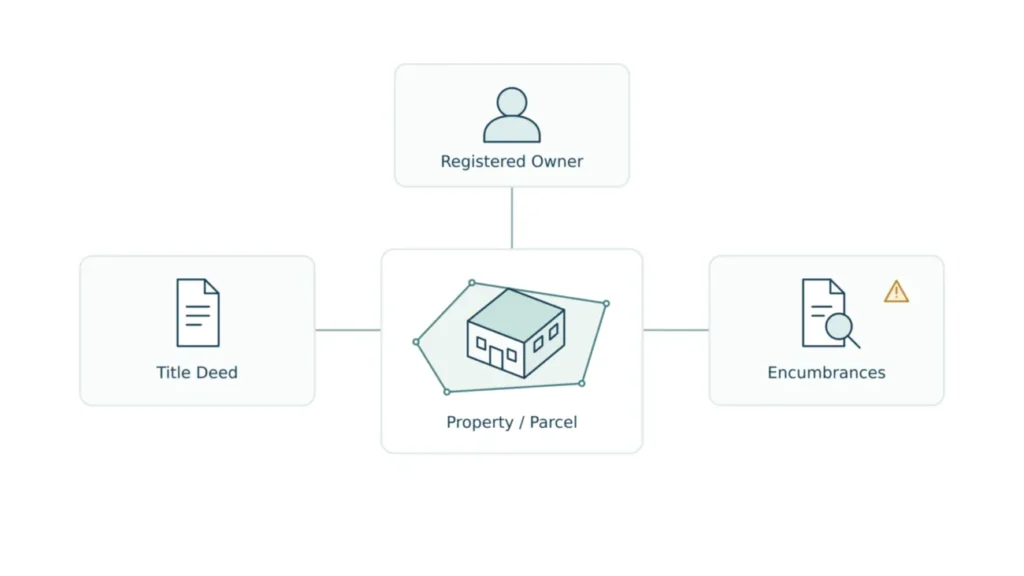
Your lawyer should verify that the seller is the registered owner, or that the contracting party has independently verified legal authority to sell on the owner’s behalf, that the parcel number corresponds to the correct piece of land, that the registered land area and unit details match the cadastral records and approved plans, and that the unit being sold — including its floor plan, room count and any included storage or parking — corresponds to what is shown in approved architectural drawings. Relying on a brochure or a developer’s floor plan without cross-referencing against the deed and the approved plans is a common and avoidable gap in buyer due diligence. A copy of a title deed is not a substitute for a current Land Registry search of mortgages, registered interests and transfer restrictions.
Search for Mortgages and Encumbrances
Confirming ownership is one thing; establishing what obligations are attached to that ownership is another. A separate Land Registry search is needed to identify any charges, restrictions or claims registered against the property or the land it sits on.
The TRNC Land Registry and Cadastral Department (Tapu ve Kadastro Dairesi) is responsible for registering and maintaining records of ownership transfers, mortgages, court orders and other legal restrictions affecting land and property in North Cyprus. A formal search of this registry should be carried out by your independent lawyer before any contract is signed and before any deposit is paid.
The search should identify:
- Mortgages — any lender’s registered charge against the land or building
- Registered charges — financial liabilities other than bank mortgages
- Court orders and attachments — injunctions or enforcement orders affecting the property
- Prior registered sale contracts — contracts from earlier transactions that remain on the register
- Restrictions on transfer — conditions limiting the owner’s ability to sell or transfer the property
Each of these can affect your ability to obtain a clean title on completion, and some can make the transaction legally impossible to complete until they are resolved.
One possible scenario in new developments illustrates the risk clearly. A developer may offer to sell individual apartments within a complex while the land on which the complex is built carries an existing mortgage in favour of a bank or financial institution. An oral assurance is not an adequate substitute for a documented and enforceable mortgage-release arrangement. The buyer’s lawyer should obtain lender confirmation and ensure the discharge mechanism is reflected in the contract as a condition of completion — not merely as a stated intention.
Where the registry search reveals encumbrances, the appropriate response is not necessarily to walk away. Some registered charges are routine and can be discharged before or simultaneously with the transfer of title. Others are more complex. The critical point is that your lawyer documents the findings in writing and advises you on what each encumbrance means for the transaction.
A clean Land Registry search is an essential part of due diligence, but it does not replace checks on building permits, title history or the property’s physical condition.
What to Do When a Property Check Reveals a Problem
| Finding | Why it matters | Next action |
|---|---|---|
| Registered mortgage | The lender may hold enforceable rights over the property | Obtain written lender confirmation and a legally reviewed discharge mechanism |
| Seller is not the registered owner | The seller may lack authority to transfer the property | Verify the legal arrangement authorising the sale |
| Individual apartment title is missing | Unit registration and transfer may depend on future developer actions | Verify land title, subdivision status and contractual transfer obligations |
| Building differs from approved plans | Unauthorised works may affect completion and registration | Request technical assessment and legal advice on possible regularisation |
| Historic ownership remains disputed | Claims may arise beyond the Turkish Cypriot registry system | Seek independent specialist advice addressing Republic of Cyprus law |
| Developer refuses to provide documents | Essential representations cannot be independently verified | Suspend payment and request formal documents |
| Purchase permission is uncertain | The buyer may be unable to complete title transfer | Obtain transaction-specific eligibility advice before commitment |
Not every problem requires immediate cancellation. However, a verbal explanation is not a substitute for a document, an enforceable obligation or an independent professional opinion.
Verify Planning and Building Documents
A building that is physically complete is not the same as a building that was constructed with all necessary approvals in place. In North Cyprus, as in most jurisdictions, property development requires a sequence of regulatory approvals, and gaps in that chain can create problems — ranging from difficulties obtaining individual title deeds to issues with insurance, resale or financing.
The key documents to check are:
- Planning approval — permission from the relevant authority to develop or use the land for the proposed purpose
- Building permit — authorisation to carry out the specific construction shown in the approved plans
- Approved architectural plans — the drawings formally approved as part of the building permit
- Completion or final approval — confirmation that the building as constructed has been inspected and meets the requirements of the permit
- Individual unit title deed — a separate koçan for the specific apartment or property unit, distinct from the title to the land
Each of these is a distinct document issued at a different stage of the development process. The implications of a missing approval depend on the document, the project’s stage and local law. Buyers should not assume that marketing or signing a contract establishes the development’s legal compliance.
Where the physical building deviates from the approved plans, the discrepancy is a legal and practical problem. Common examples include: an extra floor added beyond the permitted height; a swimming pool or outbuilding constructed without a separate permit; an apartment with a different internal layout or larger terrace than appears in the approved drawings; or a development built on a larger footprint than approved. These deviations may or may not be capable of regularisation, and that determination requires local legal and technical input — not reassurance from the selling agent.
Your lawyer should request copies of the building permit and approved plans and confirm that they relate to the property being sold. An engineer should verify that the actual building corresponds to those documents.
Physical Inspection and Snagging
Technical due diligence is the physical counterpart to legal checks. A qualified civil engineer or surveyor should inspect the property before contracts are exchanged, not after.
A thorough inspection covers structural integrity, moisture and damp (a particular concern in coastal properties), electrical installation, plumbing and drainage, roof condition, common areas and shared infrastructure, and boundary compliance. For off-plan purchases nearing completion, a snagging inspection before handover can identify defects for which the developer may be responsible under the contract, warranty provisions or applicable law.
Technical and legal due diligence solve different problems. Legal checks confirm what is registered and permitted; a physical inspection confirms what has actually been built and in what condition. Both are necessary. A building with perfect paperwork can still have serious structural defects, and a building in excellent physical condition can still lack a valid completion certificate.

Investigate the Seller or Developer
Verifying the property is only part of the process. You also need to confirm that the person or company offering it has the legal authority to sell.
For a private seller, the checks include:
- Confirmed identity — verified against the registered owner on the title deed
- Single ownership or co-ownership — if the property is jointly owned, all registered owners must consent to the sale in writing
- Power of attorney — if the seller is represented by someone acting under a PoA, the scope and validity of that document must be checked by your lawyer
- Inheritance and estate issues — where the seller acquired the property through inheritance, the chain of legal succession and any probate requirements should be confirmed
For a developer, the verification is more extensive:
- Company registration and legal existence in the TRNC
- Authority to sell — the individuals signing the contract must have authority to bind the company; where the contracting entity is not the registered landowner, the buyer’s lawyer must verify the legal basis of its authority, including any development agreement or other enforceable arrangement
- Rights over the land — whether the developer owns the land outright, holds it under a long lease, or is developing it under a different arrangement
- Existing mortgages on the land or building — registered charges should be identified at Land Registry level
- Valid building permits for the specific development being sold
- Track record — whether the developer has completed previous projects and, critically, whether individual title deeds were delivered to buyers in those projects and within what timeframe
On that last point, a developer with completed buildings is not automatically reliable. The relevant question is not whether they have built before, but whether they delivered individual title deeds to previous buyers and on what timeline. Ask for specific examples and request that your lawyer verify registration of prior transactions where possible.
Questions worth asking a developer before paying a deposit:
- Who is the registered owner of the land, and can I see the title deed?
- Does any mortgage or charge currently affect the land?
- Are the building permits in place for the specific block or unit I am buying?
- When do you expect individual title deeds to be available for this development?
- What happens to my deposit if the project is delayed or does not complete?
- Has your company delivered individual title deeds on your previous developments?
- Which law firm represents the company, and do you have any objection to me instructing a separate, independent lawyer?
Written answers to these questions, or a developer’s reluctance to provide them, are informative in themselves.
Compare New Residential Developments


 Karsıyaka
 from 73м²

 Karşıyakafrom 93.67м²
 Alsancakfrom 65м²

 Ozankoy, Kyrenia Eastfrom 305м²
 Catalkoy, Kyrenia Eastfrom 442м²
Check Ongoing Costs and Existing Debts
Before buying an apartment in a managed residential complex, request a written breakdown of monthly or annual management fees, maintenance obligations, utility charges and any planned contributions for major repairs.
Confirm whether the advertised facilities — such as a pool, gym, lift, parking or security — are included in ordinary service charges or paid for separately.
Ask the seller or management company for statements showing outstanding amounts and have your lawyer establish whether any unpaid obligations could affect the transaction or become payable by the buyer.
For off-plan projects, ask whether published service fees are fixed, estimated or subject to revision after handover.
Check Foreign Buyer Eligibility
Foreign nationals — including UK and EU citizens — are generally permitted to purchase residential property in North Cyprus, but the process involves a specific regulatory step: Permission to Purchase (Satın Alma İzni).
Understanding what Permission to Purchase is, and what it is not, prevents a common source of confusion:
- Signing a sales contract is a contractual act between buyer and seller. A foreign buyer can sign a contract before Permission to Purchase is granted.
- Registering the contract at the Land Registry creates a record of the buyer’s interest in the property and has its own procedural requirements. This is not the same as obtaining Permission to Purchase.
- Permission to Purchase is the formal governmental authorisation for a foreign national to acquire property in North Cyprus. Without it, the final transfer of title into the buyer’s name cannot be completed.
- Transfer of title is the final step — the legal act by which the koçan is issued in the buyer’s name. This requires Permission to Purchase to have been granted.
These are four distinct legal stages, and conflating them creates risk. A buyer who has signed a contract and registered it has a stronger position than an unregistered buyer, but still does not hold title until Permission to Purchase is granted and the transfer is completed.
As at 21 October 2026, the Turkish Cypriot administration’s Decree-Law 119/2026 sets acquisition limits and permission requirements for foreign buyers. Under Decree-Law 119/2026, the number and types of properties a foreign buyer may acquire depend on nationality, property category and statutory conditions. Independent local counsel should verify the applicable limits against the official decree before a contract is signed.
Additionally, published analysis of Decree-Law 119/2026 indicates a one-month requirement for registration of the stamped contract and submission of a purchase-permission application. The precise starting point, prerequisites, exceptions and consequences of non-compliance must be confirmed against the official text by independent local counsel before signing.
Do not rely on general market statements or agency summaries as confirmation of your specific eligibility. Your lawyer should confirm the current requirements and verify that the property you intend to purchase falls within the permitted category.
Check the Property, Not Just Your Nationality
Foreign-buyer eligibility is not determined solely by citizenship. Your lawyer should also check the property’s legal classification, parcel size, location, ownership structure, applicable acquisition limits and any restrictions associated with military or other designated areas.
For apartments, ask whether the development or parcel is subject to foreign-ownership limits and how compliance will be verified. If the property is not eligible for the proposed buyer under the rules in force, signing a sales contract does not resolve that problem.
For a full explanation of the application process and what it involves, see “North Cyprus Permission to Purchase“.
Critical Deadlines to Track
| Event | What must be checked | Responsible party |
|---|---|---|
| Signing the agreement | Contract date and statutory obligations triggered by signing | Buyer and independent lawyer |
| Stamp duty and registration | Applicable filing and payment deadline; published analysis of Decree-Law 119/2026 identifies a one-month requirement | Independent lawyer |
| Permission to Purchase application | Submission requirements and deadline | Independent lawyer and buyer |
| Permission decision | Date, conditions and notification or publication requirements | Independent lawyer |
| Payment of transfer charges | Current statutory deadline following permission | Buyer and independent lawyer |
| Execution of title transfer | Applicable transfer deadline and required documentation | Buyer, seller and Land Registry |
The specific deadline triggers and any post-permission periods must be confirmed against the current official legal text. Do not rely on a generic timetable or an estate agent’s estimate.
Review the Property Sales Contract
The sales contract is the legal document that governs your rights and obligations from the moment of signing until title is transferred. A poorly drafted contract — or one that has not been reviewed by an independent lawyer — is a significant source of risk in North Cyprus property transactions.
Before instructing your lawyer to proceed, it is worth understanding what a well-drafted contract should address:
- Identification of parties and property — full legal names, registered company details where applicable, and the precise cadastral description of the property
- Purchase price and currency — the agreed price, in which currency it must be paid, and what happens if exchange rates change (relevant for buyers paying in sterling or euros)
- Deposit conditions — the amount, when it is payable, and the circumstances under which it can be refunded
- Payment schedule — stage payments, milestone triggers and the dates by which each payment falls due
- Delivery date and obligations — a defined completion date for off-plan property, with consequences for the developer if it is not met
- Construction specifications — for new builds and off-plan purchases, what materials, finishes and features are included, and what happens if they are changed
- Mortgage release obligations — a contractual obligation on the seller or developer to discharge any existing mortgage on the property before or simultaneously with the transfer of title
- Title transfer mechanism — when and how the koçan will be transferred, and who bears responsibility for obtaining any required permissions
- Remedies for delay — what the buyer can do if the property is not delivered on time, including any right to compensation or termination
- Refund conditions — under what circumstances the buyer is entitled to a refund, and the procedure for enforcing that right
- Taxes, duties and fees — the contract should specify which taxes, duties and fees apply to this transaction under current local rules, including any applicable VAT, transfer charges and stamp duty, and confirm who is contractually responsible for each
- Dispute resolution — which court or authority has jurisdiction and under which law disputes are to be resolved
- Contract registration — whether and when the contract is to be registered at the Land Registry; under Decree-Law 119/2026, failure to comply with the registration and permission-application requirements can have severe consequences, including statutory invalidity under the applicable decree. Obtain transaction-specific advice before signing, and ensure the contract addresses these obligations clearly
Additional Costs to Verify Before Signing
| Cost | What to budget or verify |
|---|---|
| Stamp duty | Commonly quoted at 0.5% of the contract value; confirm the current statutory rate |
| VAT | May apply depending on the seller, property and applicable tax rules |
| Title transfer charges | Check the rate applicable to your nationality, transaction and number of properties |
| Independent legal services | Request a written quote including searches, filings and third-party expenses |
| Registration-related payments | Confirm all charges payable before or during contract registration |
| Technical inspection | Obtain a quotation for the property and inspection scope |
| Utility connections | Confirm electricity, water, meter, transformer and infrastructure charges |
| Service and management charges | Request the current schedule and check outstanding balances |
| Currency conversion | Account for exchange-rate changes and bank charges |
Illustrative calculation: for a property with a contractual price of £150,000, stamp duty at an assumed 0.5% would equal £750. VAT at an assumed 5%, if applicable to the full contract price, would equal £7,500. These amounts are separate from any title transfer charges, legal expenses or infrastructure contributions.
These examples are arithmetic illustrations, not confirmation that the quoted rates apply to every transaction in October 2026. Ask your lawyer for a written transaction-specific completion statement.
Example: Budgeting for a £150,000 Property
| Item | Illustrative amount |
|---|---|
| Agreed property price | £150,000 |
| Stamp duty at an assumed 0.5% | £750 |
| VAT at an assumed 5%, if applicable | £7,500 |
| Illustrative subtotal if both assumed charges apply | £158,250 |
| Title transfer charges | To be confirmed |
| Lawyer and technical inspection | Quotation required |
| Utilities and infrastructure | Project-specific |
| Final purchase budget | Cannot be determined without the remaining charges |
Do not confuse the property’s advertised price with the amount you must have available to complete a purchase. Ask for written confirmation of which charges are included, excluded, already paid or payable at a later stage.
| Contract Clause | Potential Risk | Buyer Protection |
|---|---|---|
| Deposit | Non-refundable payment made before checks are complete | Conditional refund terms linked to due diligence findings |
| Completion date | Vague or absent delivery obligation for off-plan property | Defined milestone dates with buyer’s right to terminate or claim compensation |
| Title transfer | No mechanism specified for when and how koçan transfers | Contractual obligation on seller with defined timeline |
| Mortgage release | Existing charge on land remains at completion | Documented and enforceable discharge procedure, confirmed by lender |
| Specification changes | Developer substitutes materials or alters layout | Approved plans attached to contract; change procedure requires buyer consent |
| Currency and price | Exchange rate risk or informal price split | Clear price in one currency; any agreed split documented formally |
| Dispute resolution | Ambiguous or inaccessible jurisdiction | Clear governing law and accessible dispute forum |
| Termination rights | No exit route for buyer if serious issues emerge | Defined termination conditions with refund obligation |
Contract conditions should be negotiated and reviewed with independent legal advice. Clauses that appear standard are not always adequate, and terms that seem protective in ordinary language may not be legally enforceable in their current form. See “How to buy property in North Cyprus” for an overview of how the transaction process works from start to finish.
Resale vs Off-Plan Due Diligence
The due diligence process differs meaningfully depending on whether you are buying an existing property from a private seller or developer, or purchasing off-plan before construction is complete.
| Due Diligence Area | Resale Property | Off-Plan Property |
|---|---|---|
| Ownership | An individual title deed may exist; if it does not, establish why and verify the legal route to its issuance and transfer. | The land title may exist before separate unit titles are issued; confirm the project’s subdivision and registration status individually |
| Construction | Physical building can be inspected and compared to approved plans | Depending on the construction stage, buyers may inspect foundations, work in progress, completed sections and engineering records in addition to approved plans and permits |
| Financial risks | Mortgages or charges attached to existing title are searchable now | Developer financing arrangements and future stages may not yet be registered |
| Completion documentation | Verify whether the relevant completion approval has been issued or is legally required for the property’s status. | Final approval and individual title issuance depend on future actions |
| Delivery risk | Property exists and can be handed over on contract terms | Developer must complete, obtain approvals and deliver title — timeline is uncertain |
| Specification risk | The completed property can be inspected, although hidden defects and undocumented alterations remain possible. | Finished property may differ from plans; changes need to be contractually controlled |
For resale property, the emphasis falls on confirming that the individual title deed is in order, that the physical condition matches the registered description and approved plans, and that no encumbrances affect the transfer of a clean title to the buyer.
For off-plan property, the risk profile shifts toward the developer’s reliability, the adequacy of contractual protections around completion and title delivery, and the financial strength of the company carrying out the construction. Milestone-based payments may reduce certain construction-timing risks when independently certified, but do not eliminate insolvency, title or recovery risks; security and refund arrangements in the contract also matter. The timeline for individual title deed issuance in new developments can be lengthy, and a buyer should understand from the outset what the contract commits the developer to deliver and when.
Example: A Buyer Considering an Off-Plan Apartment
Suppose a foreign buyer is considering a £150,000 apartment in a development that is still under construction. The developer provides a brochure, an instalment schedule and a proposed reservation agreement, but the individual apartment title deed has not yet been issued.
Before paying a non-refundable deposit, the buyer should ask an independent lawyer to verify:
- Who owns the underlying land and whether the developer has authority to sell the unit.
- Whether the land carries a mortgage or another registered restriction.
- Whether construction approvals exist for the advertised building and unit.
- How and when the individual title is expected to be established.
- Whether the buyer and property meet foreign-acquisition requirements.
- What happens to payments if the development is delayed, permission is refused or title cannot be transferred.
- Whether the amounts and dates in the proposed payment schedule reflect independently verifiable construction milestones.
Possible outcome: if the developer has valid authority but the individual title has not yet been created, the lawyer may recommend specific contractual conditions and further verification. If ownership cannot be established or an essential document is withheld, the buyer should pause the transaction.
The example is hypothetical and does not assess any particular development.
Explore completed properties in Northern Cyprus




Buyers purchasing remotely — without being physically present to inspect the property or meet the parties — face additional challenges. For guidance specific to that situation, see “How to buy property in North Cyprus remotely“.
Red Flags Before Buying
Some due diligence findings can be resolved through documents, legal arrangements or contract amendments. Others may make the transaction unsuitable for the buyer.
Situations that require additional investigation before proceeding:
- The seller cannot immediately produce the title deed but says it is obtainable — verify the reason and set a deadline for production
- There is a registered mortgage on the property — confirm the outstanding balance, obtain a written discharge timeline from the lender, and ensure this is reflected as a condition in the sales contract
- The building permit is described as “in process” or “expected shortly” — a permit that is not yet issued is not a permit
- The area of the property as described by the seller differs from the cadastral records or the approved plans — commission a surveyor’s report before proceeding
- The developer’s track record on title delivery is unclear — request specific references to previous completed projects and check registration status
Serious concerns that should not be overridden by commercial pressure:
- If the seller cannot establish valid title to the underlying land or a lawful authority to sell, do not proceed without independent legal advice. An individual unit deed may not yet exist in an off-plan project; the land title and the route to unit registration must then be independently verified.
- A mortgage exists on the property with no documented discharge mechanism — an oral assurance is not sufficient; lender confirmation and a contractual discharge obligation are required
- Building permits for the specific property have not yet been issued — where required permits are absent, the legal implications depend on the project stage and proposed works. Do not assume construction or delivery can lawfully proceed before the necessary approvals are in place
- The physical footprint, floor plan or total area differs materially from what is in the approved drawings — unapproved construction may be difficult or impossible to regularise
- Pressure to pay a non-refundable deposit before documents are provided — due diligence requires access to documents, not promises
- An agent-recommended lawyer is not necessarily conflicted, but the buyer should verify independence, disclose any existing relationships and retain counsel who acts solely for the buyer in the transaction
The absence of a document is not an invitation to trust a verbal promise. It is a reason to pause, ask why the document is missing and obtain a written explanation before committing any funds.

Documents to Request Before Paying
The following checklist covers the core documents your lawyer should review before you pay any deposit or sign a binding contract. The precise set will vary by property type — resale, off-plan, apartment, villa or land — but these documents apply in the majority of residential transactions.
| Document | Who Provides It | Who Checks It | What to Verify |
|---|---|---|---|
| Title deed (koçan) | Seller or developer | Lawyer | Registered owner, parcel number, land area, title category |
| Land Registry search | TRNC Land Registry (via lawyer) | Lawyer | Mortgages, court orders, prior registered contracts, restrictions |
| Building permit | Seller or developer | Lawyer and engineer | Valid permit issued for the specific building; permit matches construction |
| Approved architectural plans | Seller or developer | Engineer | Physical building matches approved drawings in layout, area and extent |
| Completion certificate | Seller or developer | Lawyer | Formal confirmation that construction was completed as permitted |
| Company registration documents | Developer | Lawyer | Legal existence, authority of signing directors, no insolvency proceedings; legal basis for sale if company is not the registered owner |
| Proof of seller’s identity | Seller | Lawyer | Identity matches registered owner; PoA valid if third party is signing |
| Co-owner consents | Seller | Lawyer | All registered owners have consented in writing to the sale |
| Proposed sales contract | Seller or developer | Lawyer | All clauses reviewed before signing; registration deadline and purchase-permission application addressed; amendments negotiated in writing |
| Utility statements and management-fee confirmations | Seller | Lawyer | Obtain recent utility account statements and management-fee records; ask counsel to establish whether any unpaid amounts can become the buyer’s liability |
After reviewing these documents, your lawyer should confirm in writing whether any outstanding matters need to be resolved before contracts are signed.
What Each Document Can — and Cannot — Establish
| Document | What it helps establish | What it does not establish |
|---|---|---|
| Title deed | Registered ownership and property details | Absence of all historic ownership claims |
| Registry search | Registered mortgages, restrictions and interests disclosed by the search | Building legality or unregistered claims |
| Building permit | Authorised construction according to approved documents | Actual compliance of the completed building |
| Completion approval | Completion-related regulatory status | Freedom from mortgages or legal disputes |
| Sales contract | Agreed rights and obligations of the parties | Completed legal transfer of ownership |
| Permission to Purchase | Governmental permission for the relevant acquisition | Automatic completion of title transfer |
| Engineer’s inspection report | Observable defects and technical concerns within its scope | Legal ownership or registration validity |
Read the documents together. No single certificate, registry extract or professional report can establish every aspect of a property’s legal and technical position.
The document review process can be summarised in five steps:
- Request — formally request all relevant documents from the seller or developer before any commitment is made. Do not accept the response that documents will be provided after the deposit is paid.
- Verify — instruct your independent lawyer to carry out a Land Registry search and review all documents provided. Do not rely on copies supplied by the selling agent alone.
- Clarify — where documents are missing, incomplete or inconsistent, ask for a written explanation. Where your lawyer identifies an issue, seek written advice on its implications.
- Resolve — any identified problems should be resolved — not explained away — before contracts are signed. Resolution means a document is produced, a charge is discharged or a contract clause is amended.
- Decide — once you have complete information from your lawyer, make a decision based on the verified facts, not on commercial pressure or market enthusiasm.
Ready to Compare Properties?
Now that you know which documents to request, you can begin comparing properties that match your budget, preferred location and intended use. Complete a short questionnaire to receive suitable options, then arrange independent legal checks before making a commitment.
Compare Properties
What an Independent Lawyer Should Deliver
Appointing an independent local lawyer is not a bureaucratic step — it is the single most important decision you make in this process. Independent means instructed and paid by you, not by the seller, the developer or the estate agent. An agent-recommended lawyer is not automatically conflicted, but you should ask the lawyer to disclose any relevant past or current relationships with the seller, developer or agent, explain how conflicts are assessed, and confirm in writing that they act independently for you in this transaction.
Before engaging a lawyer, confirm the scope of work they will carry out and the total estimated cost of their service.
How to Choose and Verify Your Property Lawyer
Before appointing a lawyer, ask for their full professional name, local registration details, office address and written terms of engagement. Verify their professional standing through the relevant local bar association.
Ask whether the lawyer or anyone in their firm represents the developer, landowner, seller or agent in the same transaction. A previous professional relationship does not automatically create a conflict, but any relevant conflict must be identified and assessed.
Request a written fee quotation explaining whether registry searches, translations, powers of attorney, contract registration, purchase-permission applications and post-completion assistance are included.
Your lawyer should also explain which aspects of historic title risk they can assess and whether separate Republic of Cyprus or cross-border legal advice is required.
A thorough legal due diligence report should cover:
- Verified ownership facts — who the registered owner is and how that was confirmed
- Land Registry search findings — a written record of available official registry extracts covering disclosed mortgages, encumbrances, restrictions and prior registered interests, with an explanation of any limits of the search
- Title history — a summary of how the property has changed hands and whether the chain is complete
- Title category and associated risks — what type of deed exists and what that means for potential historic claims, including any assessment of pre-1974 ownership issues
- Outstanding encumbrances — what remains registered and whether it can be discharged before completion
- Planning and permit status — whether the building has valid permits, a completion certificate and approved plans
- Foreign buyer eligibility — whether you are currently eligible to apply for Permission to Purchase under current rules, including Decree-Law 119/2026, and any applicable acquisition limits or other restrictions
- Unresolved risks — matters the lawyer cannot confirm, where uncertainty remains or where further information is needed
- Conditions to satisfy before signing — specific actions that must be taken before the contract is signed or the deposit is paid
There is a clear difference between a lawyer reviewing documents and an agent collecting them. An agent can pass documents to you; they cannot provide legal analysis, identify title defects or advise you on the enforceability of contract terms. Both roles may be useful, but they are not interchangeable.
Final Checks Before You Commit
Completing due diligence properly is not about eliminating all uncertainty — North Cyprus, like any property market, involves some degree of risk that cannot be entirely removed by documentation alone. What it does is ensure you are making an informed decision with your eyes open.
Verify ownership and title history. Confirm the registered owner through a formal Land Registry search. Understand the category of title and what it means, including any assessment of pre-1974 ownership issues and the potential for competing claims recognised outside the TRNC. Identify whether an individual unit deed exists or will need to be created, and when. Assess what the title history suggests about prior transactions and potential competing interests.
Confirm planning, permits and financial liabilities. Check that the property has the approvals and permits required for its current development stage, and establish when any completion certificate and individual title deed must be obtained. Confirm that the physical property matches its approved plans. Confirm that the Land Registry search is clean, or that any encumbrances have a credible and contractually binding discharge mechanism. The contract should specify which taxes, duties and fees apply and who is responsible for each; confirm this with your lawyer before signing. For a wider view of the costs involved in completing a transaction, see North Cyprus Property Taxes.
Obtain written independent legal advice before committing. A written legal report from a lawyer you have instructed independently is not a luxury — it is the document that defines what you are buying and what risks remain. Read it carefully. If your lawyer identifies unresolved concerns, address them before signing rather than after. Ensure the contract addresses the registration and purchase-permission application requirements under current local rules; failure to comply with the applicable deadlines may have serious consequences for the validity or enforceability of the transaction, so transaction-specific legal advice on the exact requirements and consequences is essential.
Your Next Step
If you have already found a property, send its listing, cadastral information and available documents to an independent property lawyer before making a non-refundable payment.
If you are still comparing properties, start with a shortlist that records the property type, asking price, location, stage of construction, reported title status and documents currently available. This makes it easier to identify which properties merit a full professional review.
A property shortlist is only the starting point. Independent legal and technical due diligence must follow before any binding purchase decision.
The purpose of due diligence is to put you in a position where you can make a sound decision — to proceed with confidence, to negotiate better terms, or to step back from a transaction that carries risks you are not willing to accept. All three outcomes are legitimate. The process exists to serve your interests, not to create paperwork.
 Real estate in Georgia
 Real estate in Montenegro
 Real estate in the UAE
 Real estate in Bali
 Real estate in Thailand
 Real estate in Spain
 Real estate in Saudi Arabia
 Real estate in Turkey
 Real estate in Zanzibar
 +90 533 888 29 50
 hello@cypria.homes
 Karsıyaka Sokak 8, Girne




 Get catalogue of TOP-7 objects