
 +90 533 888 29 50


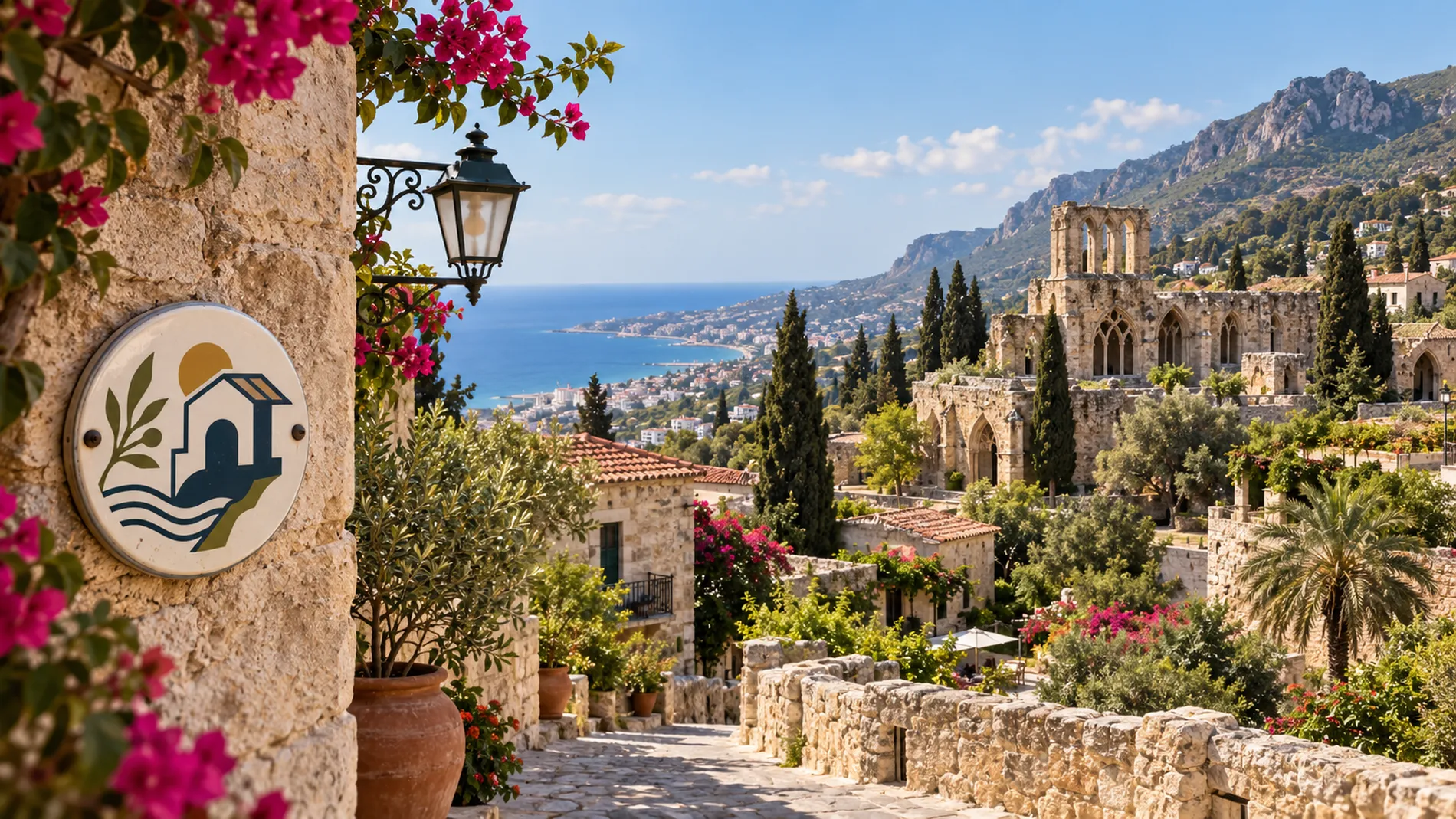

Bellapais, also known as Beylerbeyi, lies around five kilometres from Kyrenia on the northern slopes of the Kyrenia mountain range, at an elevation of roughly 220 metres above sea level. The drive up takes only a few minutes, yet the change in atmosphere is immediate: the air feels drier and cooler, the noise of the coast fades away, and the sea, instead of appearing as a narrow strip on the horizon, opens up into a sweeping panoramic view.
Most visitors come for one reason: Bellapais Abbey. That is entirely understandable. Bellapais Abbey is regarded as one of the finest surviving examples of Gothic architecture in the Eastern Mediterranean. But seeing only the monastery means experiencing perhaps a third of what makes the journey worthwhile.
Around the abbey, the historic village has retained much of its original character, with stone houses, steep narrow lanes, café terraces, and a rich literary legacy. It was here that Lawrence Durrell lived for several years and wrote Bitter Lemons of Cyprus.


 Bellapais, Kyrenia Centre, North Cyprus
 from 514м²
This guide has been designed with two very different types of visitors in mind. The first is the traveller staying in Kyrenia who has set aside half a day to explore Bellapais. The second is someone considering the area for long-term living and trying to understand what lies beyond the postcard-perfect views: the terrain, transport links, tourist traffic, and the level of peace and quiet in the evenings.
Bellapais’s attractions can reveal a great deal about both the visitor experience and everyday life in the area — provided you know what to look for.
Bellapais: What to Know Before You Go
The village’s official Turkish name is Beylerbeyi, and that is the name you will see on road signs. The historic name Bellapais remains associated with the abbey and is still widely used in tourism, so both names refer to the same place. In practice, this rarely causes confusion: navigation apps generally recognize both.
The village itself is compact. The main visitor area consists of the square in front of the abbey, a handful of surrounding streets, and the road descending toward the residential quarters. You can walk around the central part in roughly twenty minutes, but Bellapais is not really about distance. Its appeal lies in the changes in elevation and the way the scenery shifts with every few dozen metres of ascent. The streets are narrow, many are noticeably steep, and in some places pavements give way to stonework and steps.
What defines Bellapais most clearly is the contrast between a major medieval monument and the tiny residential village wrapped around it. The two exist side by side, sometimes literally across the street from one another: one courtyard may be filled with a tour group, while next door you might see laundry hanging on a line and a cat sitting on a windowsill. It is precisely this contrast that makes Bellapais so compelling — and also why visitors should explore it with a degree of sensitivity and respect.
| What to Consider | Details |
|---|---|
| Best type of visit | A half-day trip from Kyrenia: the abbey followed by an unhurried walk through the village |
| Minimum time | Around 1.5–2 hours — enough for the monastery and main square, but not for exploring the surrounding streets |
| Comfortable amount of time | 3–5 hours, allowing for coffee, a panoramic walk, and a descent into the residential quarters |
| Do you need a car? | Not essential for the village itself, but it gives you more flexibility and makes the return journey much easier |
| What to wear and bring | Shoes with non-slip soles, a hat, and water; in summer, lightweight, light-coloured clothing |
| Who will enjoy it most | Architecture and history enthusiasts, couples, independent travellers, and anyone considering the area as a place to live |
The difference between a quick stop and a proper visit is significant. In ninety minutes, you will see the Gothic monument and take in the panoramic views. Spend half a day here, however, and you begin to understand how the village actually works: where the tour groups disappear, where the ordinary residential streets begin, how steep the climb back to your car really is, and what Bellapais sounds like once the coaches have left.
1. Bellapais Abbey
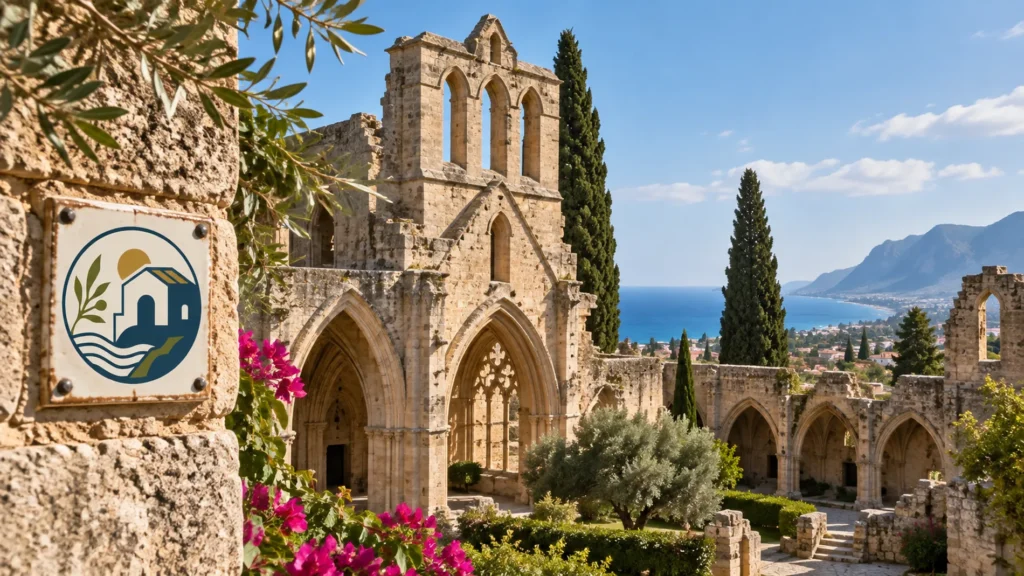
What it is. A Gothic monastic complex and the main reason the vast majority of visitors come to the village. According to the Department of Antiquities and Museums, the site was once known as Episcopia and is believed to have served as both a residence and a refuge for the bishops of Kyrenia. The first known settlers were canons of the Holy Sepulchre, who left Jerusalem after its fall in 1187. The foundation of the monastery is associated with Aimery de Lusignan, while the earliest buildings are generally dated to 1198–1205. The complex was consecrated as the Abbey of St Mary of the Mountain.
In 1206, it passed to the Premonstratensians, or “White Canons”, which is why the name “White Abbey” appears in documents from the 15th and 16th centuries. The appearance visitors see today took shape under two kings: the principal buildings were constructed during the reign of Hugh III (1267–1284), while the cloister and refectory were added under Hugh IV (1324–1359). A detailed chronology is available on the official Bellapais Manastırı page of the Department of Antiquities and Museums.
Where it is and how to get there. The abbey stands right in the heart of the village, on a projecting section of the hillside, and can be seen from below well before you reach Bellapais itself. By car, the drive uphill from central Kyrenia takes around ten minutes. Signs for Beylerbeyi and Bellapais are posted from the coastal road.
Bellapais is served by local minibus connections with Kyrenia, but departure times can change. Check the current timetable shortly before travelling rather than relying on an older published schedule. A taxi from the city is another practical option, particularly for two or three people travelling together. Parking around the historic centre is limited, and arrangements vary between individual parking areas. Some nearby lots may charge a fee, while other options may be available farther from the abbey. Check signs and current local arrangements when you arrive.
What to see.
- the church — the only fully roofed section of the complex, with a dim interior that creates a striking contrast after the bright courtyard;
- the cloister, with its arcades and open central courtyard, covered in more detail in section 2;
- the refectory, with its high vaulted ceiling and row of windows facing towards the sea, covered in section 3;
- the fortified entrance through which visitors enter the complex;
- the basement and service rooms, which tend to receive far fewer visitors;
- the terrace overlooking the slope below, which also offers the best panoramic viewpoint in the entire complex.
Pay particular attention to the building material. Architecturally, this is unmistakably French-inspired Gothic, yet it is built from warm Cypriot limestone. The result is an unusual visual contrast: pointed arches that would not look out of place in a northern European cathedral, but rendered in sun-bleached ochre instead of grey stone, with cypress trees in place of lindens.
Opening hours and admission. Admission is charged, although by European heritage-site standards the ticket is relatively inexpensive. Opening hours vary by season, with the site closing considerably earlier in winter than in summer. Published times differ between sources: some list opening at 8:00, others at 9:00, while closing times range from around midday or early afternoon in winter to the evening during the summer season.
Always check the current opening hours before setting out, particularly if you are planning to arrive later in the day during the colder months.
How much time to allow and who it suits. Set aside at least an hour, or around 90 minutes if you are particularly interested in architecture or photography. The site is particularly rewarding for visitors interested in architecture, history and photography. People with limited mobility should be aware that the complex contains steps, raised thresholds and uneven paving. There are steps, raised thresholds and uneven paving throughout the complex. Access with a stroller is possible only in some areas.
Start by walking straight through the entire complex without stopping for too long, then return to the entrance and go around again more slowly. This helps you understand the spatial logic of the site — from the gate to the church, from the church to the cloister, and from the cloister to the refectory. Your second circuit will then feel deliberate rather than like a series of random turns.
2. Gothic Cloister and Courtyard
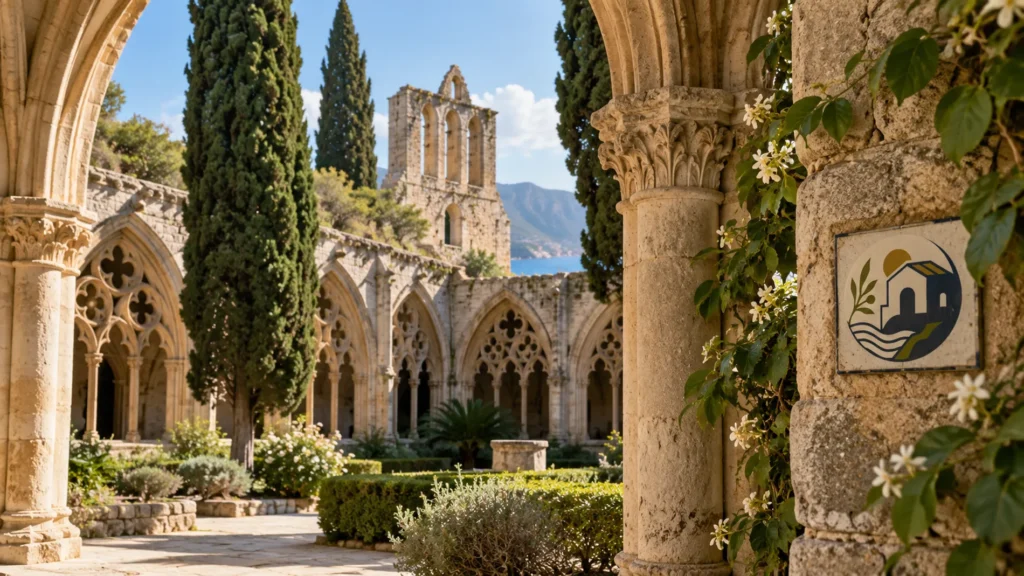
What it is. The monastery’s inner courtyard, enclosed by an arcaded gallery. It is not a separate attraction in its own right but part of the abbey complex. Even so, it deserves special attention: most visitors simply pass through the cloister on their way to the panoramic terrace and miss what makes it remarkable. Based on the chronology of the abbey’s construction, the cloister is generally associated with the reign of Hugh IV and therefore dates to the 14th century.
Where it is and how to get there. The cloister is inside the abbey, on the left after the church. There is no separate entrance; access is included with the monastery ticket. It is reached on foot, and there are no significant changes in elevation within the courtyard itself.
What to look for. Three details are especially worth noticing. The first is the proportion of the arches: they are strikingly tall and slender, making the relatively small courtyard feel much more spacious than it actually is. The second is the carving on the corbels and capitals. Their state of preservation varies, and some details have been lost, but fragments of floral motifs and figurative scenes can still be clearly made out.
The third is the light. Around midday, the courtyard is bright and high-contrast, with hard, sharply defined shadows. Toward evening, the stone takes on a warmer tone and the arches cast a softer pattern of shadows across the paving. The cypress trees in the courtyard act as strong vertical accents and appear in almost every photograph — they are one of the elements that make the classic image of Bellapais instantly recognizable.
Opening hours and admission. These are the same as for the abbey itself. There is no additional charge, as access to the cloister is included in the general admission ticket. Keep in mind that during preparations for concerts or other events, access to certain parts of the complex may be temporarily restricted.
How much time to allow and who will enjoy it. Fifteen to twenty minutes is enough, but these are minutes well worth taking. This spot will appeal especially to people who experience architecture as a space rather than as a list of dates — here, you can physically sense why monks needed an enclosed courtyard in the middle of a mountain slope.
If you are taking photographs, stand beneath the gallery and shoot outward: the arch will create a natural frame for the view.
3. Abbey Refectory
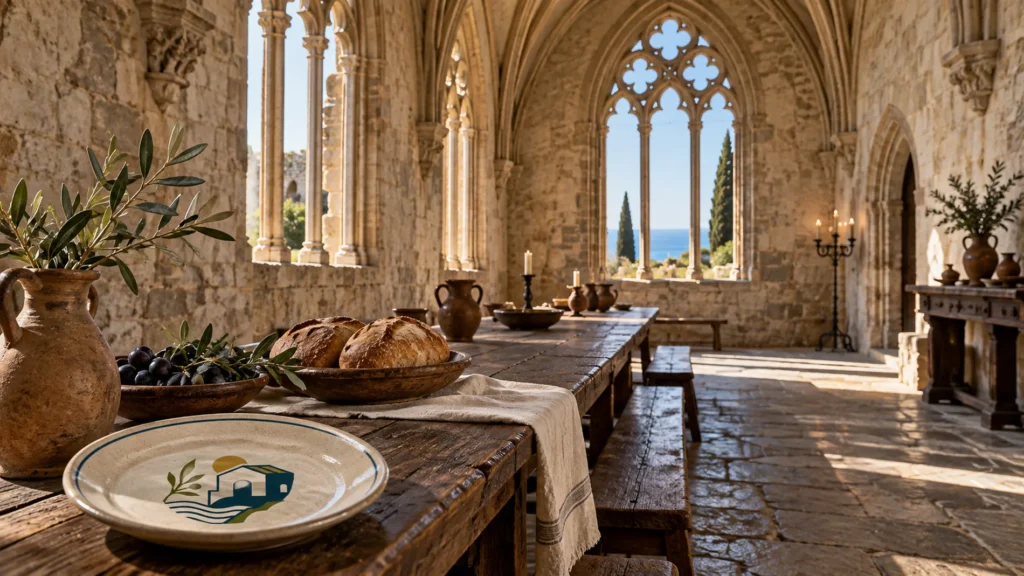
What it is. The monastery’s principal hall and arguably the most impressive interior in the entire complex: a long chamber beneath a high pointed vault, where the canons once ate in silence while listening to a reader. Its construction dates to the same period as the cloister. During the British period, the hall was put to more practical uses; sources mention, among other changes, the installation of a cement floor and the adaptation of the space for use as a military hospital.
Where it is and how to get there. The refectory is inside the abbey and is reached almost directly from the cloister gallery. There is no separate entrance or dedicated route.
What to look for. Pay particular attention to the reader’s pulpit built into the thickness of the wall, reached by a narrow staircase — one of the details visitors most often overlook. Also notice the row of tall windows in the north wall. They open directly onto the hillside, giving sweeping views down toward Kyrenia and the sea. The effect is unusual: a medieval dining hall with something close to panoramic glazing.
It is also worth simply standing in the centre of the room and listening. The refectory has pronounced acoustics, which helps explain its modern-day use.
Opening hours and admission. Entry is included in the general abbey ticket and follows the same opening hours. The refectory is also used as a venue for concerts and lectures, and musical events featuring local and international performers are commonly held here in spring and early summer. Schedules should always be checked separately, as specific dates change from year to year, and the chances of simply happening upon a concert are very slim. Tickets for these events are sold separately from standard admission.
How much time to allow and who will enjoy it. Allow around 15–25 minutes for a normal visit, or an entire evening if you are attending a concert. The hall tends to impress even visitors with little interest in medieval architecture, largely because of its sheer scale. It makes the most sense to see it immediately after the cloister, as the third stop within the complex.
4. Panoramic Viewpoints in Bellapais

What it is. This is not a single attraction, but a collection of places offering sweeping views over the coastline. There is no official purpose-built observation deck in the village, and there is no need to invent one: in Bellapais, the panorama is simply part of the landscape.
Where it is and how to get there. Views open up from the terrace near the abbey, from the refectory windows, from several bends in the streets below the main square, and from the road leading up from Kyrenia. Another excellent vantage point lies a little above the village, about a ten- to fifteen-minute walk uphill from the square. All of these spots are easily reached on foot, with no need for separate transport.
What to look for. The main outlook faces northwest. Below, the plain stretches out in a patchwork of olive groves and citrus orchards, followed by the coastal development, then Kyrenia and, beyond it, the line of the sea. On a clear day, the horizon seems to extend almost indefinitely. The village’s elevation explains almost everything about the character of Bellapais: the cooler evenings, the sense of distance from the noise of the beach resorts, and the fact that almost every walk from home involves some kind of slope.
Opening hours and cost. Viewpoints outside the monastery are accessible around the clock and free of charge. The panoramas from within the abbey grounds are available only during opening hours and require an admission ticket. The light is generally best in the first half of the day and again closer to sunset. At midday, harsh contrast tends to flatten the landscape, while the sea can merge with the sky into a pale, washed-out strip. There is little point in promising a specific “golden shot,” as visibility depends heavily on haze, which can be surprisingly dense in summer even on cloudless days.
How much time to allow and who it is for. The views do not really require a separate stop, since they accompany you throughout the route. Even so, it is worth deliberately setting aside 20–30 minutes simply to stand and take everything in without a camera. This is especially useful for anyone considering Bellapais as a place to live, because from these viewpoints you can clearly see how far the village really is from both the sea and the city.
5. The Old Village Streets
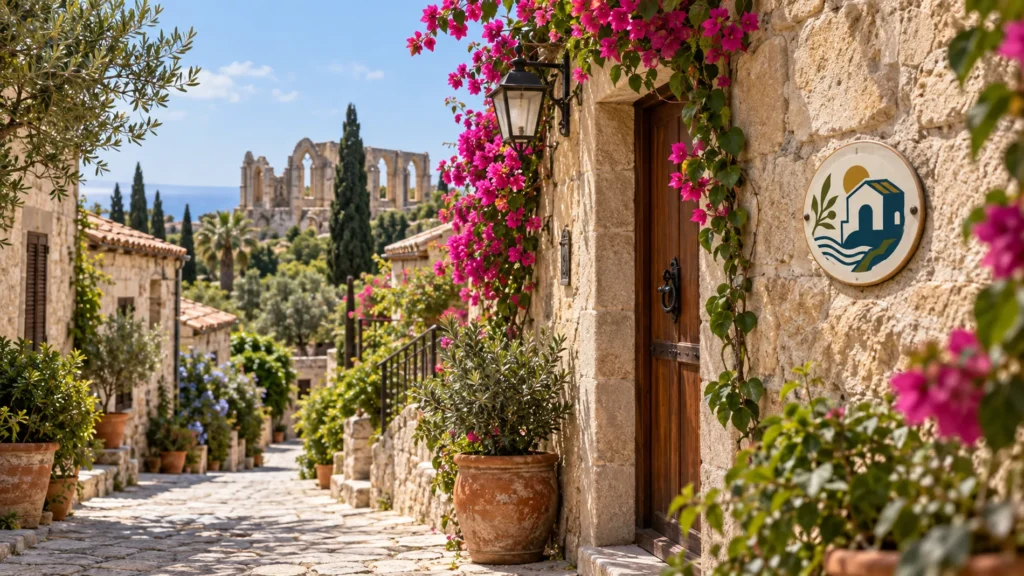
What it is. The most underrated part of Bellapais is the village’s residential heart, with its traditional stone houses beginning where the signposts and obvious visitor routes end.
Where it is and how to get there. Simply turn off the main square into almost any side lane and walk 100–200 metres downhill. No transport is needed — or even possible in many places: a number of the streets are effectively stairways, far too narrow and steep for a car. Bear in mind that the walk back is uphill.
What to look for.
- old wooden doors with wrought-iron hinges and weathered, darkened paint;
- stone arches spanning passageways between houses;
- bougainvillea and jasmine forming canopies over entire lanes;
- stairway streets and secluded courtyards hidden behind high gates;
- the contrast between original masonry and later restoration work, visible in the joints and the way window openings have been set;
- the everyday details of a lived-in village: drainage channels, wall niches, and house numbers.
Opening hours and cost. Access is free at any time. The only real restriction is one of basic courtesy: these courtyards belong to people who live here; they are not part of a film set, so do not enter through private gates or photograph residents without permission. The streets are also poorly lit after dark, with relatively few street lamps.
How much time to allow and who it suits. Set aside 40–60 minutes. This walk offers something the abbey cannot: a sense of everyday scale and lived reality. The abbey tells you about Bellapais’s history; the streets show you its present. For anyone considering a move here, this is one of the most important parts of the route, because it makes clear that “living in Bellapais” and “visiting Bellapais” are two very different experiences.
6. Lawrence Durrell’s House
What it is. British writer Lawrence Durrell lived in Bellapais in the 1950s while working on Bitter Lemons of Cyprus, the book that later helped give the village much of its literary reputation. His former home remains one of the most recognisable literary landmarks in Bellapais.
Where it is. The house stands uphill from the abbey and can be identified from the street by a plaque. Lonely Planet places it roughly 200 metres uphill from the village centre, making it an easy addition to a walking route through the old streets. It is now a private residence, so visitors should treat it as an exterior stop rather than assume it operates as a conventional museum. Lonely Planet currently notes that public access is highly limited.
What to look for. The main value of the stop is its context: the relationship between the house, the steep village streets and the landscape Durrell described in Bitter Lemons of Cyprus. It works best as part of a short literary walk rather than as a standalone attraction.
How much time to allow. Ten to fifteen minutes is sufficient for most visitors. Stay on the public street, respect the privacy of residents and do not enter private property.
7. Tree of Idleness

What it is. The “Tree of Idleness” is one of Bellapais’s most talked-about — and most disputed — landmarks. The legend is simple: anyone who sits in its shade loses all desire to work. Lawrence Durrell mentions the tree in Bitter Lemons, and after the book was published, it became part of the village’s tourist folklore.
Where it is and how to get there. It is said to be near the monastery gates, on the main square — roughly a 30-second walk from the abbey ticket office. There is no need to make a separate trip to find it; you will naturally pass through the area on your way around the village.
What to look for. The complication is that there is no universally accepted identification of one specific tree. Several establishments near the monastery associate themselves with the story in different ways, and sources do not agree on which tree, if any, should be considered the original. Claiming that one particular tree is definitely the one beneath which Durrell sat would be a stretch. It makes more sense to take in the square itself: the shade, café tables, conversations, and unhurried pace of life all fit remarkably well with the village’s reputation.
Opening hours and cost. The square is always accessible and free to visit. If you sit down at a table beneath one of the trees, however, you are effectively visiting a café, with its own opening hours and prices. Prices vary considerably between establishments, so check the menu before ordering rather than assuming that cafés around the square follow the same pricing.
How much time to allow and who it suits. Half an hour here over coffee can tell you more about the character of Bellapais than another circuit of the monastery. Visitors travelling with children or those focused on ticking off specific “sights” may find this stop rather uneventful. For anyone who enjoys literary tourism, local legends, and atmosphere, however, it can be one of the village’s most charming experiences.
8. Village Cafés and Terraces
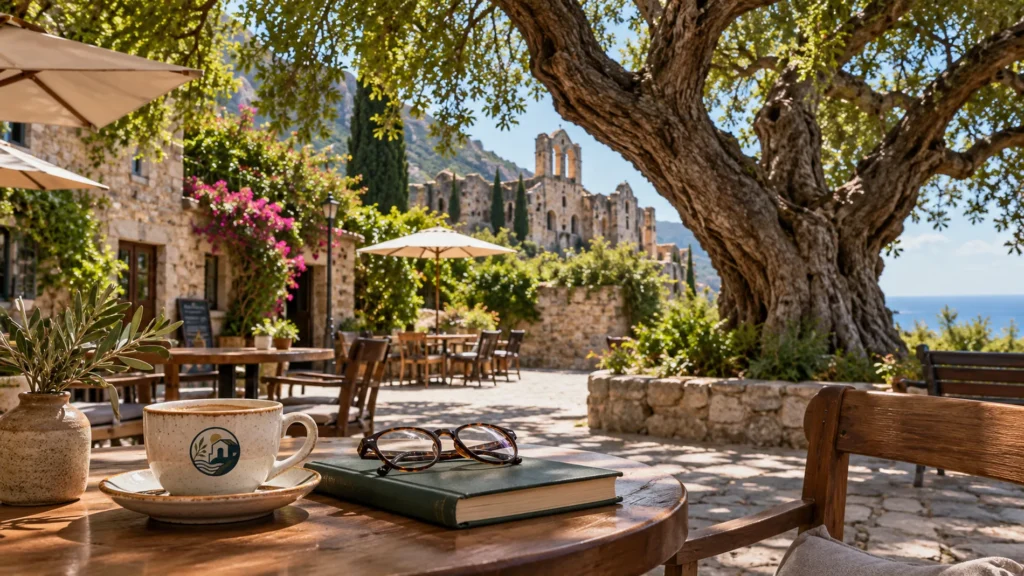
What it is. This is not so much a list of restaurants as an essential part of the route. Bellapais is the kind of village that is difficult to appreciate properly without taking a break: after an hour spent walking over stone streets in the sun, you will want to sit down.
Where it is and how to get there. Most cafés and restaurants are concentrated around the square in front of the abbey and along the upper street of the village. A few places can also be found lower down in the residential part, where the atmosphere is usually quieter. Everything is within walking distance of the parking area, so no additional transport is needed.
What to look for. The main attraction here is the view rather than the interior. Almost every terrace takes advantage of the hillside setting, opening out toward the coast below. One of the most interesting things to watch is how the atmosphere changes throughout the day: Visitor numbers often change noticeably over the course of the day. The square can feel busier during popular sightseeing periods and quieter later on, although the pattern varies by season, day and organised-tour schedules. In Bellapais, you are paying not only for the food, but also for the view, and it is worth setting your expectations accordingly.
Opening hours and prices. Opening times vary from place to place and are strongly seasonal. In winter, some establishments operate reduced hours or close altogether for several months. Prices vary between establishments and can change over time, so it is more useful to check the current menu before ordering than to rely on older price guides. During high season, it is advisable to reserve a table in advance if you want dinner with a view.
How much time to allow and who it suits. Allow around 45–90 minutes. A café stop fits naturally between visiting the abbey and walking through the village streets, or, alternatively, as the final part of the day before heading back down to Kyrenia. It suits anyone who prefers a slower pace rather than trying to tick off as many sights as possible. If you are travelling on an organised coach tour with a strict schedule, however, you will most likely not have enough time for it.
9. Mountain Walks Around Bellapais
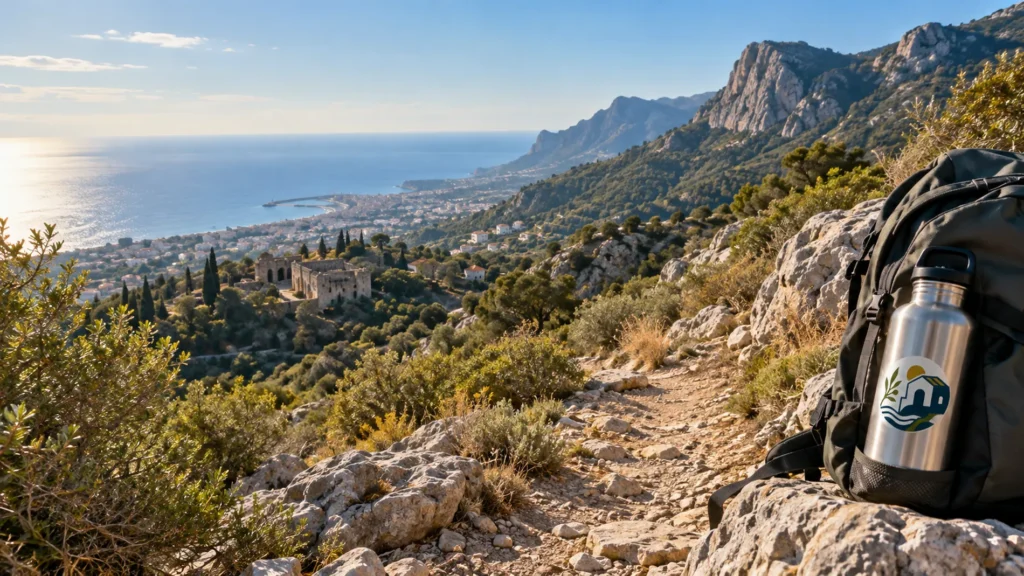
What it is. Walking routes along the lower slopes of the Kyrenia mountain range, known in Turkish as Beşparmak and in Greek as Pentadaktylos — “Five Fingers.” Bellapais effectively sits on the mountainside itself, giving visitors access to walking opportunities that coastal villages simply do not have.
Where it is and how to get there. The routes begin above the village, where dirt roads and footpaths wind through pine trees, olive groves, and Mediterranean scrub. Below Bellapais lie old agricultural terraces. The easiest starting point is from the upper streets of the village, continuing on foot. You can drive closer to the beginning of some trails, but parking is generally limited to the roadside along narrow mountain roads.
What to see. Look for the way the vegetation changes with elevation, the remains of old terraces and irrigation channels, and views back down over Bellapais from above — a perspective you are unlikely to find on any postcard. In spring, the slopes are green and full of flowers; by autumn, the landscape becomes dry, stark, and almost graphic in character.
Opening hours and cost. Walking on public roads and accessible paths around the village generally does not require an admission fee. Conditions, access and trail maintenance can vary, so longer routes should be checked before setting out. However, marked hiking routes in this area vary considerably in quality and maintenance, so do not attempt a serious hike without an up-to-date map, a verified GPS track, and enough water. Walking after dark is not recommended: there is no lighting, and the terrain is rocky and uneven. In summer, it is far more sensible to go early in the morning before the heat builds.
How much time to allow and who it suits. For most visitors, a sensible option is to spend around one to one and a half hours walking along the roads and paths above the village, returning by the same route. It is best suited to people who walk regularly and want to understand what lies beyond Bellapais’s picturesque village façade. Visitors with limited mobility may prefer to skip this section: the gradients here are very real, not merely scenic.
10. Kyrenia as the Next Stop on the Route
What it is. A seaside city with an ancient harbour, an imposing fortress, and a compact historic centre. It is included in this ranking with one important clarification: Kyrenia (Girne) is not part of Bellapais. It lies roughly five kilometres downhill and is a separate city in its own right, so the two should not be confused.
Where it is and how to get there. Simply follow the same road back down from the village that you used on the way up. By car, the journey takes only a few minutes; by dolmuş, allow around half an hour including waiting time. Walking downhill is theoretically possible, but walking back up is another matter unless you are prepared for a fairly strenuous climb.
What to see. Start with the Old Harbour, lined with fishing boats and restaurants around virtually its entire perimeter. Then visit Kyrenia Castle, home to the Shipwreck Museum, before exploring the narrow streets of the old town just behind the waterfront. After the quiet, elevated atmosphere of Bellapais, the city feels noticeably more dynamic — and all the more memorable because of that contrast.
Opening hours and admission. The harbour and surrounding streets are always accessible and free to explore. The castle and museum charge admission and operate on seasonal schedules, so check current opening hours and ticket prices separately, as they do not follow the same timetable as Bellapais Abbey. The most practical way to plan the day is simple: the abbey and village reward a slower pace and are best visited in the morning, while the harbour comes into its own in the evening, when the temperatures ease and the waterfront lights come on.
How much time to allow and who it suits. Allow at least two hours for the harbour, or half a day if you also want to visit the castle and explore the historic centre properly. Kyrenia is ideal for anyone who leaves Bellapais wanting more energy, a wider choice of restaurants, and direct access to the sea. We cover the city in greater detail in our guide to the top attractions in Kyrenia, but for the purposes of this route, the key point is that Kyrenia provides exactly what Bellapais, by its very nature, does not.
What to See Nearby
All of the places in this section are located outside the village and require a trip by car or taxi. They are not attractions in Bellapais itself, but they make logical additions to the same day’s itinerary. The format below follows the same structure as above.
St Hilarion Castle. This dramatic fortress sits high on the rocky ridge above the mountain pass. From Bellapais, you need to drive back via the coastal road; there is no direct mountain road connecting the two sites. Highlights include the castle’s three defensive levels, the royal apartments on the upper tier, and sweeping views across the entire coastline, including the slopes around Bellapais. Moving between the different levels involves uneven steps and rocky paths, and reaching the highest point requires a fair amount of effort. Admission is charged, opening arrangements are seasonal, and current hours should be checked separately before visiting. Allow around 1.5–2.5 hours and wear proper footwear.
Kyrenia Castle and the Old Harbour. These are down in the city, at the eastern end of the harbour. Kyrenia Castle charges an entrance fee and contains the Shipwreck Museum, home to the remains of an ancient merchant vessel. Walking the walls and seeing the exhibitions takes considerably longer than the castle may appear to require from the outside. The harbour is immediately adjacent, free to visit, and accessible at any time. Most visitors combine the two in a single stop and should allow around 2–3 hours.
Ozanköy and Çatalköy. These neighbouring villages lie along the same foothill belt and are noticeably less tourist-oriented than Bellapais. There is little to see here in the conventional sightseeing sense, and there are no admission fees, but for anyone comparing the foothill districts as potential places to live, spending half an hour driving through them is well worthwhile.
Vounous. This site provides important archaeological context for the wider area. Vounous is an Early Bronze Age necropolis whose 1931–1932 excavations were documented in an academic study of Vounous-Bellapais published in Archaeologia. It is not a developed visitor attraction with a ticket office and directional signs, but rather a site of scholarly archaeological interest. Its importance lies in the much deeper archaeological history of the wider Bellapais area: the Early Bronze Age necropolis documents funerary activity here thousands of years before the medieval abbey was built.
| Place | Location relative to Bellapais | Time to allow | Best suited to |
|---|---|---|---|
| St Hilarion Castle | Higher along the ridge; requires a separate drive | 1.5–2.5 hours including the climb | Visitors comfortable with steep steps and heights |
| Kyrenia Castle | Down in the city, beside the harbour | 1–2 hours including the museum | History and archaeology enthusiasts, families |
| Kyrenia Old Harbour | Down in the city centre | 1–2 hours, ideally in the evening | Everyone; an excellent way to end the day |
| Ozanköy and Çatalköy | Neighbouring villages on the same foothill slopes | 30–60 minutes by car | Those comparing foothill areas as potential places to live |
Driving times between these places are usually fairly short, but they cannot be guaranteed. During the high season, traffic on the coastal road and on the approaches to Kyrenia can become heavy, while the mountain roads themselves are narrow.
How to Spend a Day in Bellapais
In Bellapais, the order in which you visit places matters more than the number of stops you manage to fit in. Below is the itinerary that works best for a full day starting from Kyrenia.
- Morning, right at opening time — the abbey. The air is cooler, the light is softer, and visitor numbers are at their lowest. Start with a quick walk through the entire complex, then make a second, slower circuit focusing on the details: the church, cloister, refectory, reader’s pulpit, and the vaulted rooms below.
- After the monastery — the old streets. Walk 150–300 metres downhill from the square and explore two or three side streets. This is where the atmosphere of organised sightseeing quickly disappears.
- The Durrell house and literary landmarks. Stop briefly by the façade and its plaque, without intruding on private property, then make your way back towards the square.
- Coffee or a long lunch on a terrace. Take a break before you are tired, not after. In hot weather, it is much harder to recover your energy once it is gone.
- A panoramic walk. Follow the road uphill from the village for around forty minutes in one direction. If you would rather avoid the climb, walk to the end of the upper street and return the same way.
- Evening — Kyrenia or St Hilarion. The castle takes energy and is better visited before lunch; the harbour is the opposite and is at its best after six in the evening.
| If you have | Best format |
|---|---|
| 2 hours | The abbey and the square only: see the full complex, take a short walk around the exterior, then have coffee on a terrace |
| Half a day | The abbey, a walk down through the old streets, the Durrell house, lunch with a view, then head back downhill |
| A full day | The same itinerary, plus a panoramic walk above the village and an evening in Kyrenia, or St Hilarion before lunch |
If the choice is between “seeing more sights” and “spending longer in Bellapais,” choose the latter. The village is not about ticking off attractions. It reveals itself through the time you spend there and through the changing light from morning to evening.
When Is the Best Time to Visit?
The difference between early morning and midday in Bellapais is greater than the difference between some seasons. At monastery opening time, there are few visitors, the stone has not yet heated up, and the air is clearer. Visitor numbers can increase noticeably during the middle of the day, particularly when organised tours are visiting the abbey. The village often feels quieter earlier in the morning and later in the day, although the pattern varies by season and tour schedules.
Seasonally, the pattern is typical of the Mediterranean, though the village’s elevation changes things slightly. Spring is often one of the most comfortable periods for exploring Bellapais on foot, when the surrounding hills are greener and temperatures are generally more suitable for walking. Autumn can also be a comfortable time to visit, although conditions vary from year to year. In summer, Bellapais is noticeably cooler than the coast thanks to its elevation and breeze, but the monastery’s open courtyards can still feel like a furnace. In July and August, an early visit is generally more comfortable in the heat. A later visit can also work if the current abbey opening schedule allows it. Winter can bring rain and low cloud, and the panoramic views may disappear entirely, but there are very few tourists. Opening hours are also shorter in winter, so arriving “towards evening” is often no longer practical.
Another factor is the cultural programme. The refectory is used as a concert venue, and musical events are often held here in spring and early summer. Dates and programmes vary from year to year, so current event schedules, opening hours, and admission prices should always be checked through official sources shortly before your visit.
Bellapais Through the Eyes of a Future Resident
A short walk through the village can tell you surprisingly much about Bellapais as a place to live — provided you look beyond the arches and the views.
The first thing you notice is the terrain. Bellapais sits on a hillside, and the gradient is not merely a scenic feature; it is part of everyday life. Two hundred metres on a map may involve a climb that feels very different in summer with shopping bags than it does in spring when you are travelling light. In a mountain village, walkability is measured not only by distance, but by elevation change. The same applies to parking: at some homes you can leave the car right outside the door, while at others the nearest space may be several dozen metres uphill or downhill.
The second factor is the distance from Kyrenia. Although Kyrenia is only a short drive downhill, Bellapais’s hillside location can make everyday life considerably more car-dependent, especially for groceries, school runs, work and evening plans. Anyone who does not drive should realistically consider what an ordinary week would look like when relying on dolmuş minibuses that may run only at roughly hourly intervals.
The third factor is tourism. Visitor activity is concentrated around the monastery and nearby cafés, and during the season this part of the village can feel quite busy. Walk just two or three hundred metres downhill or off to one side, however, and the atmosphere changes completely: ordinary residential streets, quiet, neighbours going about their day. The tourist centre of Bellapais is not the same thing as residential Bellapais, and the difference between individual streets can sometimes be greater than the difference between entire neighbourhoods elsewhere.
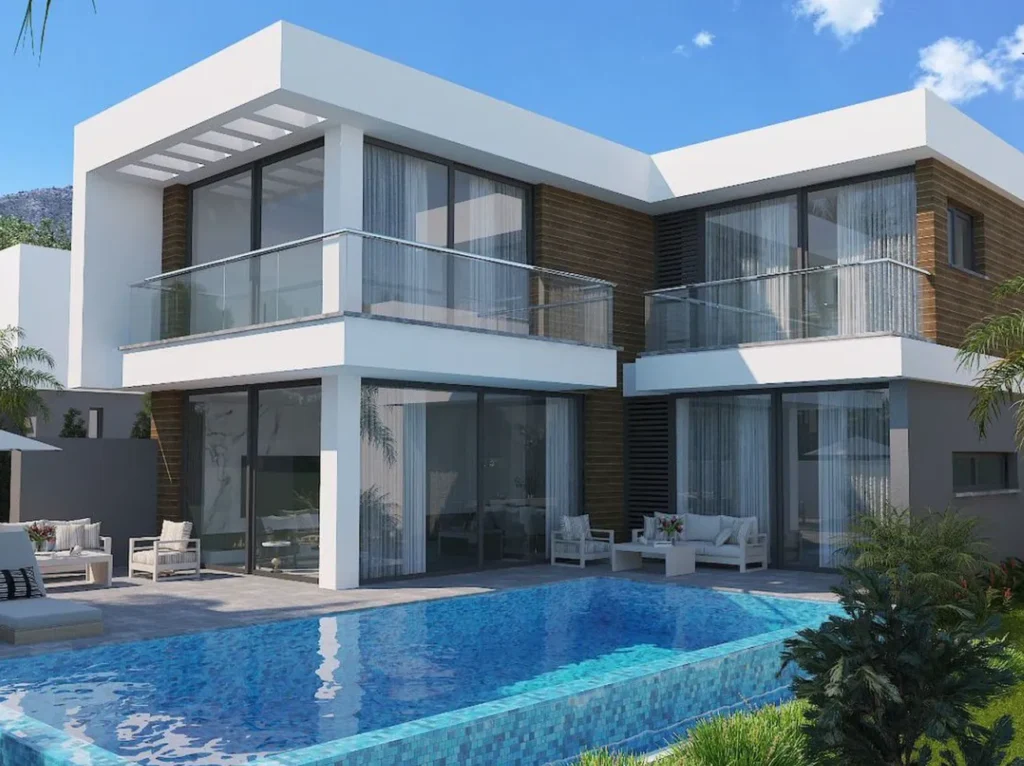
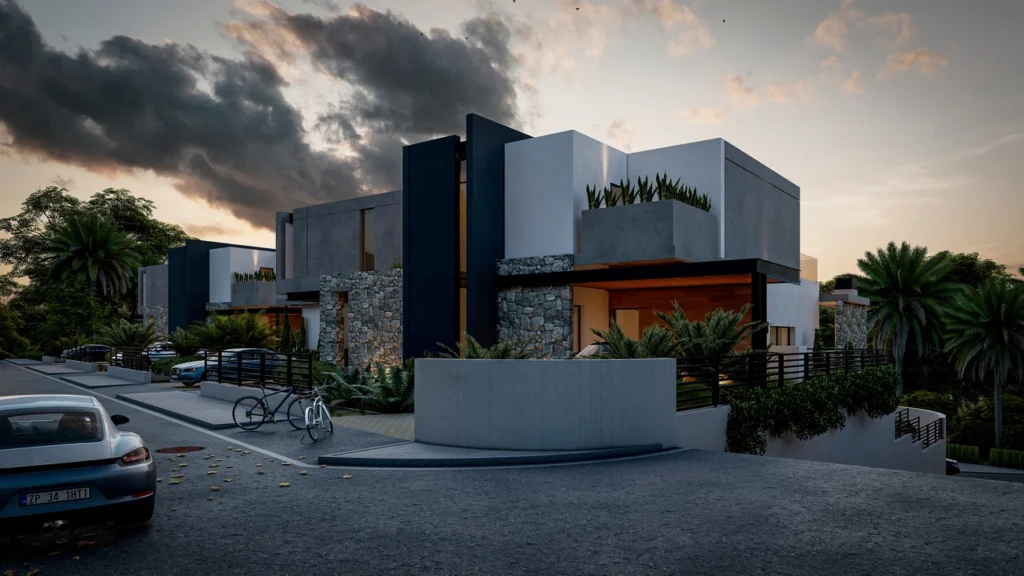
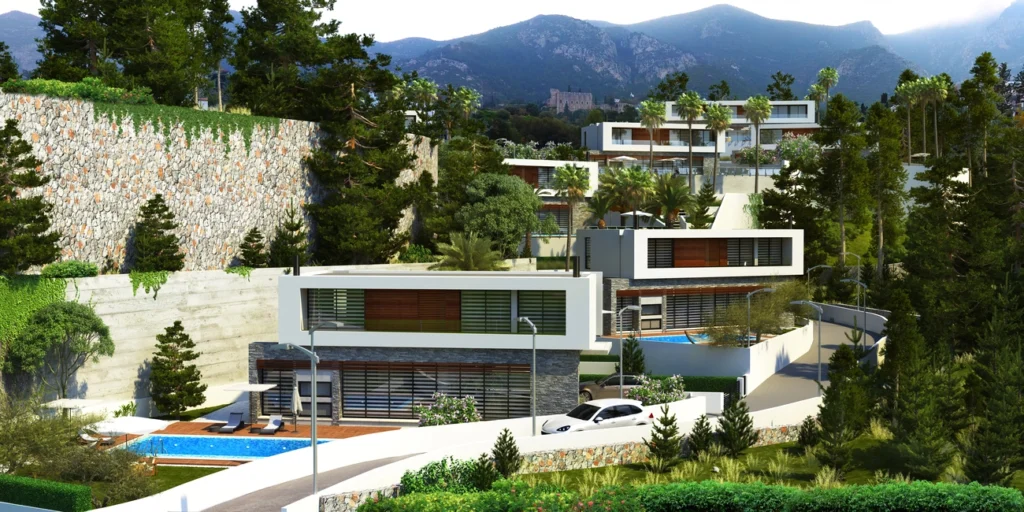
The fourth factor is the housing itself. The village combines old stone houses, carefully restored properties, and modern villas built on the slopes above and below the historic core. These are very different ways of living, with different infrastructure, different levels of privacy, and different standards of road access. Any property should therefore be assessed in its exact location rather than judging “Bellapais as a whole” from attractive photographs.
If you are considering Bellapais not just as a place to visit but as somewhere to live, walk through it twice — once in the morning and once in the evening. The abbey square in the middle of the day and a quiet residential street at nine at night can feel like two entirely different places, and it is worth experiencing both before making a decision.
The fifth and most general point is that the things that make a place attractive to visitors are not necessarily the things that make it easy to live there permanently. A visitor pays for the view and the silence for three hours. A resident pays for them every day — through steep roads, driving, seasonal fluctuations in visitor traffic, and the need to plan trips down into town. For some people, that trade-off is ideal; for others, it is not. Visiting in person is one of the best ways to judge whether those trade-offs suit your everyday routine.
To compare Bellapais with nearby locations, see our separate guides: our overview of Bellapais as a place to live and our detailed guide to Kyrenia. If you prefer a more coastal lifestyle, our guide to Lapta may also be useful.
Find a property that fits the way you want to live
If you are considering Bellapais, Kyrenia, or other areas of Northern Cyprus, you can take a short property-matching quiz to narrow down suitable options based on your budget, the purpose of your stay, and your preferred type of home: find a property. The World Estate Homes team can help refine the shortlist and arrange viewings on the ground.
Practical Tips
- Your footwear matters more than your route. The stone slabs inside the monastery have been polished smooth by centuries of foot traffic, and some of the village streets are quite steep. Flat shoes with non-slip soles are essential; flip-flops and heels are best avoided.
- Plan for the walk back up. Walking downhill through the lanes is enjoyable; climbing back to the parking area is less so. In hot weather, allow roughly twice as much time for the return journey.
- Parking close to the historic centre can be limited, particularly at busier times. Check the available parking areas when you arrive and be prepared for a short uphill walk if the closest spaces are occupied.
- Check opening hours in advance. Summer and winter schedules differ, information varies between sources, and concerts or special events can sometimes affect access to certain parts of the complex.
- Carry some cash as a backup. Payment options can vary between cafés, small businesses and parking facilities, so it is useful not to rely exclusively on a bank card.
- Bring water with you. Drinks are available within the complex and around the village square, but once you head farther uphill beyond the village, there may be nowhere to buy them.
- Treat the monument with respect. Do not sit on historic masonry, lean against carved architectural details, or cross barriers into restricted areas.
- Respect residents’ privacy. Residential courtyards are people’s homes. Avoid photographing residents or peering into windows, including around the Durrell house.
- Combine Bellapais with Kyrenia thoughtfully. Trying to fit two packed sightseeing programmes into one day can be exhausting. It is better to explore the village at an unhurried pace and spend the evening by Kyrenia Harbour than to rush through everything at once.
Is Bellapais Worth Visiting?
Bellapais is well worth the trip for three types of travellers: those interested in medieval architecture, those who enjoy slow travel without a packed itinerary, and those staying in Kyrenia who want to see what Northern Cyprus looks like from around 200 metres above the sea. The ideal amount of time to set aside is half a day, arriving when the abbey opens and making a point of exploring beyond the central square.
What sets the village apart from an ordinary tourist attraction is that its historic monument is not separated from everyday life. Although entry to the abbey itself is controlled, the monument sits directly within the historic village rather than in an isolated archaeological zone. Cafés, homes and village streets begin immediately around the complex. People drink coffee beside its walls, while across the road others simply go about their daily lives. The result is a rare sense of continuity: eight centuries of history, village life, and a tour group all sharing the same scene.
For anyone considering the area as a place to relocate, a visit reveals far more than any collection of property listings ever could. Within a few hours, you begin to understand the things photographs cannot show: how steep the roads really are, where the tourist zone ends, what the village sounds like in the evening, and how long the journey down actually takes. These are the details that shape everyday comfort, and exploring the area on foot is one of the best ways to understand them before making a decision.
 Real estate in Georgia
 Real estate in Montenegro
 Real estate in the UAE
 Real estate in Bali
 Real estate in Thailand
 Real estate in Spain
 Real estate in Saudi Arabia
 Real estate in Turkey
 Real estate in Zanzibar
 +90 533 888 29 50
 hello@cypria.homes
 Karsıyaka Sokak 8, Girne


 Get catalogue of TOP-7 objects