
 +90 533 888 29 50



You have found a property on Northern Cyprus that fits your plans. The price is agreed, the developer or seller is ready to proceed — but you cannot travel to the island to sign documents in person. This is precisely where a power of attorney (POA) becomes relevant.
A properly prepared power of attorney allows a named representative to act on your behalf for specific legal and administrative steps in the property purchase. It does not transfer ownership. It does not replace the Permission to Purchase that foreign buyers must obtain. What it does is give your authorised representative the defined authority to sign particular documents, submit applications and interact with the Land Registry — all without you needing to be physically present at each stage.
Quick answer: A power of attorney for buying property in North Cyprus is a legal document that authorises a named representative — typically an independent local lawyer — to act on your behalf during the purchase process. It is not mandatory if you attend in person, but buyers who cannot attend each stage may appoint a representative. The scope of authority must be clearly defined; the document must be signed, certified and delivered in a form acceptable to the receiving authority. It does not guarantee Permission to Purchase, and it does not replace independent legal due diligence on the property itself.
This guide explains what a POA covers, how to prepare and sign one from abroad, which powers to grant and which to limit, how to protect your money and your interests, and what the document cannot do on its own.
Important: This guide provides general information, not individual legal advice. Have an independent lawyer confirm the current requirements before signing or relying on a power of attorney.
Power of Attorney in North Cyprus: Key Facts at a Glance
| Question | Quick answer |
|---|---|
| Is a POA mandatory? | No, if you can complete the required procedures personally |
| Who can represent you? | A suitably authorised person; many buyers choose an independent local lawyer |
| Which POA is preferable? | A transaction-specific POA with clearly limited powers |
| Can it be signed abroad? | Yes, subject to the receiving authority’s certification requirements |
| Is a passport required? | Identity verification is normally required; your lawyer should confirm acceptable documents |
| Does an apostille automatically work? | No. The acceptable authentication route must be confirmed in advance |
| Does a POA transfer ownership? | No. Legal title transfer is a separate procedure |
| Contract registration | Generally within one month for transactions covered by Decree-Law 119/2026, subject to its conditions |
| Title-transfer fee payment | Generally within 75 working days after publication of purchase permission |
| Title transfer | Generally subject to a one-year period, with statutory rules affecting when it begins |
| Can the POA be revoked? | Generally yes, following the applicable formalities and notification requirements |
The statutory deadlines above concern the property purchase, not the time needed to issue a power of attorney. Their application depends on the transaction and current legislation.
What Is a Property Power of Attorney?
A power of attorney is a legal instrument by which one person — the principal — formally authorises another person — the attorney or authorised representative — to carry out defined actions on their behalf. In a North Cyprus property purchase, the principal is the buyer. Buyers often consider appointing an independent locally qualified lawyer, although another suitable representative may be authorised where the receiving authority accepts that arrangement.
The document is not a contract for services. A retainer or fee agreement with a lawyer governs the professional relationship. The POA governs what that lawyer is legally permitted to do in your name. Both documents may be needed, but they serve different functions.
A POA becomes useful — though not always compulsory — when a buyer cannot attend every step of the transaction in person. That might mean signing a sale contract, registering it at the District Land Registry Office, submitting the Permission to Purchase application to the TRNC Ministry of Interior, or attending the final title deed transfer. Not all of these steps require a POA; some buyers are present for the key signing moments and delegate only administrative tasks. Others complete the entire purchase remotely.
The most important distinction to understand before drafting the document is the difference between a limited (specific) POA and a general POA.
| Type | Scope of authority | Potential risk | Practical suitability |
|---|---|---|---|
| Limited / Specific POA | Covers named tasks only — e.g., signing a specific contract, submitting a named application | Lower risk; each action requires a corresponding authority | Recommended for most property purchases; limits exposure if instructions are misunderstood |
| General POA | Grants broad authority over financial and legal matters | Higher risk; representative could theoretically act beyond buyer’s intentions | Rarely advisable for a single property transaction; more suited to ongoing representation |
A general POA may feel convenient, but it creates significant exposure. If your representative has authority over your finances broadly, a dispute or misunderstanding becomes considerably harder to resolve. For a single property purchase — even a complex one — a carefully drafted limited POA tied to specific actions, a specific property and a defined time frame offers far better protection.
Can You Arrange a POA Before Choosing a Property?
Yes, you may discuss arranging a power of attorney before selecting a property. However, a document granting authority to purchase any property at any price can expose you to unnecessary risk.
If your shortlist is not yet final, consider limiting the initial authority to specified administrative tasks. You can then ask your lawyer whether a new or amended transaction-specific POA is needed once the property, seller, purchase price and contract terms have been confirmed. Never assume that an existing POA automatically covers a different property or an amended contract.
For a fuller explanation of the purchase process this document sits within, see “How to buy property in North Cyprus“.
Who Can Act on Your Behalf?
Foreign buyers may appoint a local independent lawyer as their attorney, which can be a practical option where Turkish-language documentation and Land Registry procedures are involved. This is not merely a matter of convenience — a locally qualified representative needs to understand TRNC property law and know the procedural expectations of the Land Registry and Ministry of Interior.
“Independent” is the critical word. Your lawyer should have no financial interest in the property being sold, no ongoing relationship with the developer or seller that could create a conflict, and no arrangement with the estate agency that creates pressure to complete a particular deal. Cypria Homes can assist with property selection and help coordinate introductions, but it does not replace independent legal counsel — and reputable agencies will say the same.
When assessing a potential representative, consider the following:
- Are they registered with the TRNC Bar Association?
- Do they carry professional indemnity cover?
- Have they handled property purchase transactions for foreign buyers before?
- Can they clearly explain what they will and will not do under the POA?
- Will they provide written confirmation of actions taken and documents lodged?
A representative need not necessarily be the buyer’s lawyer, but the eligibility of a proposed non-lawyer and their authority to carry out each task must be checked with the receiving body. In practice, however, the procedural requirements of a North Cyprus property transaction — including Land Registry interactions, the Permission to Purchase application, and potentially the title deed transfer — make a legally trained local representative the substantially more practical choice.
How to Verify the Lawyer Before Signing a POA
Before appointing a representative, request their full professional name, firm details, registration information and written terms of engagement. Check professional registration using the relevant Bar Association’s official channels rather than relying solely on a developer’s or estate agent’s recommendation.
Ask the lawyer to confirm who will personally act under the POA, who will hold the original document, how copies will be controlled and how you will receive evidence of each completed action.
If the lawyer recommends another representative or proposes to delegate any authority, obtain a written explanation before agreeing.

What Powers Should You Grant?
This section deserves careful thought before any document is drafted. The powers listed in your POA define exactly what your representative can and cannot do. Vague or overreaching authority creates the conditions for error, dispute or misuse. Overly narrow authority may mean your representative cannot complete the steps the purchase actually requires.
The following categories of power are commonly relevant to a North Cyprus property purchase.
Powers that may be needed, depending on the transaction and the steps the buyer cannot complete personally:
- Receiving and reviewing Land Registry searches and official searches relating to the specific property
- Signing a named sale and purchase contract on your behalf
- Registering that contract at the District Land Registry Office within the applicable deadline
- Submitting and following up the Permission to Purchase application to the TRNC Ministry of Interior on your behalf — noting that, under the Ministry’s own guidance, applications can be made personally, through a lawyer, or through an authorised representative
- Signing documents related to the title deed transfer once all applicable conditions have been met
- Paying defined taxes and official fees from funds provided for that purpose
Powers that require careful consideration:
- Receiving sums of money on your behalf
- Changing the agreed purchase price or terms
- Substituting a different property
- Placing a mortgage or charge on the property
- Delegating the attorney’s authority to another person (sub-delegation)
- Cancelling or substantially varying the sale contract
This second category should generally either be excluded or be subject to explicit written approval from you before any such action is taken. Even where a buyer trusts their representative completely, granting unlimited financial authority in a property POA is rarely appropriate.
| Action | Typical purpose | Suggested safeguard | Buyer approval needed? |
|---|---|---|---|
| Sign named sale contract | Finalise purchase without buyer travelling | Specify property address and exact contract version | Confirm before signing |
| Register contract at Land Registry | Protect buyer’s interest within applicable deadline | Confirm registration in writing with filing receipt | No separate signature may be needed if validly authorised; request written notice and evidence of filing |
| Submit Permission to Purchase application | Required step for foreign buyers | Obtain copy of submitted application and acknowledgement | No separate signature may be needed if validly authorised; request written notice and evidence of filing |
| Pay stamp duty and registration fees | Administrative completion | Define exact amounts or require prior authorisation | Consider requiring approval above threshold |
| Receive purchase funds on buyer’s behalf | Uncommon; used in some investor scenarios | Strongly consider excluding this power | Yes — high risk without it |
| Change agreed price or terms | Not typically delegated | Exclude unless there is a specific, defined reason | Always |
| Sub-delegate authority to another person | Rarely appropriate | Exclude as a default | Always |
| Sign for title deed transfer | Final ownership step | Confirm all applicable conditions precedent are met first | Confirm before action |
An illustrative example of a limiting clause — not a legally complete template — might read: “This authority is limited to signing the sale and purchase agreement dated [date] in respect of [property description], and does not extend to varying its terms, paying the purchase price or accepting funds.” Your lawyer should draft language appropriate to the specific transaction and acceptable to the receiving authority.
What Should a Property-Specific POA Identify?
A buyer can use the following checklist when reviewing a draft with an independent lawyer. It is not a ready-to-sign legal template.
| Detail | Illustrative entry |
|---|---|
| Buyer | Full legal name and passport details |
| Representative | Full legal name and relevant identification |
| Property | Address and available plot, parcel or unit identifiers |
| Seller | Name matching the reviewed sale agreement |
| Contract | The specific sale agreement and its approved version |
| Authorised actions | Sign the approved contract, submit identified applications and attend specified registration procedures |
| Financial limitations | No authority to change the purchase price or redirect funds without separate written approval |
| Sub-delegation | Excluded unless specifically agreed |
| Expiry | Defined date or transaction-related termination condition, subject to local legal advice |
| Reporting | Provide copies of signed documents, applications and official receipts |
A POA should not give the representative unlimited discretion to choose a different property, change the purchase price, borrow money against the property or redirect payments. The precise wording and enforceability of each restriction must be confirmed by the lawyer preparing the document.
Still Choosing a Property?
Before arranging a transaction-specific power of attorney, identify the type of property, location and budget that suit your plans.
Answer four short questions to receive a personalised property selection from Cypria Homes.
How to Arrange a Power of Attorney
Which Power of Attorney Signing Route Should You Choose?
| Your situation | Potential route | What to check first |
|---|---|---|
| You are visiting North Cyprus | Sign locally using the required certification procedure | Which official must certify your signature |
| You live in the UK | Local notary and an accepted authentication route, or a recognised representative-office procedure | Exact requirements of the TRNC receiving authority |
| You live elsewhere in Europe | Local notarisation and any required additional authentication | Whether the document will be accepted and whether Turkish translation is required |
| You can access a TRNC representative office | Ask whether it offers an appropriate document certification service | Appointment, accepted documents and the validity of the certification for the intended transaction |
| You are buying jointly | Each buyer establishes the necessary authority | Whether separate POAs or a combined instrument will be accepted |
These are possible routes, not universally accepted procedures. Ask your North Cyprus lawyer to confirm the chosen route with the receiving authority before signing.
Signing in North Cyprus
If you are visiting the island before or during the purchase process, signing the POA locally is generally the simpler route. The typical sequence is as follows:
- Engage an independent lawyer and confirm their willingness to act as your attorney or to prepare the document for a separate representative.
- Agree the scope of authority in writing before any document is drafted. Discuss which specific actions are needed for your purchase.
- Request a draft document and review it carefully. If you are not fluent in Turkish, ensure you have an accurate English version to compare.
- Confirm the form of certification required by each authority that will rely on the document — the Land Registry may have different expectations from the Ministry of Interior.
- Sign in the required form — this may involve signing before a specific official or in a particular setting. Confirm this with your lawyer before attending.
- Obtain written confirmation that the signed document has been accepted by the relevant authority.
Do not assume that signing before any lawyer or official is automatically sufficient for all TRNC authorities. Requirements can vary by authority and by the nature of the act being authorised.
Signing from Abroad
Preparing and signing a POA from outside North Cyprus involves an additional layer of steps, and the exact requirements depend on which country you are in and which authority will rely on the document.
The general process is as follows:
- Your lawyer in North Cyprus prepares a draft POA tailored to the specific transaction. Agree the scope before the draft is finalised.
- You confirm your identity — typically by providing a clear copy of your passport at the outset.
- Before signing, your lawyer confirms what form of certification will be accepted by the receiving authority. This is not a step to skip: assumptions about recognition can cause delays or rejections later.
- The document may need to be signed before a notary public in your country of residence.
- Depending on which TRNC authority will use the document, additional steps may be required — which could include consular involvement or another acceptable authentication process. Do not assume that an apostille automatically satisfies TRNC requirements. Northern Cyprus has a distinct institutional framework from the Republic of Cyprus, and the acceptance of foreign documents should be confirmed with your local lawyer and the specific receiving authority before you sign.
- A translation into Turkish may be required. Confirm whether a certified translation is needed and who should provide it.
- Allow additional time for certification, any required authentication or translation, courier delivery and confirmation of acceptance. Ask your lawyer for a country-specific estimate before setting contractual deadlines.
- Once delivered, obtain written confirmation that the document has been received and accepted as valid.
Confirm the document’s acceptance before signing abroad. The authentication chain that works for one country may not be accepted in the same form for another. Your local lawyer in North Cyprus should verify requirements with the relevant authority before you incur the costs of notarisation or courier.
Practical checklist for overseas buyers preparing a POA:
- Draft received and reviewed (in English and Turkish if applicable)
- Scope of authority confirmed in writing with your lawyer
- Receiving authority’s requirements confirmed before signing
- Identity document (passport) provided to your lawyer
- Signing arrangements confirmed (notary or other required official)
- Translation requirements clarified
- Original dispatch method agreed (courier, tracked)
- Adequate time allowed for certification, delivery and confirmation
- Written confirmation of acceptance obtained from your lawyer
For broader guidance on completing a North Cyprus purchase without being present at every stage, see “How to buy property in North Cyprus remotely“.

Explore Residential Developments in North Cyprus


 Gonyeli, Nicosia, North Cyprus
 from 185м²





Documents and Certification Checklist
Preparing a power of attorney for a North Cyprus property purchase involves two overlapping sets of documents: those needed to create and certify the POA itself, and those required for the underlying property transaction. It is worth keeping these clearly separate in your planning.
Information typically required for the POA document itself:
- A valid passport (or other accepted identity document) for the principal — you, the buyer
- Full legal name, date of birth, nationality and address of the principal
- Full name and relevant professional details of the attorney/representative
- Description of the specific property, if the authority is property-specific (address, plot number or description)
- A precise and clear list of the powers being granted
- The duration of the authority, or the conditions under which it ends — for example, on completion of the named transaction
- Signatures in the required form, with certification by the appropriate official
- Translation into Turkish if required by the receiving authority
- Original document or confirmed acceptable alternative
Documents for the wider property purchase — which are not necessarily required to sign the POA itself — include items such as a criminal-record document, copies of the property’s title deed, site plans, the seller’s ownership documents, and supporting materials for the Permission to Purchase application. These relate to specific stages of the transaction and should be prepared with your lawyer’s guidance at the appropriate time.
Regarding the criminal-record document specifically: the Ministry publishes a document checklist for purchase-permission applications, which includes criminal-record documentation. The format, issue date, translation and authentication requirements applicable to an individual buyer should be confirmed with the Ministry or a qualified local lawyer. Requirements for a property POA and requirements for a PTP application are separate; an apostille used for one document should not be assumed to satisfy the other. Do not rely on an older checklist as a guide to what is required today.
The TRNC Ministry of Interior’s Immovable Property Unit confirms that an application can be made personally, through a lawyer or through an authorised representative — making the POA relevant specifically to this stage. The detailed document requirements for that application should be confirmed with your lawyer against the current version of the official requirements, as administrative requirements can and do change.
Pre-dispatch checklist for your POA document:
- All names and dates match the passport exactly
- Property identifiers, including plot or parcel details where available, match the transaction documents and meet the receiving authority’s requirements
- List of powers is specific, not open-ended
- Duration or termination condition is stated
- Document has been signed in the form required by the receiving authority
- Translation attached if required
- Certification/authentication is complete
- Original (or confirmed acceptable format) ready to dispatch
- Courier tracking arranged and tracking number shared with your lawyer
Buying Property Through a POA
A power of attorney is not a shortcut around the purchase process — it is a mechanism for conducting that process without being physically present at each stage. A POA changes who can perform authorised steps, not the underlying legal requirements. The applicable registration deadlines and completion procedure depend on the contract date, buyer’s status and rules in force at the time. In its officially published text, Decree-Law 119/2026 sets out registration and post-permission deadlines for transactions within its scope, effective from 6 October 2026.
Understanding where the POA is relevant — and where your own decisions remain necessary — matters for anyone buying remotely.
1. Property selection. Identifying the property, agreeing the price and reviewing the terms of the offer are decisions that belong to you. Your lawyer or agent may advise, but these are not steps that a POA typically authorises a representative to make on your behalf without prior agreement.
2. Independent due diligence. Before any contract is signed, your independent lawyer should carry out searches and checks — on the seller’s ownership, any encumbrances, mortgages or charges on the property, and any planning or development restrictions. This process is distinct from the POA and cannot be delegated away: a POA does not replace an independent investigation of title, encumbrances, planning status and historical ownership risks. Contractual protections may help, but they cannot eliminate all of these risks.
3. Agreeing and signing the contract. Once due diligence is satisfactory, the sale contract is prepared and reviewed. This is typically where a POA is used to allow your representative to sign on your behalf. The contract should be in an agreed final form before signature is delegated.
4. Contract registration. For foreign-buyer transactions covered by Decree-Law 119/2026, the stamped agreement must be registered with the relevant District Land Registry, and the Permission to Purchase application must be submitted, within the applicable one-month period. Registration is subject to payment of the taxes and fees legally due from the buyer and seller. The decree provides that failure to comply causes the agreement to become invalid. Have a local lawyer confirm the precise deadlines, payment prerequisites and any transitional rules that may apply to earlier contracts. Registration may protect contractual interests under the applicable rules, but it does not itself transfer legal title or eliminate mortgages, competing claims or disputes over historical ownership. Source: TRNC Official Gazette No. 196, 6 October 2026 — Decree-Law 119/2026, Article 4. The published Turkish text governs; obtain transaction-specific advice on deadlines and transitional provisions. Your POA can authorise your representative to carry out this step and to obtain written confirmation that it has been completed.
5. Permission to Purchase. Foreign nationals buying property in North Cyprus are required to obtain Permission to Purchase (PTP) from the Council of Ministers via the TRNC Ministry of Interior. This is a separate administrative process and is not guaranteed. A POA can authorise your representative to submit and manage the application, but it cannot determine the outcome. See “North Cyprus Permission to Purchase” for a full explanation of this requirement. The Ministry of Interior introduced an online application process for foreign property purchases. If your representative submits the application for you, request the application reference or acknowledgement and ask how you can independently verify its status. Confirm the current submission procedure with the Ministry or your lawyer.
6. Financial obligations. Payment of the purchase price, stamp duty, taxes and registration fees are distinct responsibilities. Your POA may authorise payment of defined fees from a specified account, but broad authority to handle money is generally not advisable. See the payment protection section below.
7. Title deed transfer. Following publication of the Council of Ministers’ purchase permission in the Official Gazette, the decree generally requires the applicable title-transfer fees to be paid within 75 working days; non-payment may cause the permission to lapse automatically. Title transfer is generally subject to a one-year deadline, but the start of that period can differ in certain cases, including where the purchase price has not been paid in full. Have your lawyer confirm which deadline applies before completion, and ensure your POA covers the steps needed at this stage. For more background, see “North Cyprus Title Deeds Explained“.
Remote Purchase Timeline
| Purchase stage | Representative’s role | Buyer’s responsibility | Proof to request |
|---|---|---|---|
| Due diligence | Search Land Registry records, check encumbrances, report to buyer | Review the report; decide whether to proceed | Written due diligence report |
| Contract review | Review draft contract, advise on terms | Approve final contract before signing authority is given | Confirmed final contract version |
| Contract signing | Sign on buyer’s behalf if authorised | Confirm authority covers this specific contract | Countersigned copy of contract |
| Contract registration | Lodge the duly stamped contract with the District Land Registry within the one-month period applicable under Decree-Law 119/2026; have a local lawyer confirm the relevant start date and tax/fee prerequisites | None — but confirm it has been done and obtain filing receipt | Registration receipt or confirmation |
| PTP application | Compile documents, submit application within applicable deadline, monitor progress | Provide required personal documents; confirm current document list and authentication requirements with lawyer | Application acknowledgement; updates on progress |
| Staged payments (off-plan) | Notify buyer of payment due dates | Approve and initiate each payment directly | Payment receipts |
| Title deed transfer | Attend Land Registry on buyer’s behalf if authorised | Confirm all applicable conditions are met; approve final transfer | Title deed in buyer’s name |
What Should You Receive After a Remote Purchase?
Before treating the purchase process as complete, ask your representative for a closing file containing the documents relevant to your transaction:
- The final signed sale and purchase agreement, including annexes.
- Evidence that the contract was registered, where registration is required.
- Copies or acknowledgements of the Permission to Purchase application and decision.
- Receipts for taxes and official fees paid on your behalf.
- The completed title-transfer documentation and evidence of registration in your name, once transfer has occurred.
- Any handover report, defect list, key receipt and relevant warranties if possession has been delivered.
A contract registration receipt, purchase permission and registered title deed are different documents. Do not treat evidence of one stage as proof that all later stages are complete.
Can Your Representative Accept the Property and Collect the Keys?
Signing a sale agreement, obtaining purchase permission and accepting physical possession are separate actions. A POA that authorises contract signing does not necessarily authorise the representative to accept the property’s condition or sign a handover certificate.
If you cannot attend handover, arrange an independent inspection and agree in advance who is authorised to receive keys, record defects and sign the handover documents.
Ask for:
- A dated handover certificate.
- Photographs or video showing the property’s actual condition.
- A written defect or snagging list, if relevant.
- Meter readings and confirmation of the keys and access devices received.
- Confirmation of which defects the seller or developer has agreed to remedy.
Do not authorise unconditional acceptance of the property’s condition before you have reviewed the inspection results and any outstanding defects.
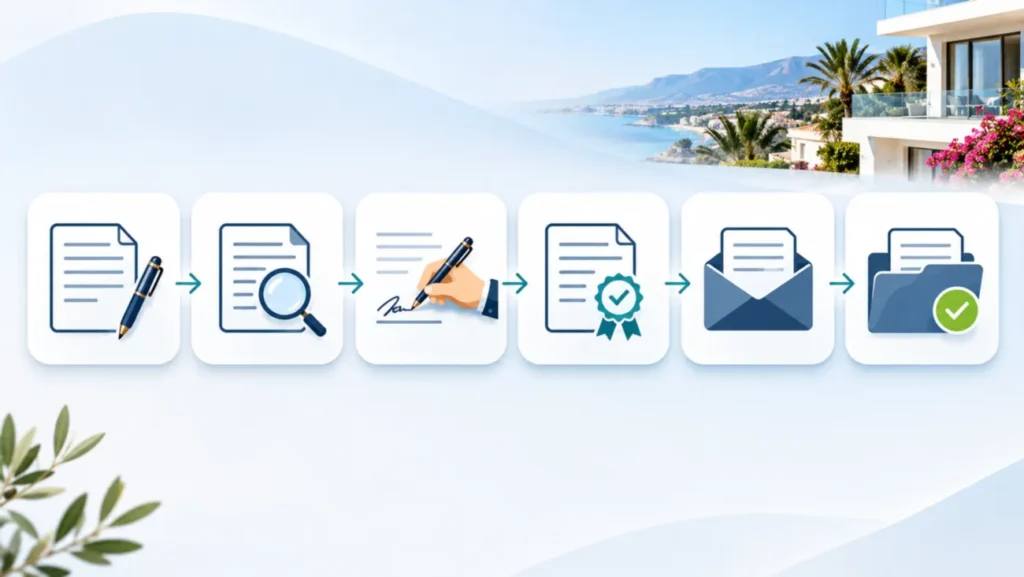
Note that a fully remote purchase may be possible in some cases, but buyers should confirm in advance whether any authority requires personal attendance or additional identity checks. This should be established with your lawyer at the outset, not discovered mid-transaction.
Buying in North Cyprus From Abroad?
Cypria Homes can help you shortlist properties by location, budget and intended use. Before signing a purchase agreement or issuing a property-specific POA, have your chosen property independently reviewed by a qualified lawyer.
Power of Attorney Costs and Timing
The total cost of a POA for a North Cyprus property purchase depends on several factors: where you are signing, the complexity of the document, the authorities that will rely on it, and whether translation or courier services are required. No fixed fee applies universally.
Potential cost elements include:
| Expense | When it applies | What affects the cost | What to confirm |
|---|---|---|---|
| POA drafting (by your North Cyprus lawyer) | If separately charged | Complexity of powers granted; whether it is property-specific or broader | Whether this is included in overall legal fees or charged separately |
| Notarisation in your country | When signing abroad and notarisation is required | Country of residence; notary fees vary significantly | Whether the receiving authority requires this specific form |
| Certification or authentication | If required by the receiving authority | Country and type of document | Confirm requirement before signing |
| Certified translation | If the document must be presented in Turkish | Length and complexity of document | Whether your lawyer provides this or recommends a translator |
| Courier or tracked delivery | When original must be sent from abroad | Distance; speed required; insurance | Whether your lawyer can advise on preferred carriers |
| Additional legal work | Due diligence, contract review, PTP application | Scope and complexity | Agreed in writing before instruction |
The POA-related charges should be itemised separately from purchase taxes, title-transfer charges and other transaction costs, even if the lawyer collects them together. It is important not to conflate the cost of the POA itself with the broader legal costs of the purchase transaction — these are different categories, and reputable lawyers should be willing to give you a clear breakdown.
POA costs are entirely distinct from the taxes and fees associated with the property purchase itself — stamp duty, transfer fees, VAT where applicable, and any outstanding levies on the property. For an overview of those, see “North Cyprus Property Taxes“.
Timing deserves equal attention. Signing a POA in North Cyprus in person is typically quicker than doing so from abroad, because the authentication chain is shorter. Allow additional time for certification, any required authentication or translation, courier delivery and confirmation of acceptance — ask your lawyer for a country-specific estimate before setting contractual deadlines. Building extra time into the process is advisable: courier delays and administrative queues do occur, and a purchase that has to pause because a POA has not been accepted can be frustrating and occasionally costly.
Example of a POA Cost Breakdown
| Cost | What the buyer should ask |
|---|---|
| POA drafting | Is this included in the lawyer’s existing conveyancing fee? |
| Signature certification | What official or professional must certify the signature? |
| Additional authentication | Is consular attestation or another process needed? |
| Translation | Is Turkish translation required, and who must certify it? |
| Courier | Must the original be delivered, and what tracked method is accepted? |
| Amendments | Will changes to the property, contract or representative trigger extra fees? |
Request a written quotation in the applicable currency before signing. There is no reliable universal total for every country and transaction.
How to Protect Yourself
A power of attorney is a tool of convenience, not an insurance policy. The risks associated with remote property purchases in North Cyprus are real, and several of them relate directly to how the POA is used.
Overly broad authority is one of the most common vulnerabilities. A document that authorises your representative to “do anything necessary” in connection with your property purchase is an invitation for misunderstanding. Define every authorised action specifically.
A representative with a conflict of interest creates a structural problem. If the person acting as your attorney also has a financial relationship with the developer or vendor — through commission, referral fees or shared business interests — their advice and actions may not serve your interests alone. Always appoint a lawyer who acts exclusively for you.
Incorrect personal details in a POA can cause the document to be rejected or, worse, to be used in connection with a transaction the buyer did not intend. Check every name, date and document reference against the original passport before signing.
Payment fraud is a significant risk in all international property transactions. Retain direct oversight of purchase-price payments. Any arrangement involving a lawyer’s client account, escrow or delegated payment authority should be independently verified and documented in writing. Never transfer funds solely on the basis of email instructions, however legitimate the correspondence appears — always verify bank account details independently, by telephone to a number you have confirmed through a separate channel.
Who Should Control the Money During a POA Purchase?
The person authorised to sign property documents does not automatically need authority to receive, withdraw or redirect the purchase price.
Before making a payment, confirm the payment recipient, bank account ownership, contractual payment conditions and any escrow or client-account arrangement. Where an independent lawyer administers client funds, ask for the written terms governing receipt, release and accounting.
If payment instructions change unexpectedly, pause the transfer and verify the new details through a previously established independent contact channel.
Signing an unapproved contract is another risk specific to remote buyers. If your POA authorises your representative to sign a contract, that authority should be tied to a specific, finalised version. Avoid giving authority to sign a contract “in whatever form the representative considers appropriate.”
Absent registration confirmations leave you uncertain whether your interest in the property has been protected. Always ask for written confirmation of every registration step, along with a copy of any filing receipt.
Never delegate payment authority without clear limits. Specify the exact fees and taxes your representative may pay, and keep control of the purchase price transfer yourself.
The POA does not address every risk in a North Cyprus property purchase. In particular, it cannot resolve questions about the legal status of the title, historical ownership claims or encumbrances on the property. Registration may protect contractual interests under the applicable rules, but it does not itself transfer legal title or eliminate competing claims. The UK Government’s FCDO guidance on property in Cyprus notes that buyers on the northern part of the island face specific risks, including the possibility of historical property claims from pre-1974 owners, and recommends taking independent legal advice before committing. This can be found at gov.uk. It does not constitute a political position, but it is information that UK buyers in particular should read.

Can You Revoke a Power of Attorney?
Yes. A POA can be revoked, provided the principal is legally capable of doing so. But the process requires more than simply informing your representative by email — and the consequences of revocation need to be understood carefully.
Duration and expiry. A well-drafted limited POA for a property purchase should specify either a defined end date or a triggering condition — such as completion of the title deed transfer. If the POA has no express expiry date, do not assume it ends automatically at completion. The circumstances in which it continues or terminates must be checked under the governing law and the document’s wording.
Revoking a POA requires a formal step: typically a written revocation that is signed, possibly certified, and served on the representative. The formal requirements for a valid revocation — and its effect on third parties — must be confirmed by a locally qualified lawyer. A written notice alone may not be enough where the original authority was certified or filed with a public authority.
Notifying all relevant parties is as important as revoking the document itself. Ask your lawyer which authorities and third parties must receive formal notice of revocation, in what form, and how delivery and acknowledgement should be documented. Failure to notify properly leaves open the risk that the representative continues to act in your name.
Dealing with copies. If certified copies of the POA were provided to multiple parties, steps should be taken to recover or formally cancel them. Your lawyer can advise on the practical steps.
If you change your lawyer, the original POA in that lawyer’s favour should be revoked before or at the same time as a new POA is granted to the replacement. Having two outstanding and potentially overlapping authorities is a situation to avoid.
Actions already taken under a valid POA are not necessarily undone by revocation. The effect of revocation on pending transactions and third parties depends on the applicable law, the document and when relevant parties were notified. Obtain transaction-specific legal advice before relying on revocation to stop a particular step.
Practical steps if you need to end a POA:
- Contact your North Cyprus lawyer immediately and instruct them in writing that the authority is to be revoked.
- Ask for a formal revocation document to be prepared and confirm the form it needs to take under the governing law.
- Identify every authority or party that has received the original POA or a certified copy.
- Ask your lawyer which of those parties must receive formal notice of revocation, in what form, and within what timeframe.
- Obtain written acknowledgement from each relevant party.
- If appointing a replacement, coordinate the timing of the new authority and revocation with independent counsel. Where misuse is suspected, prioritise prompt protective steps rather than keeping the original authority active solely to avoid a gap.
Common Buyer Scenarios
The following illustrative scenarios are intended to show how the POA fits into practical situations. They do not represent actual client cases.
Scenario 1: A UK buyer purchasing remotely.
A buyer in England has agreed a price on a resale apartment in Kyrenia. They cannot travel to sign the contract or attend the title deed transfer. They instruct an independent North Cyprus lawyer to act as their attorney.
Before any document is signed, the lawyer confirms with the Land Registry and Ministry of Interior what form of POA is acceptable for the specific steps involved — including the registration deadline applicable under the rules then in force. The buyer’s lawyer in North Cyprus prepares a draft; the buyer reviews the English version carefully. The buyer signs before a notary in the UK; the lawyer first confirms the authentication requirements for TRNC use. The certified original is couriered to North Cyprus. Written confirmation of acceptance is received before any action is taken.
The buyer retains direct control over all financial transfers and approves the final contract version before authorising the signature. See “North Cyprus Permission to Purchase” for the separate process that the lawyer manages on the buyer’s behalf.
Scenario 2: A couple buying together.
Two partners are purchasing a villa together. One can travel to North Cyprus; the other cannot. The couple assumes the visiting partner can sign for both.
This assumption should be checked with a lawyer before travel is booked. Where two buyers acquire a property together, their respective registered shares, succession implications and the form of co-ownership permitted under the applicable local law should be confirmed with an independent North Cyprus lawyer and reflected accurately in the transaction documents. A POA from the absent partner to the attending partner, or to an independent lawyer, may be required for the absent party’s interest. Each buyer must individually grant valid authority; ask the receiving authority whether separate instruments are required or a combined instrument can be accepted.
Scenario 3: An off-plan buyer.
A buyer commits to a property under construction, paying a reservation deposit and planning to complete over a two-year build period. They plan to sign everything remotely and use a POA throughout.
Off-plan purchases carry additional considerations. Before delegating any signing authority, the buyer should ensure that an independent lawyer has reviewed the developer’s title and planning permissions, the build licence, the schedule of payments and the completion terms. Authorising a representative to sign an off-plan contract without prior legal review of the developer’s position exposes the buyer to significant risk. The POA cannot correct a poorly drafted contract or protect the buyer if the developer’s permissions are not in order. See “Buying Off-Plan Property in North Cyprus” for the specific considerations relevant to this type of purchase.

Compare Completed Properties in North Cyprus




Final Checklist Before You Sign
A power of attorney is a practical solution to a real logistical challenge. It allows a trusted, qualified representative to move your purchase forward when you cannot be present — signing a contract, registering your interest within the applicable deadline, submitting the Permission to Purchase application and, eventually, completing the title deed transfer once all conditions are satisfied. Used well, it makes remote buying workable.
Used carelessly, it creates risk. The safeguard is specificity: know exactly what your representative is authorised to do, confirm that the document is in a form accepted by every authority that will rely on it, and keep control of the elements — particularly payments — that the POA does not need to cover.
Before you sign, confirm the following:
- You have engaged an independent lawyer with no conflict of interest
- The POA is specific to this transaction and does not grant broader authority than needed
- You have reviewed and approved the final contract version before delegating signature authority
- The authentication requirements for your country of residence have been confirmed with the receiving authority
- A certified translation has been obtained if required
- You know how the original will be delivered and have a tracking method
- Your lawyer will provide written confirmation of every action taken, including any filing receipts
- You are keeping direct control of all financial transfers
- You have read the “North Cyprus Property Due Diligence” guidance
- You understand that the POA is separate from, and does not replace, the Permission to Purchase
- Your lawyer has confirmed the contract registration deadline (generally one month under Decree-Law 119/2026) and the post-PTP deadlines for fee payment (75 working days) and title transfer (one year, with start date confirmed)
The key is ensuring that every step your representative takes on your behalf is one you have specifically authorised, confirmed in advance and will be given evidence of once complete. Applicable rules — including Decree-Law 119/2026 for transactions entered into from October 2026 — impose specific deadlines whose breach can invalidate the agreement or cause purchase permission to lapse. The starting point is always a current, transaction-specific conversation with a qualified local lawyer.
Ready to Explore North Cyprus Properties?
Knowing how a power of attorney works is one part of preparing for a property purchase. The next step is finding suitable properties and arranging independent checks before committing.
Tell Cypria Homes what you are looking for and receive a tailored shortlist.
 Real estate in Georgia
 Real estate in Montenegro
 Real estate in the UAE
 Real estate in Bali
 Real estate in Thailand
 Real estate in Spain
 Real estate in Saudi Arabia
 Real estate in Turkey
 Real estate in Zanzibar
 +90 533 888 29 50
 hello@cypria.homes
 Karsıyaka Sokak 8, Girne




 Get catalogue of TOP-7 objects